
A housing authority must reuse one kitchenette prototype across hundreds of unit shells. Which approach best fits large-scale identical civic components?
Select an answer to reveal the explanation.
Short Explanation
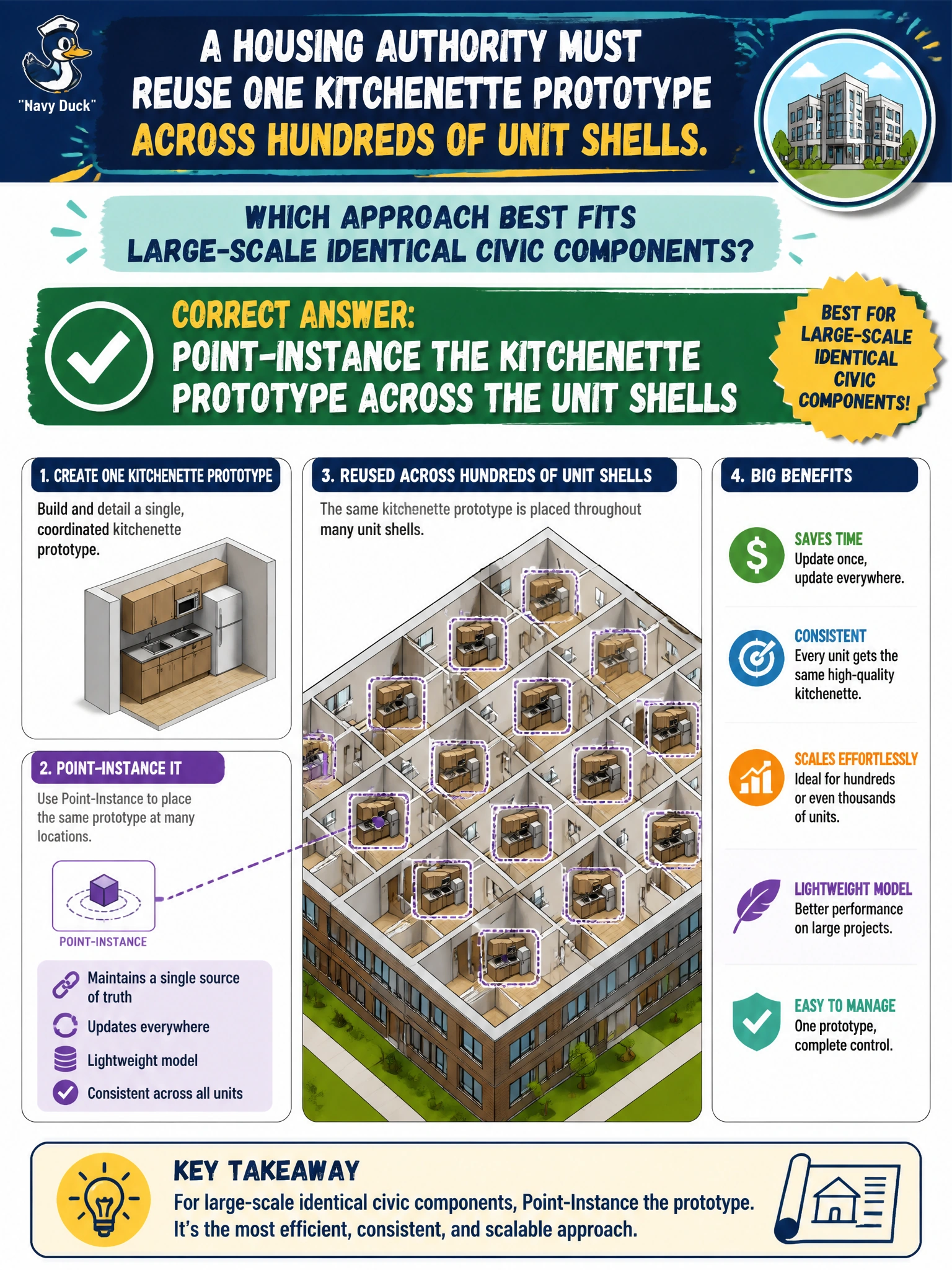
One kitchenette drawing, hundreds of apartments—point instancing is the housing authority’s rubber stamp. Reusing one prototype keeps the twin light. Unique full copies or screenshot metadata don’t scale unit assemblies.
Full Explanation
Large-scale identical civic components should share one prototype. A housing authority reusing one kitchenette across hundreds of unit shells should point-instance that kitchenette prototype across the unit shells. Point instancing keeps a single authored kitchenette definition while placing many efficient instances into residential units, which is the scalable OpenUSD pattern for repetitive municipal housing interiors.
Embedding a full unique kitchenette hierarchy under every unit with no sharing fails by concept: it multiplies geometry and opinions without benefit when units are identical, ballooning twin size. Storing kitchenette meshes only as JPEG screenshots in metadata fails because screenshots are not composed 3D assets—reviewers cannot assemble, measure, or simulate from image metadata. Specializing each unit from a payload that deliberately breaks instancing fails because the goal is reuse at scale; intentionally defeating instancing contradicts the housing authority’s efficiency requirement.
Exam caveat: “identical and many” → point instancing; uniqueness theater and metadata-as-geometry are traps. Operational check: place the kitchenette prototype once, instance it across a sample of unit shells, confirm instance count matches unit count, edit a prototype material once and verify all units update, and ensure no per-unit full hierarchy copies were authored.