
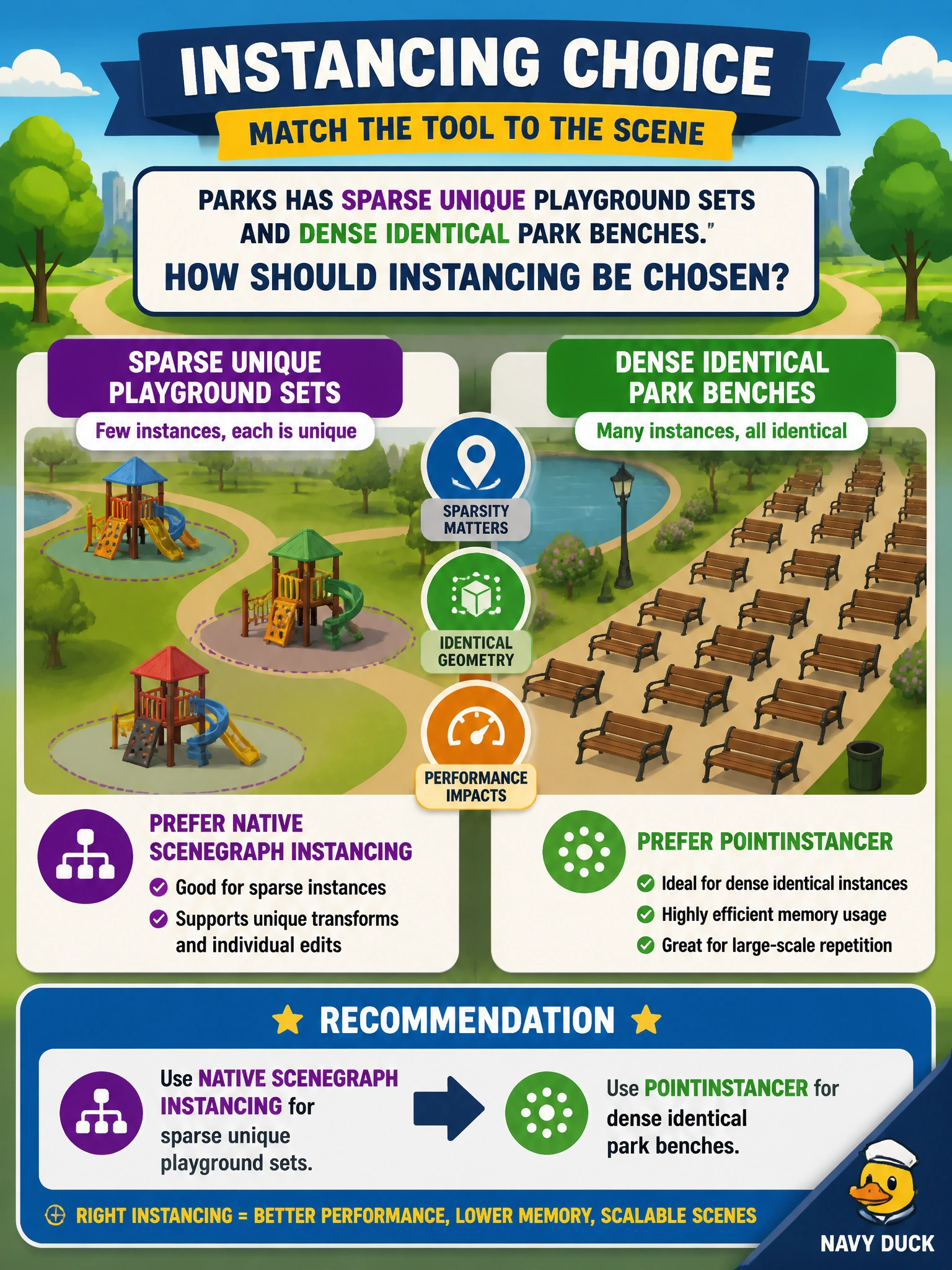
Parks has sparse unique playground sets and dense identical park benches. How should instancing be chosen?
Select an answer to reveal the explanation.
Short Explanation
Unique playground kits are like specialty sculptures—native instances keep their identity. Identical benches are factory chairs—point-instance those by the hundred. Mixing that up either wastes memory or flattens the uniqueness parks still need.
Full Explanation
Instancing style should match asset uniqueness and density. Parks with sparse unique playground sets and dense identical park benches should prefer native scenegraph instancing for the sparse unique playground assemblies and a pointInstancer for the dense identical benches. Native instancing preserves richer per-assembly scenegraph identity useful for unique playground kits, while point instancing efficiently stamps many identical benches without unique full copies.
Point-instancing both playgrounds and benches so uniqueness is discarded fails conceptually: unique playground configurations lose the scenegraph nuance native instancing retains, and forcing uniqueness into point instances is the wrong trade. Never instancing either asset because “uniqueness always forbids reuse” fails because identical benches are explicitly reusable; refusing all instancing wastes memory at park scale. Native-instancing the benches and point-instancing the unique playgrounds fails by swapping the styles: dense identical benches want point instancing, while unique playgrounds want native-style treatment—not the reverse.
Exam caveat: Domain 1 expects a split decision—native for sparse unique, point for dense identical—not a single blunt policy. Operational check: count prototypes vs instances for benches (few prototypes, many instances), confirm playground assemblies remain addressable as native-style instances with distinct structure, and walk a composed park stage to ensure both asset classes appear with acceptable memory cost.