
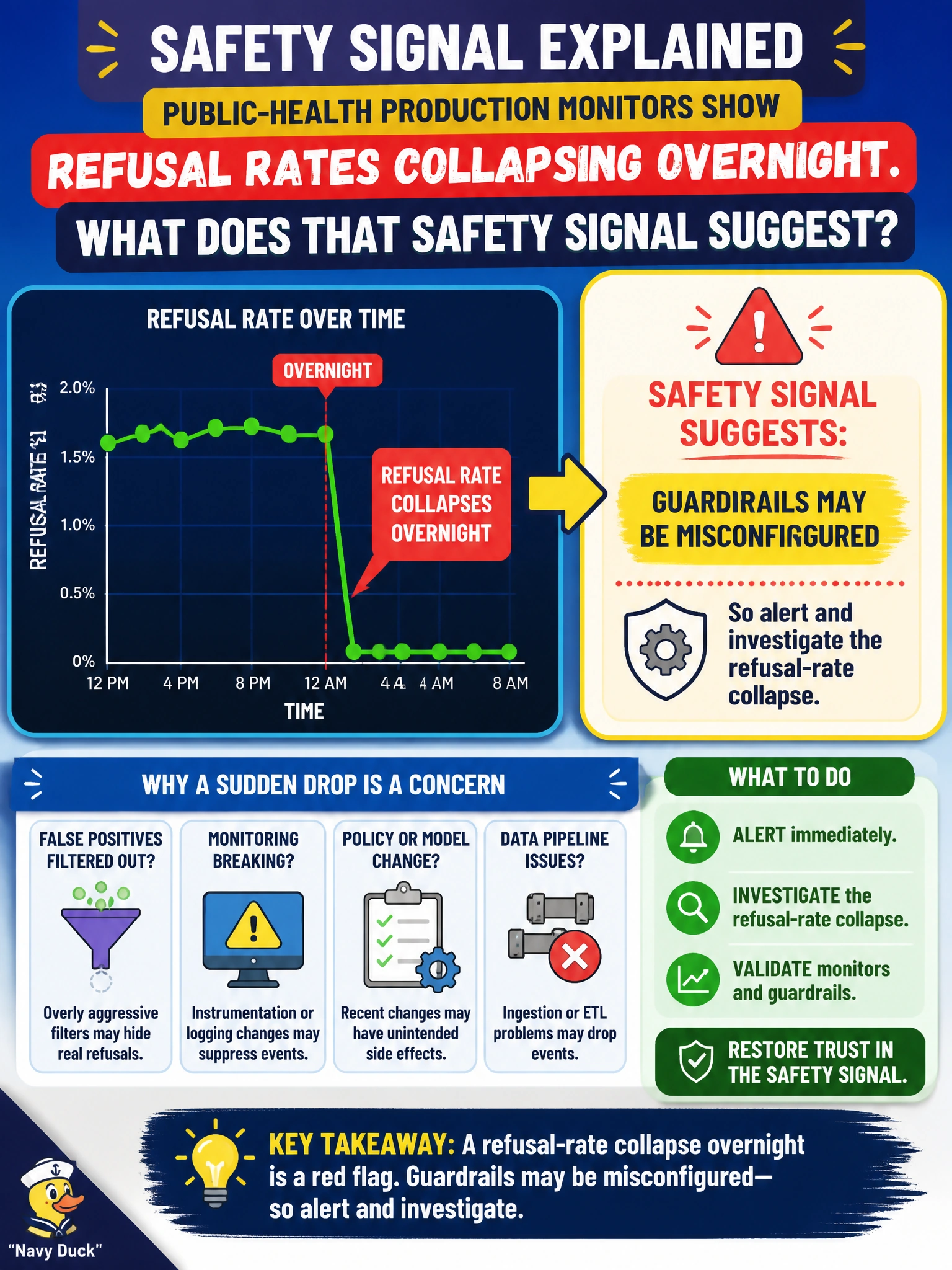
Public-health production monitors show refusal rates collapsing overnight. What does that safety signal suggest?
Select an answer to reveal the explanation.
Short Explanation
When a clinic bot suddenly stops refusing risky asks, do not throw a party—that refusal-rate collapse often means the guardrails broke. Alert, investigate, then fix.
Full Explanation
When public-health production monitors show refusal rates collapsing overnight, that safety signal suggests guardrails may be misconfigured—so ops should alert and investigate the refusal-rate collapse. Clinic bots are supposed to refuse risky or out-of-scope medical asks; a sudden drop in refusals often means policy filters, system prompts, safety classifiers, or routing rules broke, were disabled, or were overwritten by a deploy—not that prohibited topics magically vanished. Treating the collapse as an incident preserves resident safety. Interpreting lower refusal as automatic proof of higher medical quality with no review confuses agreeableness with clinical appropriateness. Disabling safety monitors because fewer refusals look friendlier removes the smoke alarm during a likely guardrail failure. Celebrating the collapse as evidence that prohibited topics vanished assumes demand changed rather than controls failed—usually the wrong default overnight. Exam caveat: validate with replay of known-refuse prompts and review of newly allowed risky asks; traffic mix shifts can move refusal rates, but overnight collapses still deserve immediate guardrail inspection. Operational check: page on refusal-rate collapse, diff recent prompt/guardrail/model changes, run a canary suite of prohibited clinic asks, restore prior guardrail config if refusals do not return, and only then clear the public-health safety alert.