
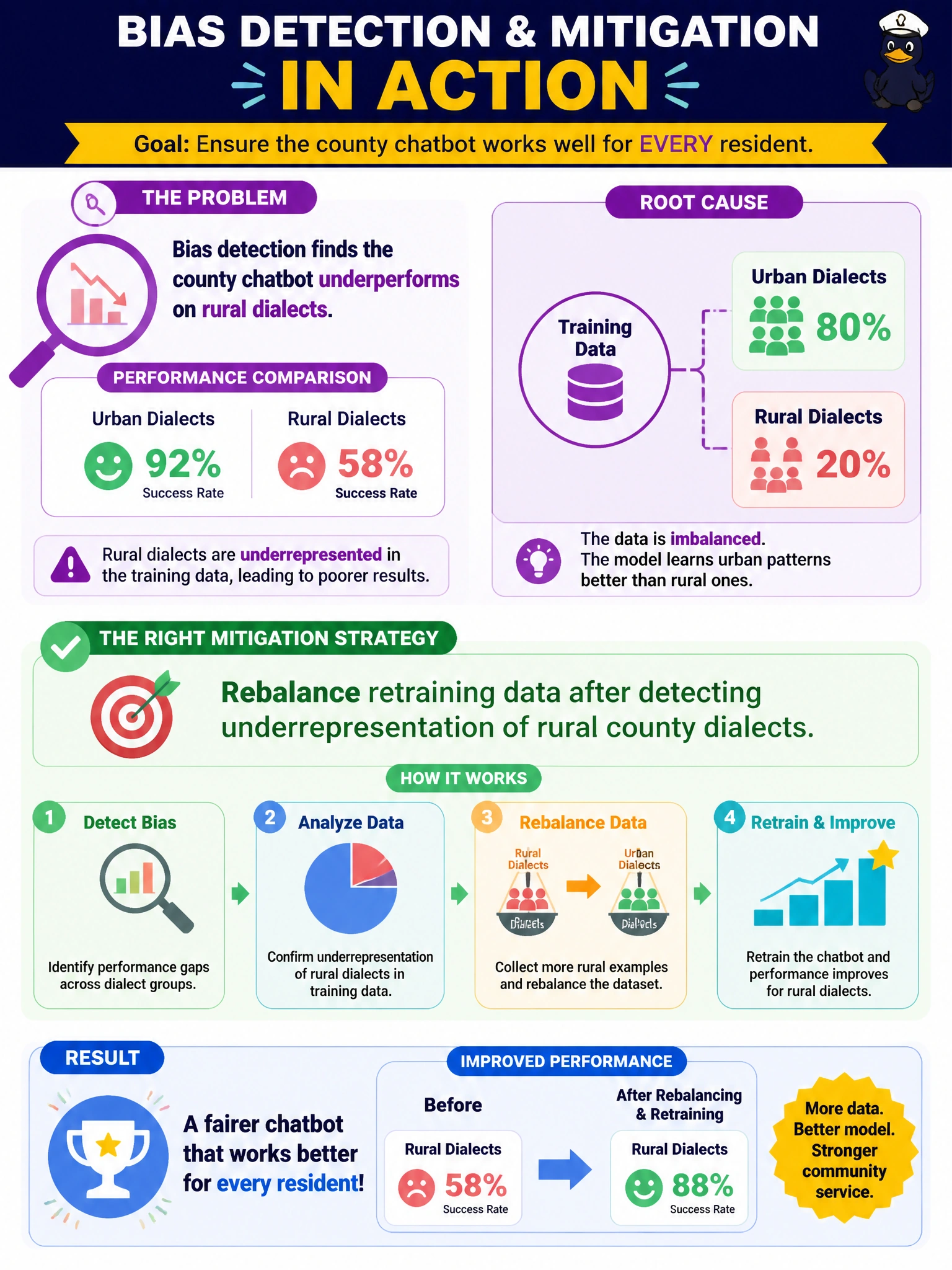
Bias detection finds the county chatbot underperforms on rural dialects. Which mitigation strategy fits?
Select an answer to reveal the explanation.
Short Explanation
If rural dialects get worse answers, fix the training mix—rebalance the data so those voices show up. Hiding the gap by dropping rural evals is cheating, not mitigation.
Full Explanation
Bias detection finds the county chatbot underperforms on rural dialects; the fitting mitigation is to rebalance retraining data after detecting underrepresentation of rural county dialects. Performance gaps tied to dialect underrepresentation are classic data-coverage failures: the model heard too little rural phrasing in training or fine-tuning, so intent understanding and answer quality degrade for those residents. Rebalancing the data—adding representative rural transcripts, paraphrases, and labeled intents—targets the cause rather than hiding the metric. Removing rural residents from evaluation so the gap disappears on paper is metric gaming, not mitigation, and abandons equity. Hard-coding mockery of rural phrasing as a feature weaponizes the bias. Ignoring detection results because urban accuracy is already high accepts a two-tier county service. Exam caveat: rebalancing must respect privacy and consent for county recordings, and evaluation should keep a held-out rural dialect slice so “fixed” claims are testable; also check whether ASR or retrieval layers—not only the LLM—drive the gap. Operational check: quantify rural versus urban slice metrics, augment and rebalance training/fine-tune sets with rural dialect coverage, retrain or adapt, re-evaluate on the frozen rural slice, and ship only when the gap meets the county’s fairness threshold.