
City ops already tracks latency for the 311 LLM. Which monitoring configuration adds ethical compliance signals?
Select an answer to reveal the explanation.
Short Explanation
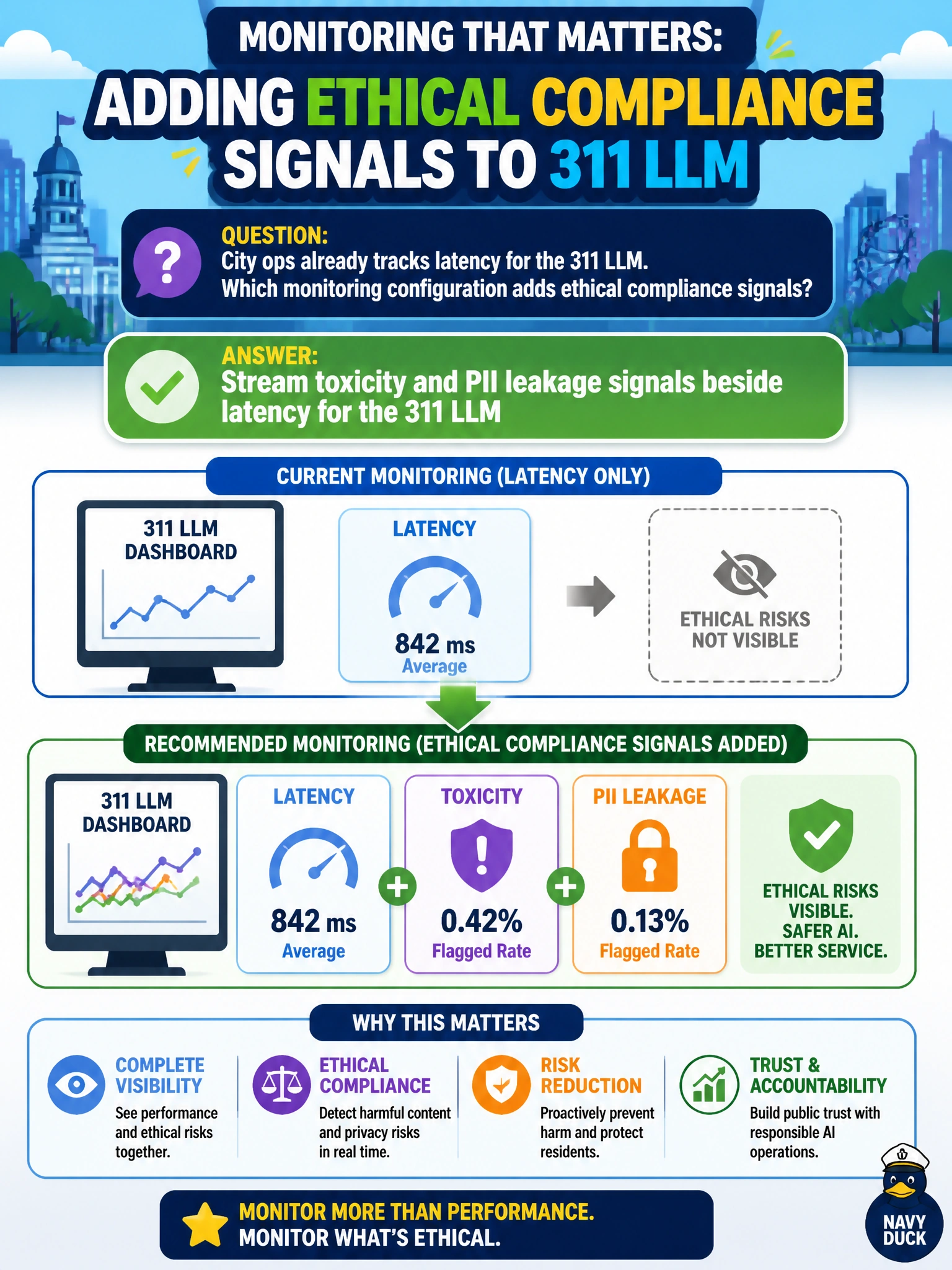
Latency says how fast 311 answers; toxicity and PII leakage say whether those answers are safe. Put the ethics signals on the same board as speed so compliance is not an afterthought.
Full Explanation
City ops already tracks latency for the 311 LLM; adding ethical compliance signals means streaming toxicity and PII leakage signals beside latency on the same board. Latency answers “how fast,” while toxicity and PII leakage answer “how safe.” Municipal 311 assistants can be fast yet emit abusive language or echo resident phone numbers, addresses, or case details back into logs and replies. Placing ethics signals beside speed makes compliance a live operational concern rather than a quarterly afterthought. Replacing all safety signals with only disk free-space alerts swaps content risk for infrastructure trivia. Monitoring solely marketing unsubscribe rates tracks campaign preference, not LLM safety. Tracking only GPU temperature and ignoring content risks leaves toxicity and privacy incidents invisible while hardware looks fine. Exam caveat: detectors need calibrated thresholds and privacy-preserving handling of flagged PII; also distinguish user-supplied PII in inputs from model-leaked PII in outputs when defining alerts. Operational check: deploy toxicity and PII detectors on 311 outputs (and carefully on inputs if policy requires), stream rates next to latency, alert on spikes, route samples to privacy/compliance review, and verify redaction or refusal paths fire when leakage is detected.