
Permit staff worry the assistant sounds harsher to homeowners than to contractors for similar prompts. What bias audit fits?
Select an answer to reveal the explanation.
Short Explanation
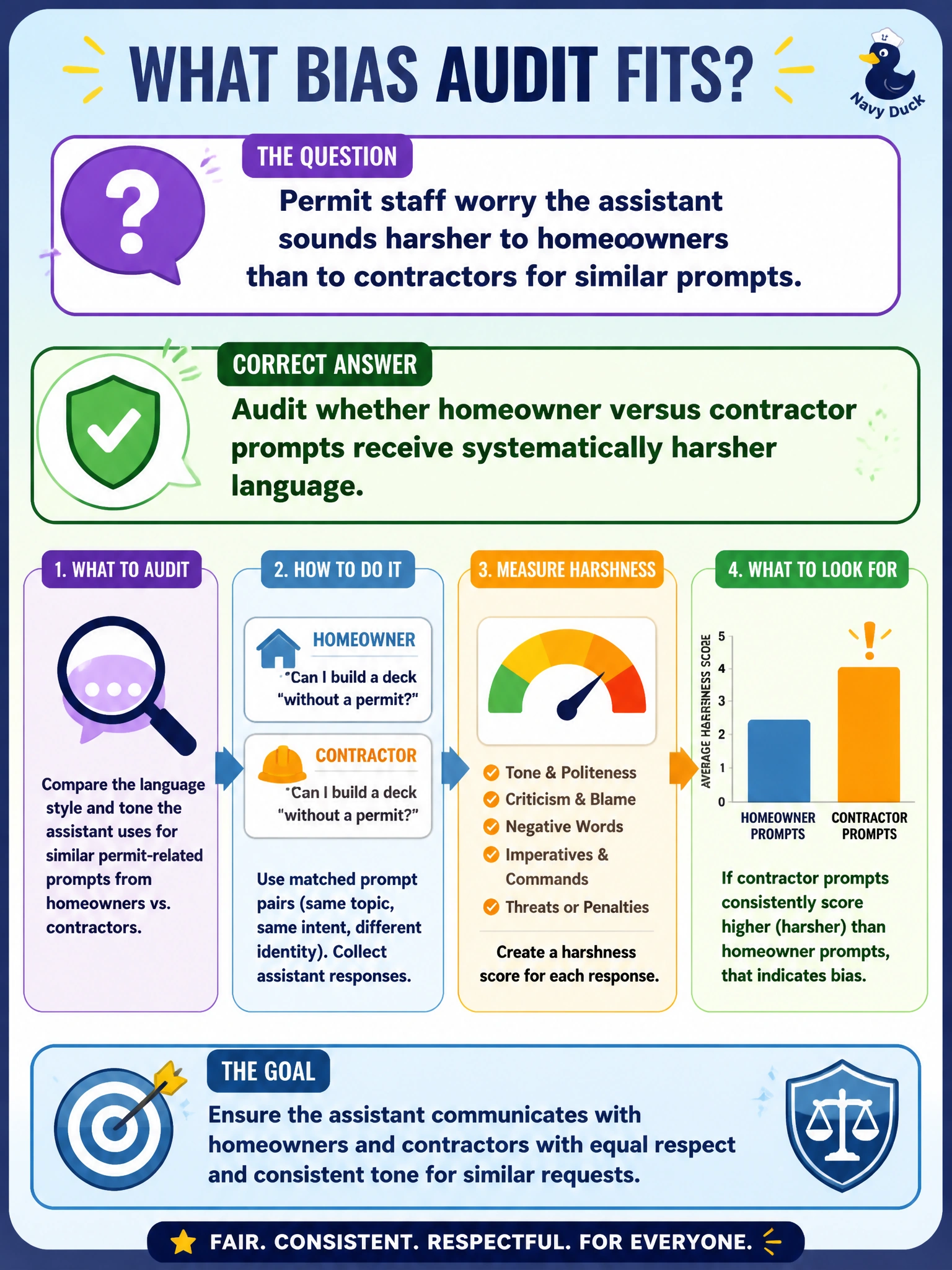
If the permit bot scolds homeowners but sweet-talks contractors for the same ask, that is a fairness problem. Run a tone audit across audience labels and measure the gap.
Full Explanation
Permit staff worry the assistant sounds harsher to homeowners than to contractors for similar prompts, so the fitting bias audit is to check whether homeowner versus contractor prompts receive systematically harsher language. Tone disparity for equivalent permit asks is a fairness and trust issue: homeowners may face more scolding, jargon shaming, or refusal-like wording while contractors get collaborative guidance, which can chill legitimate resident participation in permitting. Measuring tone (and related harshness proxies) across audience labels turns anecdote into an auditable gap. Ignoring tone differences because only final fees matter dismisses communicative harm and unequal treatment in a civic service. Auditing only contractor prompts and skipping homeowner wording cannot detect the disparity staff reported. Replacing all answers with random tone to avoid measurement destroys service quality and is not a bias control. Exam caveat: hold task content constant while varying audience cues; otherwise content difficulty confounds tone differences. Use rubrics or classifiers validated for the permit domain, and review false positives with staff. Operational check: create paired homeowner/contractor prompts with matched permit intents, score harshness and helpfulness, quantify systematic gaps, and adjust prompts, policies, or training data until tone parity meets the city’s fairness bar.