
Before launching a benefits chatbot, what responsible AI deployment practice should the city complete?
Select an answer to reveal the explanation.
Short Explanation
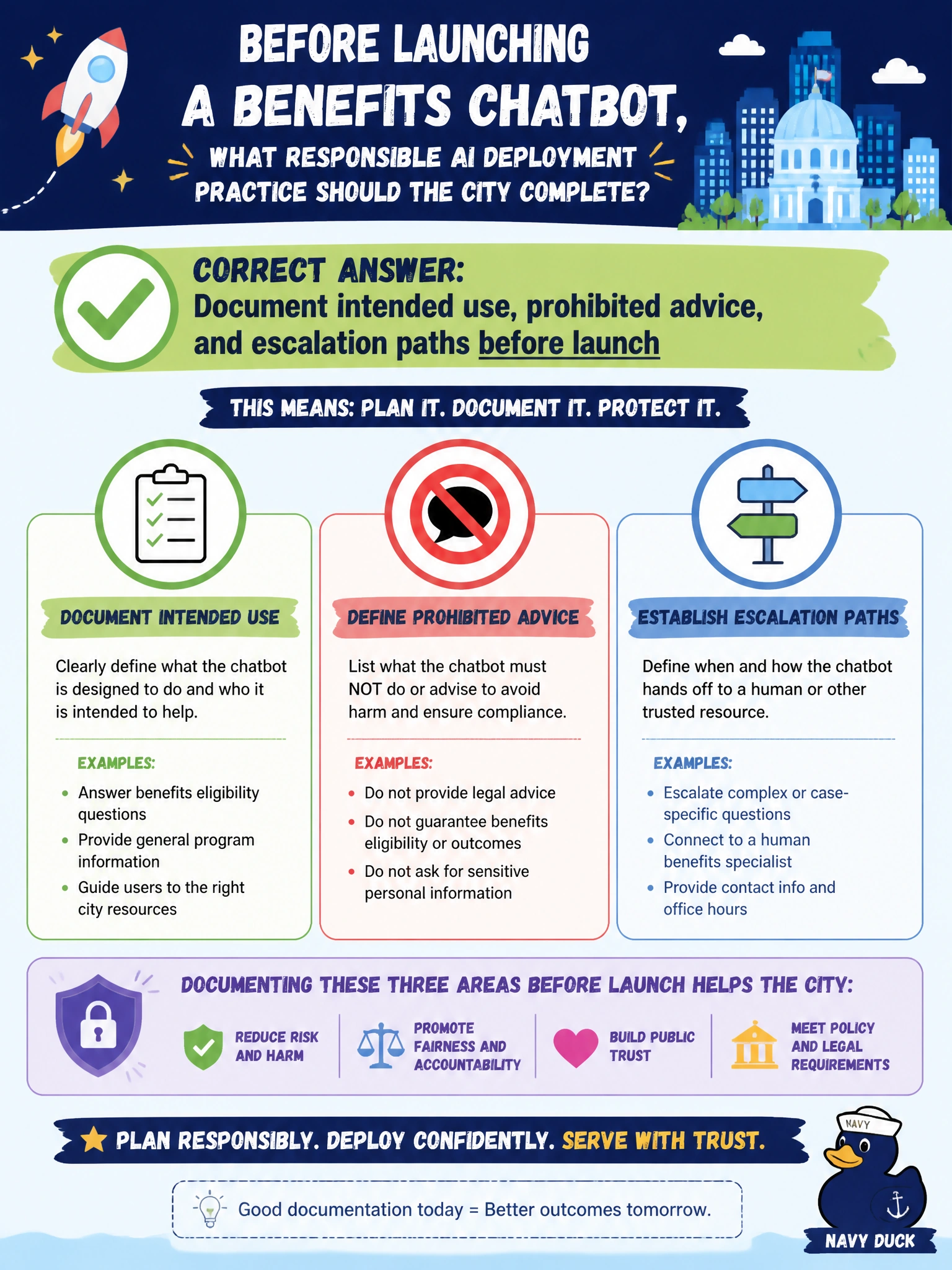
Before the benefits bot goes live, write down what it is for, what advice it must never give, and how to escalate to a human. That paperwork is the seatbelt—not optional chrome.
Full Explanation
Before launching a benefits chatbot, responsible AI deployment practice requires documenting intended use, prohibited advice, and escalation paths before go-live. Municipal benefits assistants sit at the intersection of eligibility complexity and resident harm: without a written intended-use scope, the bot may be treated as a caseworker or lawyer; without prohibited-advice classes, it may invent appeal strategies or guarantee benefits; without escalation paths, residents facing edge cases or distress have nowhere human to go. Pre-launch documentation is the control plane for safety, training, and incident response—not optional paperwork after harm reports. Skipping documentation and discovering prohibited advice only after harm reports externalizes risk onto vulnerable residents. Documenting only GPU SKUs and omitting intended use or escalation paths captures hardware inventory while missing the civic safety contract. Allowing unrestricted legal advice generation to maximize engagement prioritizes session metrics over lawful, scoped municipal guidance. Exam caveat: documents must be operationalized (enforced in prompts/guardrails, staff runbooks, and monitoring), not filed once and ignored; also align prohibited-advice lists with counsel and program owners. Operational check: complete an intended-use and prohibition brief signed by program owners, encode refusals and escalation triggers in the serving path, train operators on handoff, and block launch until those artifacts exist and are testable.