
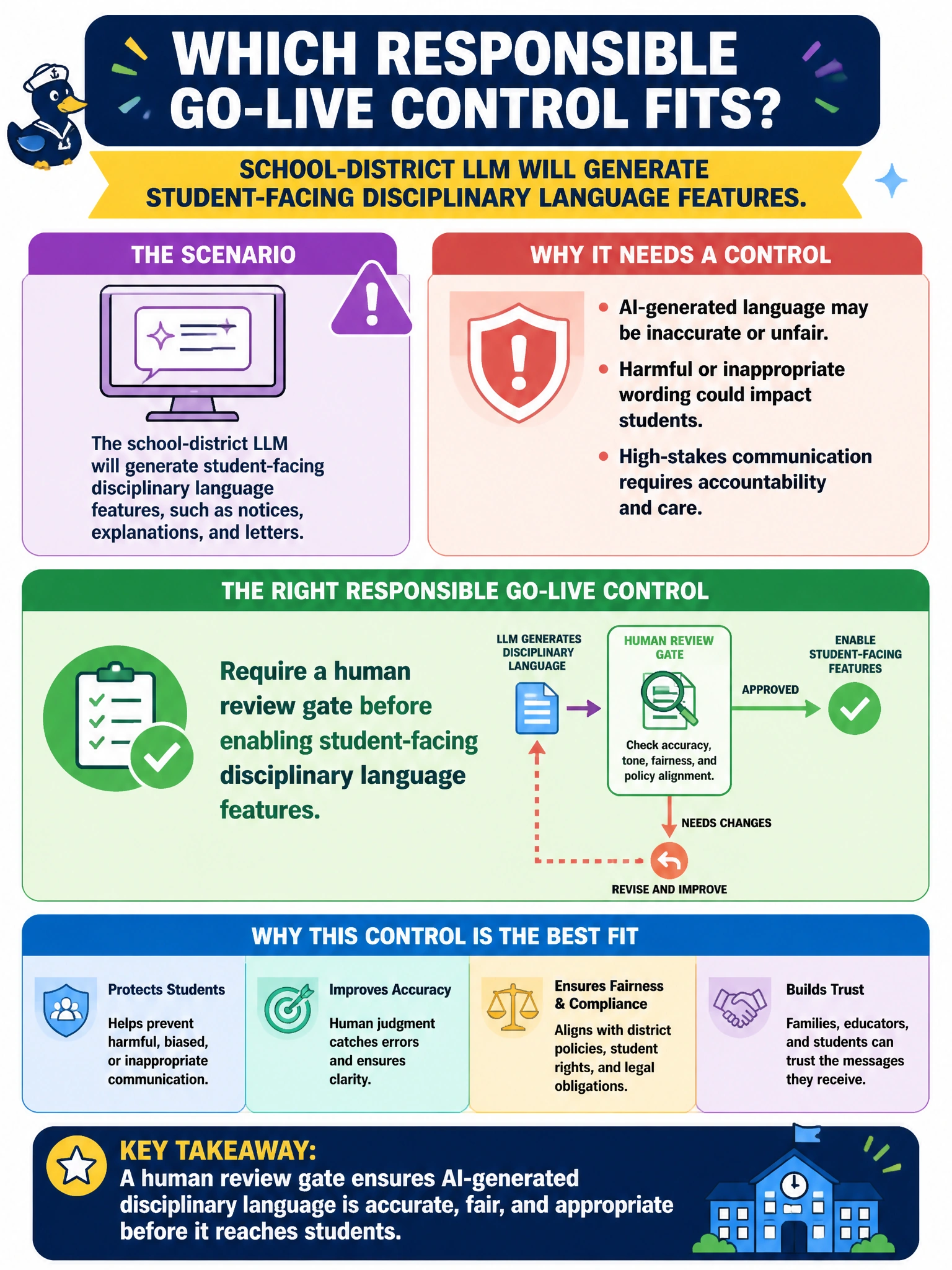
A school-district LLM will generate student-facing disciplinary language features. Which responsible go-live control fits?
Select an answer to reveal the explanation.
Short Explanation
Anything that talks discipline to students needs a human gate before the switch flips—like a principal signing off, not a silent feature flag. Sensitive populations get extra brakes on go-live.
Full Explanation
A school-district LLM that will generate student-facing disciplinary language features needs a responsible go-live control: require a human review gate before enabling those features. Disciplinary language directed at students is high-sensitivity content involving minors, fairness, due process optics, and potential lasting harm from harsh or biased phrasing. A human review gate—policy owners, administrators, or designated reviewers—before the feature flag flips adds an adult accountability checkpoint that silent automation lacks. Auto-enabling all disciplinary features with no adult review removes that brake and treats student discipline copy like a low-stakes UI tweak. Hiding the feature flag from governance and shipping silently defeats oversight and audit. Treating disciplinary language as low-risk marketing copy misclassifies the risk tier and invites inappropriate tone or policy drift. Exam caveat: human review should cover sample outputs across student scenarios and demographic counterfactuals, not merely a checkbox that “someone glanced once”; ongoing monitoring still follows after enablement. Operational check: keep the disciplinary language flag off by default, route candidate outputs through a documented human review workflow, record approval before enablement, and retain the ability to disable instantly if post-go-live samples fail policy.