
Emergency information LLM answers must continue if one city GPU pool fails. Which reliability architecture fits?
Select an answer to reveal the explanation.
Short Explanation
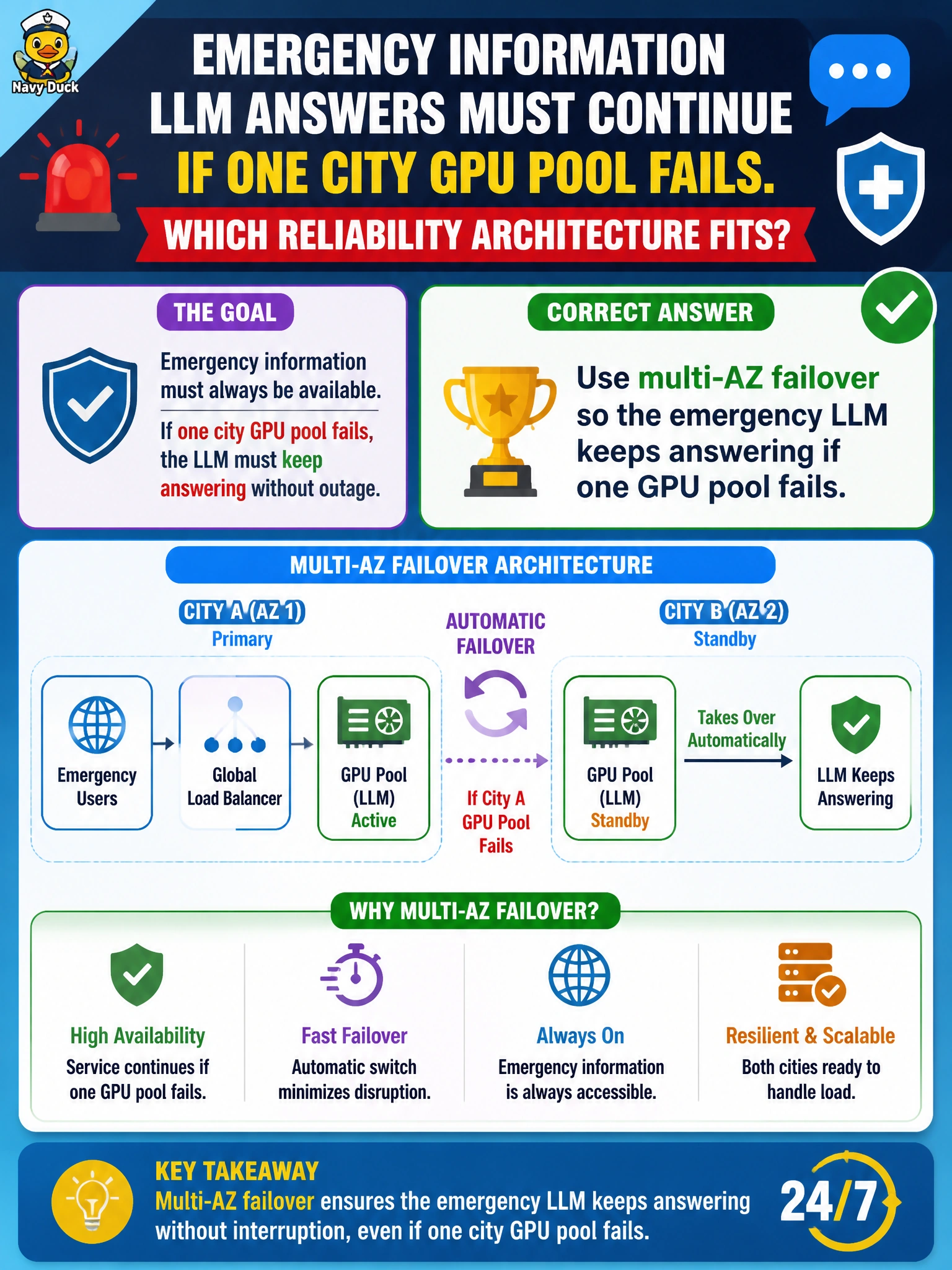
Emergency answers cannot live on one lonely GPU closet. Multi-AZ failover is the spare generator—when one city pool dies, the information LLM keeps talking from another zone.
Full Explanation
Emergency information LLM answers must continue if one city GPU pool fails, which requires multi-AZ failover so the emergency LLM keeps answering when one GPU pool is down. Continuous-uptime architecture for critical municipal GenAI spreads serving capacity across availability zones (or equivalent failure domains) with health checks and traffic shift so a single pool, rack, or zone outage does not silence emergency guidance. That is the spare-generator pattern for life-safety adjacent information services. Running a single unreplicated GPU pool with no failover path makes one failure a citywide assistant outage. Shutting the assistant down citywide whenever any node reboots maximizes blast radius instead of isolating failure. Storing model weights only on the failed pool’s local disk prevents peer pools from loading the model and blocks failover even if compute exists elsewhere. Exam caveat: multi-AZ failover needs replicated model artifacts, warm or fast-cold capacity planning, and tested failover drills—topology diagrams alone do not prove RTO under emergency load. Operational check: deploy the emergency LLM across at least two AZ GPU pools with shared or replicated weights, simulate pool failure, verify traffic fails over within the stated RTO, and confirm residents still receive answers without a citywide shutdown.