
Residents ask whether the permitting assistant is trustworthy and currently working. Which transparency practice supports uptime trust?
Select an answer to reveal the explanation.
Short Explanation
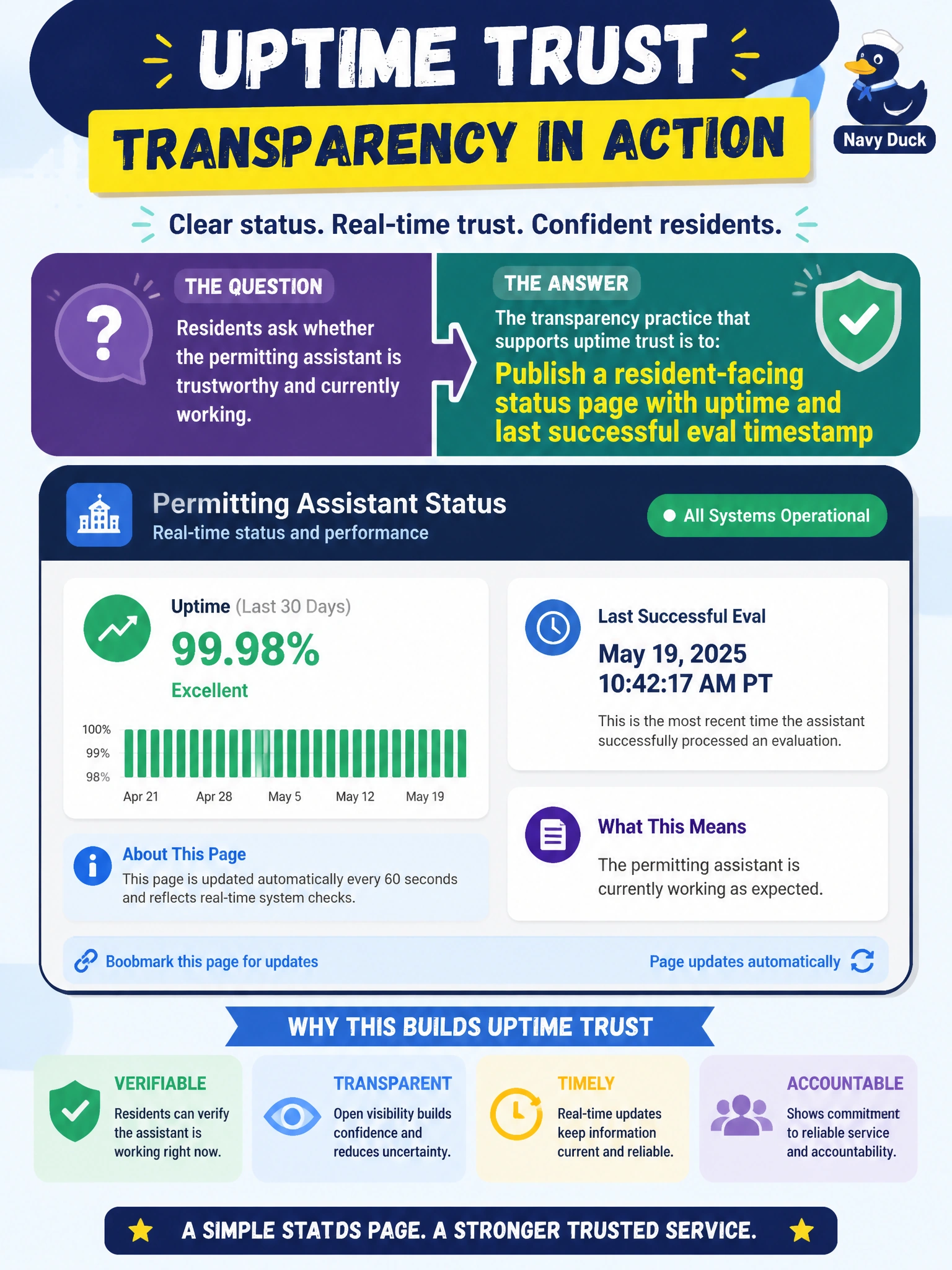
Trust looks like a clear status page: is the permitting assistant up, and when did the last eval pass? Hiding outages on an internal wiki or flashing pretty animations does not build resident confidence.
Full Explanation
Residents ask whether the permitting assistant is trustworthy and currently working; a transparency practice that supports uptime trust is publishing a resident-facing status page with uptime and last successful eval timestamp. Civic GenAI trust is operational as well as ethical: people need to see whether the assistant is up and whether it recently passed a defined evaluation, not merely marketing claims. Uptime plus last successful eval timestamp gives concrete, time-bound evidence that the permitting service is alive and was quality-checked. Hiding all outage information behind an internal wiki only keeps staff informed while residents hit silent failures and lose trust. Claiming continuous perfection with no timestamps or metrics is unverifiable and collapses when the first outage is noticed externally. Showing only decorative animations with no operational data substitutes aesthetics for accountability. Exam caveat: status pages should avoid exposing sensitive internal topology while still being honest about degraded modes; eval timestamps imply a real recurring eval job, not a one-time launch checkbox. Operational check: host a public permitting status page, feed it from the same uptime monitors ops uses, update last successful eval when the nightly/weekly suite passes, and communicate partial outages clearly when the assistant is degraded rather than pretending green.