
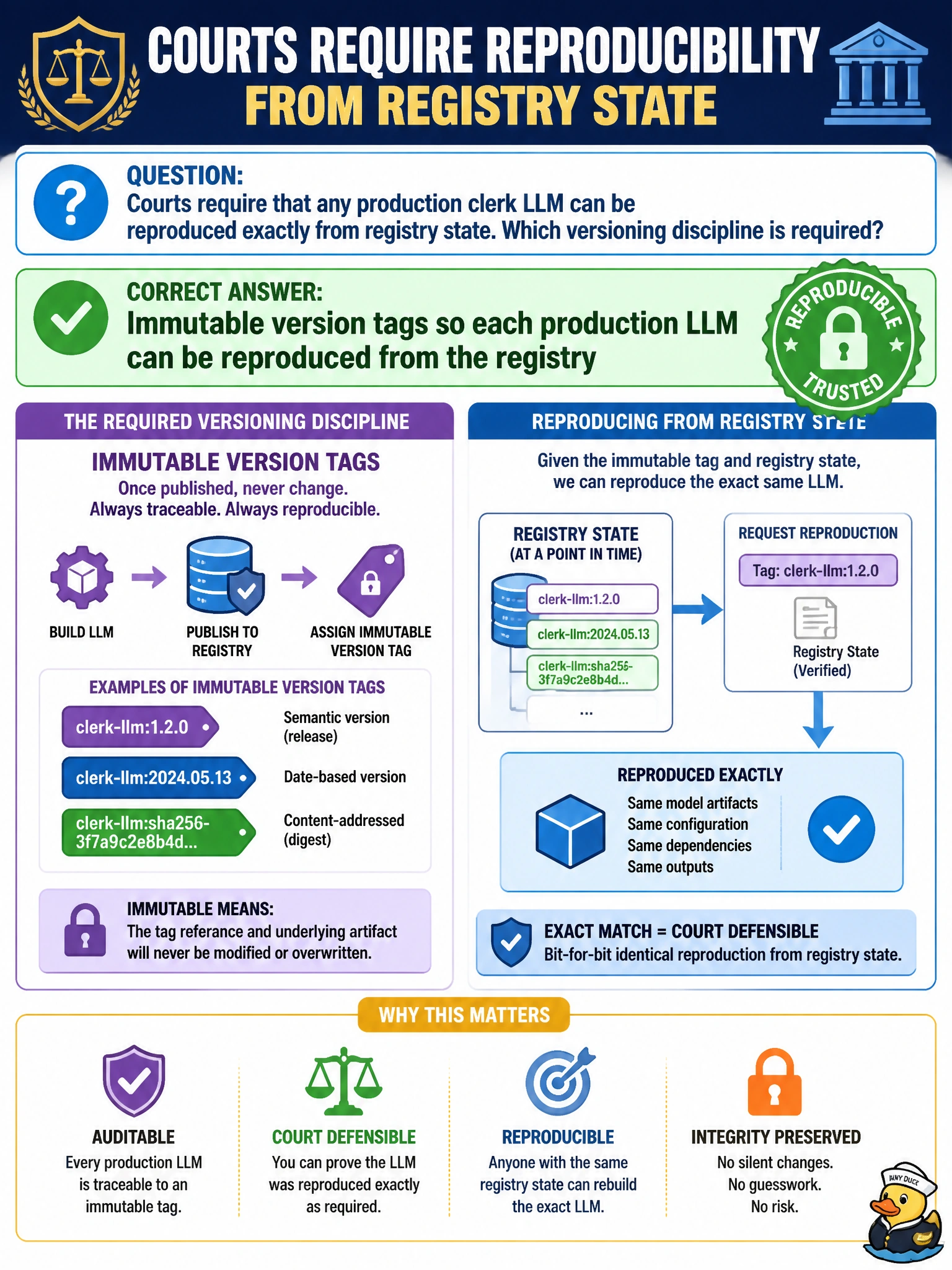
Courts require that any production clerk LLM can be reproduced exactly from registry state. Which versioning discipline is required?
Select an answer to reveal the explanation.
Short Explanation
Court LLMs need seatbelt tags: immutable versions in the registry so yesterday’s clerk model can be rebuilt exactly. A floating ‘latest’ or tribal-knowledge nickname will not hold up when someone asks what residents saw Tuesday.
Full Explanation
Courts require that any production clerk LLM can be reproduced exactly from registry state, so versioning discipline must use immutable version tags that make each production LLM reproducible from the registry. Immutability means a tag always resolves to the same weights, tokenizer, and serving config digest; given the registry entry for last Tuesday’s clerk model, ops can rebuild or redeploy the identical resident-facing system for audit, discovery, or rollback. That is the seatbelt for court GenAI accountability. Floating “latest” only with no pinned historical tags moves underneath you—Tuesday’s answers cannot be reconstructed when “latest” advanced overnight. Anonymous nightly dumps that replace prior hashes silently erase lineage and make reproducibility impossible. Verbal version names remembered by on-call staff only are tribal knowledge that fails staffing changes, incidents, and formal court review. Exam caveat: immutability must cover the full serving bundle (model, tokenizer, prompt/template hashes, decoding config), not weights alone, or “reproduced” systems still drift in clerk behavior. Operational check: publish each clerk release under an immutable registry tag with content digests, pin Kubernetes/serving config to that tag (never mutable latest), verify a clean environment can pull and serve the same tag, and store tag IDs in request logs for court forensics.