
After a tokenizer update, the clerk bot suddenly returns many empty responses. How should ops treat that signal?
Select an answer to reveal the explanation.
Short Explanation
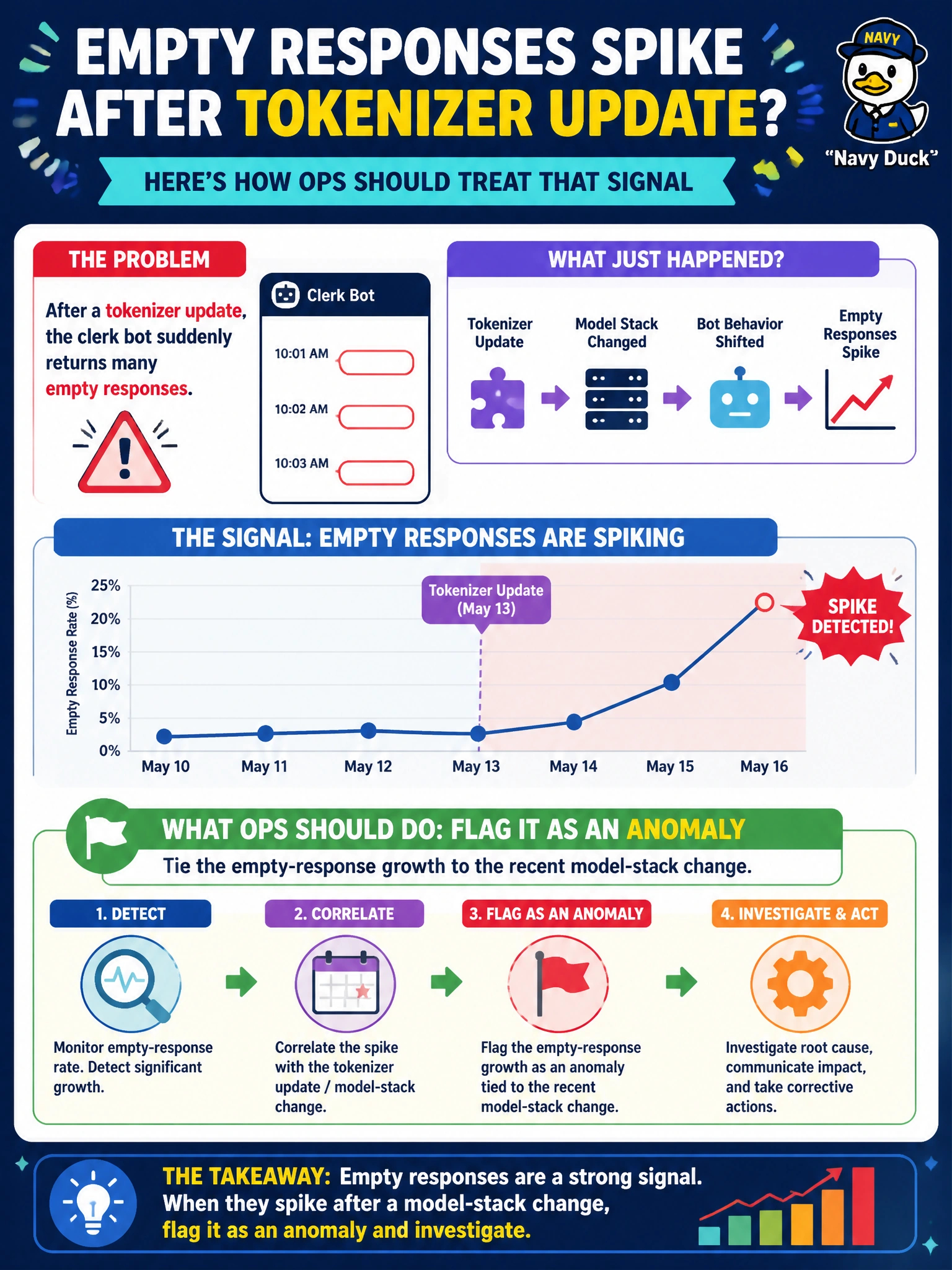
A sudden flood of blank clerk answers after a tokenizer change is an anomaly siren, not proof that the city got quieter. Tie the empty-response spike to the change so you can roll back or fix tokenization.
Full Explanation
After a tokenizer update, a sudden flood of empty clerk-bot responses is an anomaly tied to the recent model-stack change, not proof that the city went quiet. Empty replies after tokenization changes commonly mean encoding/decoding mismatches, special-token mishandling, or generation stopping immediately—failure modes that look like “no answer” while the service still returns success codes. Ops should flag the empty-response growth as an anomaly linked to the tokenizer deploy so they can roll back the stack change or fix tokenization before court or clerk workflows accumulate silent failures. Treating empty replies as proof that residents stopped asking questions confuses a quality/serving defect with demand collapse and delays rollback. Increasing temperature randomly until empty replies disappear is undirected thrashing that does not address tokenizer breakage and may worsen answer stability. Turning off anomaly detection because empty strings are always “valid JSON” prioritizes syntactic validity over civic usefulness; an empty clerk answer is still a failed resident interaction. Exam caveat: confirm the spike’s start aligns with the tokenizer change via version tags and deploy markers; other causes (prompt template bugs, max-token=0 misconfig) can also empty outputs, but change-correlated anomalies still deserve immediate investigation. Operational check: chart empty-response rate by model/tokenizer version, freeze further stack changes, compare against the prior tokenizer build on a fixed clerk prompt suite, and roll back or hotfix before clearing the anomaly.