
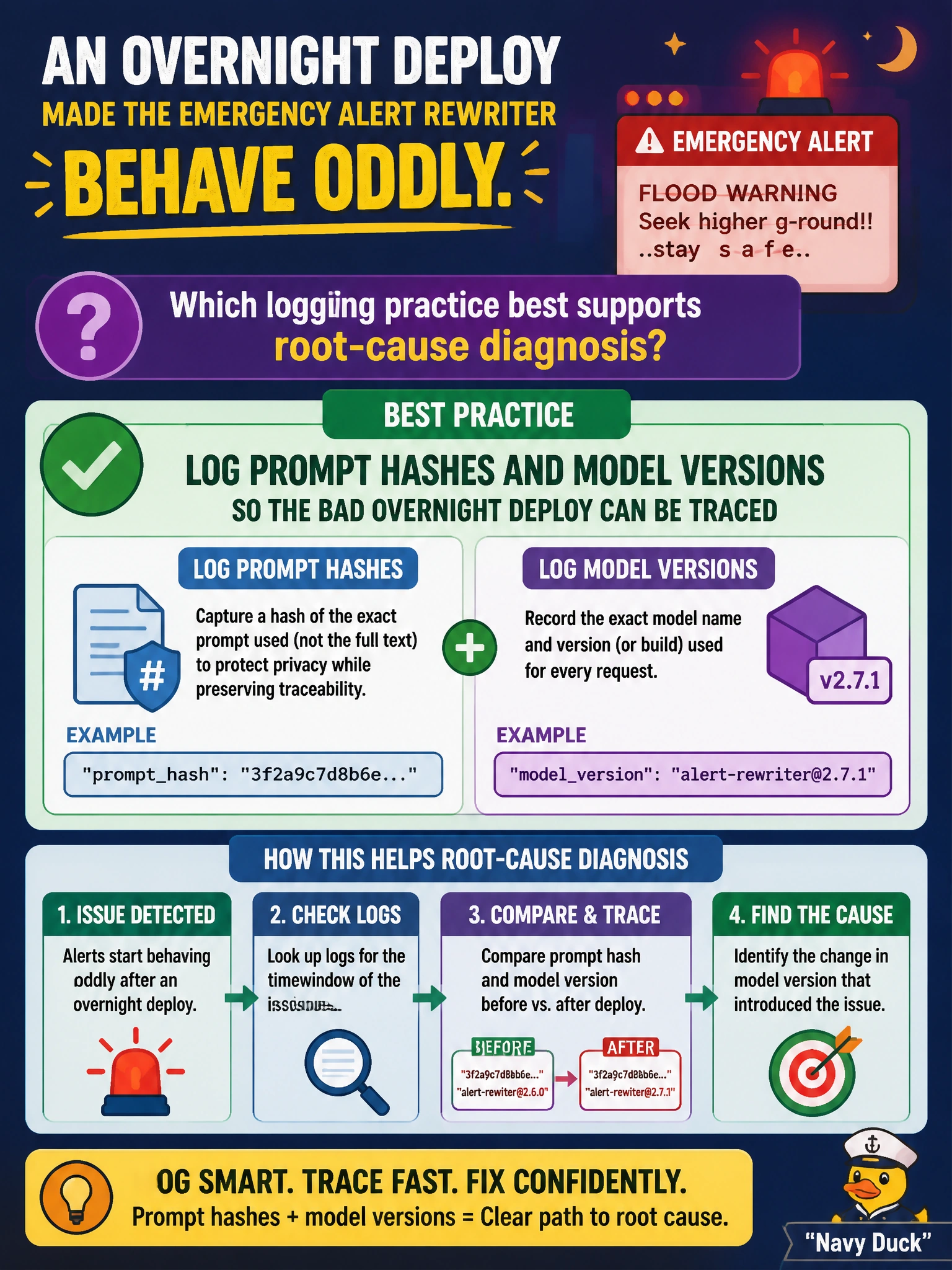
An overnight deploy made the emergency alert rewriter behave oddly. Which logging practice best supports root-cause diagnosis?
Select an answer to reveal the explanation.
Short Explanation
When last night’s alert rewriter went weird, you need breadcrumbs: which model version and which prompt hash. Without those tags in the logs, overnight deploys become ghost stories.
Full Explanation
When an overnight deploy made the emergency alert rewriter behave oddly, root-cause diagnosis depends on logging prompt hashes and model versions so the bad overnight deploy can be traced. Emergency alert rewriting is high stakes: wrong tone, truncated hazards, or unintended content changes must be attributable to a specific model build and prompt artifact. Prompt hashes identify which instruction template produced each rewrite; model version tags identify which weights or serving image ran. Together they turn “something weird overnight” into a reproducible lineage for rollback and postmortem. Logging only GPU utilization percentages with no model identity shows capacity, not which rewriter generation misfired. Overwriting prior deploy markers so only the newest run remains erases the audit trail needed to compare good versus bad overnight builds. Storing alerts as unmarked free text with no version fields leaves investigators without breadcrumbs when residents or incident commanders dispute what the system emitted. Exam caveat: hashes and versions must be immutable and correlated with request IDs and timestamps; logging them without retention or queryability still fails forensics. Operational check: emit model version, prompt hash, and request ID on every emergency rewrite log line; retain logs across deploys; reproduce the odd behavior by replaying the logged prompt hash against the suspected model version; and pin rollback to the last known-good version tag.