
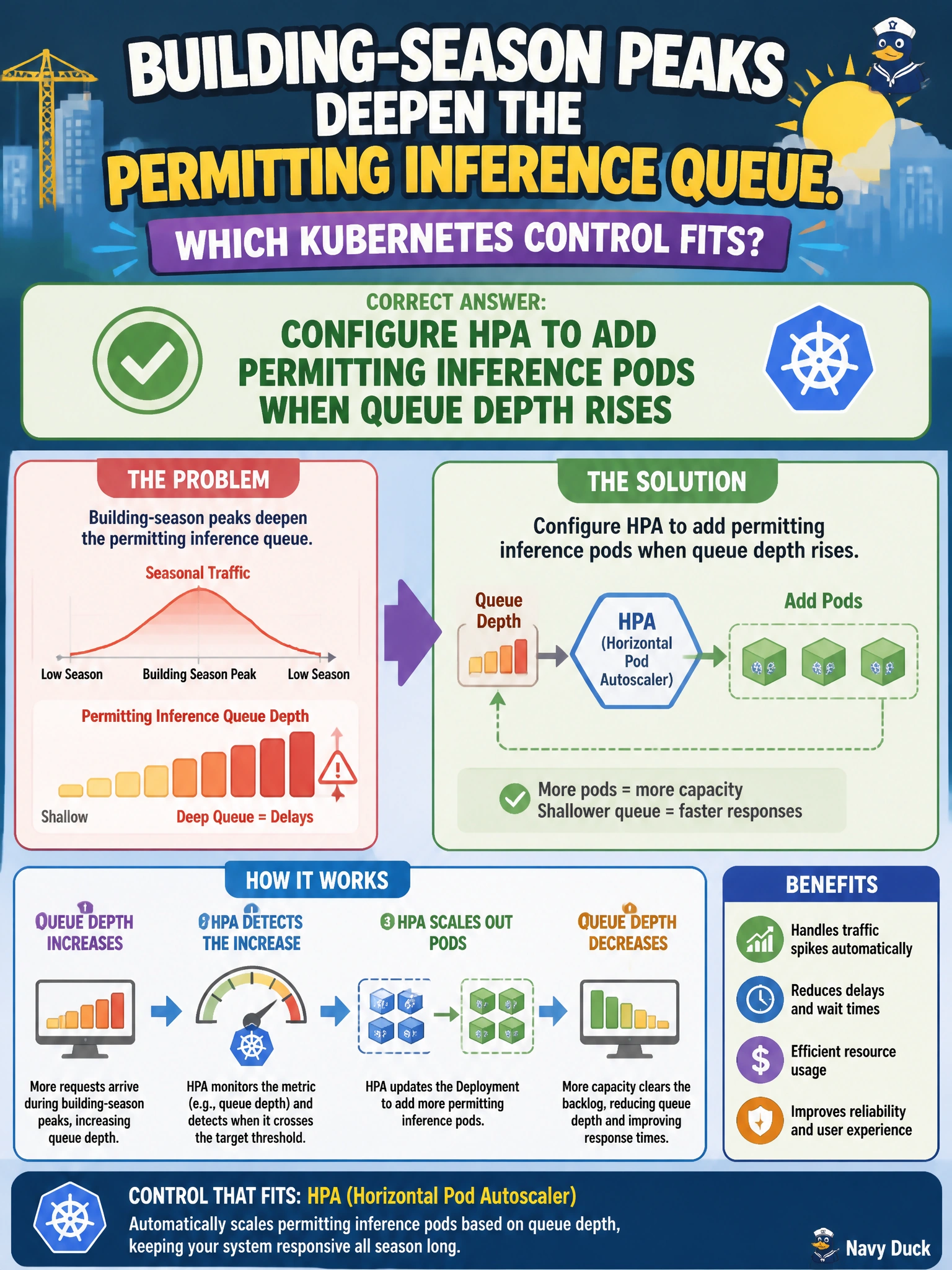
Building-season peaks deepen the permitting inference queue. Which Kubernetes control fits?
Select an answer to reveal the explanation.
Short Explanation
When the permitting line snakes out the door, add more counters—not more sticky notes on the wall. Point HPA at queue depth so inference pods grow with building season.
Full Explanation
Building-season peaks that deepen the permitting inference queue should be handled with Kubernetes Horizontal Pod Autoscaler rules that add permitting inference pods when queue depth or an equivalent lag metric rises, then scale back when demand falls. That ties civic capacity to observed load instead of a static guess that fails every spring. Freezing replica count at one pod year-round regardless of queue depth guarantees multi-minute waits when applications surge. Deleting the HPA before peak season begins removes the control loop exactly when residents and contractors need it most. Scaling only logging sidecars while leaving inference pods unchanged increases observability noise without adding serving capacity. Exam caveat: HPA on queue depth needs a stable custom metric pipeline; scaling solely on CPU can lag for GPU inference where the bottleneck is request concurrency and batching rather than host CPU percent. Operational check: define a queue-depth metric exported to the metrics server, load-test a building-season peak traffic shape, confirm HPA adds inference replicas as depth crosses thresholds, and verify p95 permitting latency returns under SLA without manual replica edits.