
A school lab must run the same NIM-style LLM image used in staging. What approach is appropriate?
Select an answer to reveal the explanation.
Short Explanation
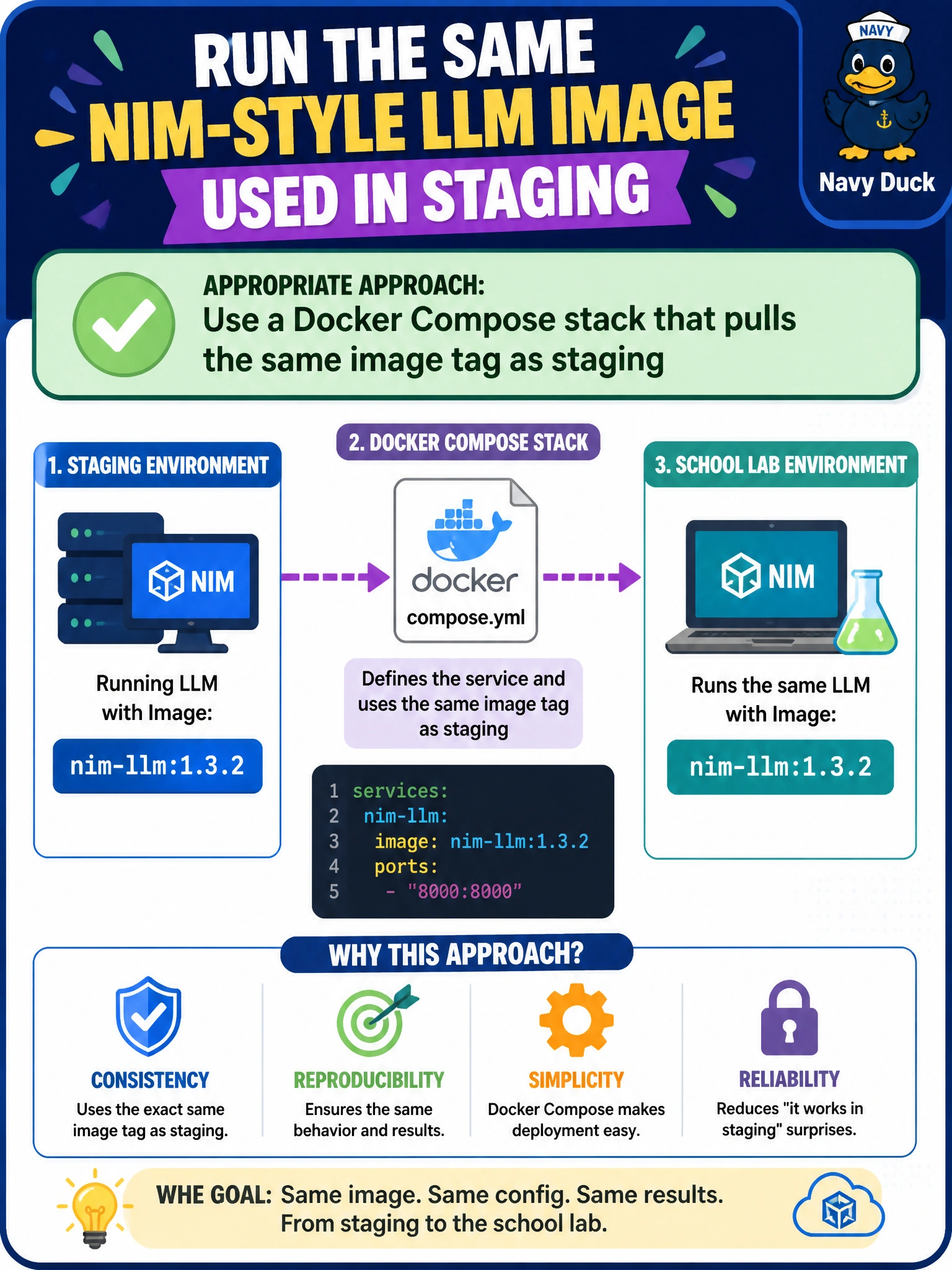
Labs that drift from staging become mystery boxes. Docker Compose with the same NIM-style image tag keeps the classroom on the same rails as staging.
Full Explanation
A school lab that must run the same NIM-style LLM image used in staging should use a Docker Compose stack that pulls that exact image tag so student environments mirror staging dependencies, entrypoints, and GPU runtime assumptions. That parity makes labs a valid rehearsal for production behavior rather than a one-off classroom experiment. Installing conflicting library versions by hand on each student laptop recreates dependency hell and invalidates comparisons to staging. Requiring every student to recompile CUDA from source before class wastes instructional time and still fails to guarantee image parity with the staging service. Serving a different untested model family only in the lab teaches the wrong operational surface and hides staging regressions until they hit production. Exam caveat: Compose parity still requires host driver capability matching the image’s CUDA requirements; an old lab driver can block a correctly tagged NIM image from starting even when Compose files match. Operational check: pin the staging image digest in Compose, bring the stack up on a lab GPU node, and confirm container image ID and a smoke inference match staging outputs on a shared prompt set before class begins.