
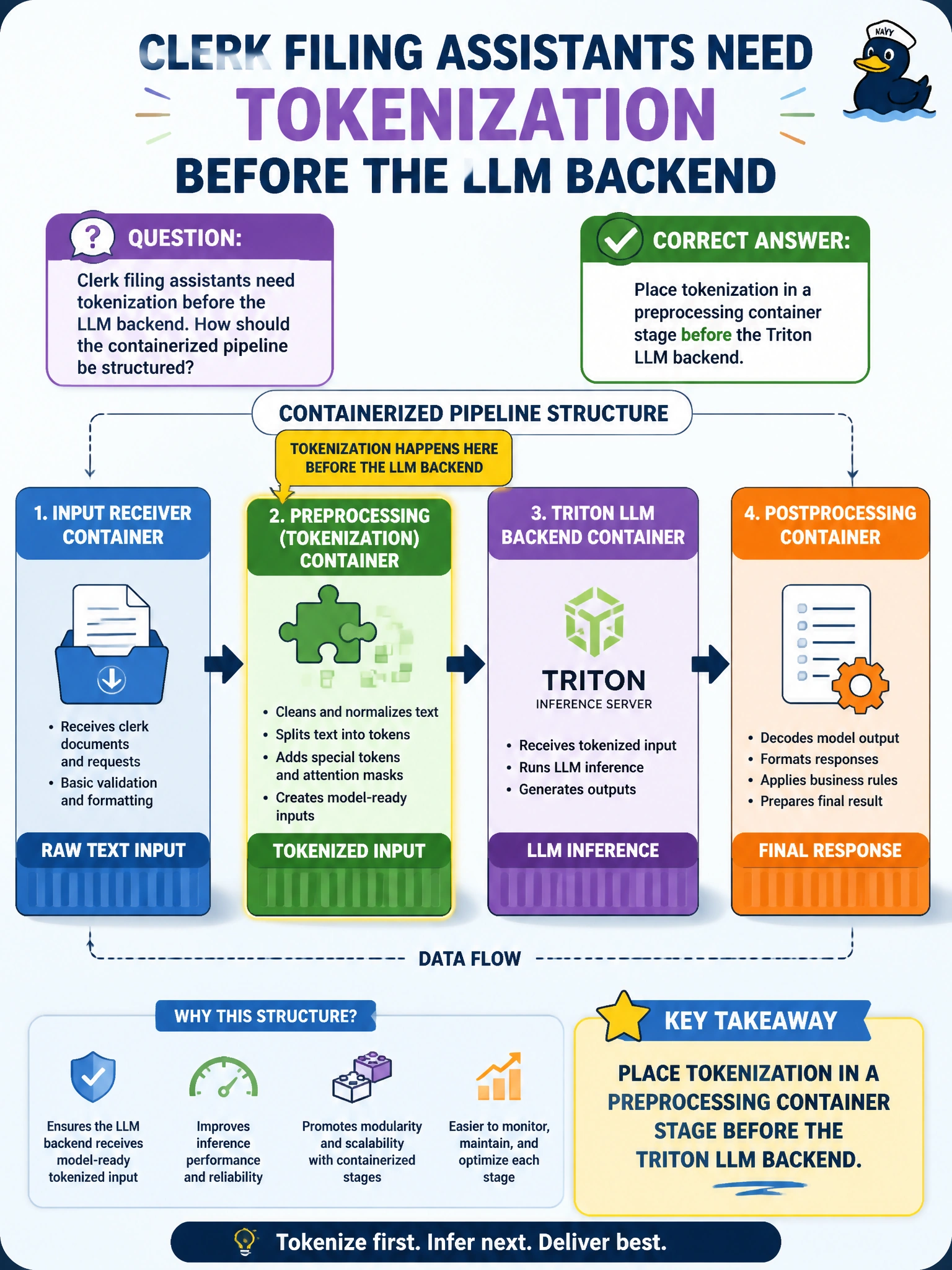
Clerk filing assistants need tokenization before the LLM backend. How should the containerized pipeline be structured?
Select an answer to reveal the explanation.
Short Explanation
Tokenize first, then talk to the LLM—like stamping a form before it hits the clerk window. A preprocessing container stage in front of Triton keeps the filing pipeline honest.
Full Explanation
Clerk filing assistants that need tokenization before the LLM backend should place tokenization in a preprocessing container stage ahead of the Triton LLM backend so raw filings become model-ready token IDs in a controlled server path. That preserves consistent tokenizer versions, max-length policy, and auditability. Embedding tokenization only inside resident browsers with no server stage yields inconsistent client tokenizers and weakens server-side validation. Skipping tokenization to feed raw scanned PDFs straight into the LLM backend assumes a model interface that expects text/token IDs, not arbitrary PDF bytes, and breaks serving contracts. Running tokenization after the LLM has already generated filing answers inverts the pipeline and cannot condition generation on correctly tokenized input. Exam caveat: preprocessing must use the exact tokenizer vocabulary tied to the served checkpoint; a mismatched tokenizer silently degrades clerk answer quality even when the graph “runs.” Operational check: in the container graph, assert tokenizer name/hash matches the LLM config, send a golden filing through preprocess→Triton, and verify input token IDs and outputs match the staging reference before production cutover.