
Public works has one GPU for a small ticket classifier and a large work-order summarizer. How can Triton help?
Select an answer to reveal the explanation.
Short Explanation
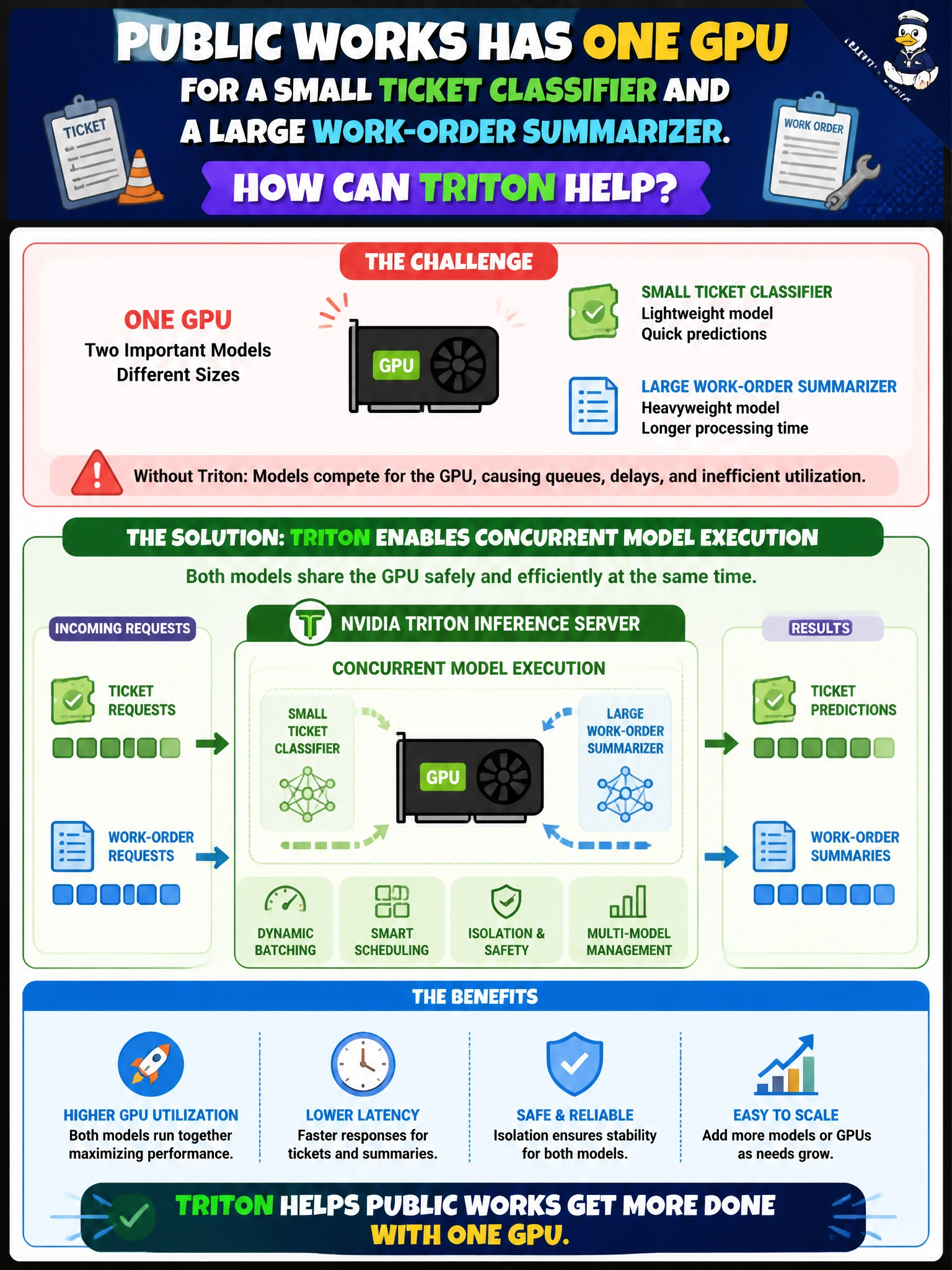
One GPU, two city tools—don’t make the summarizer wait until the classifier is fired. Triton’s concurrent execution lets both share the card instead of fighting for exclusive ownership.
Full Explanation
Public works with one GPU shared by a small ticket classifier and a large work-order summarizer should enable Triton’s concurrent model execution so both models can be loaded and scheduled on the same device without permanently serializing product ownership. Concurrency settings and instance groups let the smaller classifier keep responding while the summarizer runs, subject to memory limits and scheduling policy. Serializing forever so the summarizer never starts until the classifier is deleted forces an unnecessary product tradeoff the department cannot afford. Loading only the summarizer and discarding classification labels drops a required municipal workflow for ticket routing. Running both models exclusively on CPU to avoid Triton’s concurrent features surrenders GPU throughput those models were meant to use. Exam caveat: concurrent execution still requires combined weights, activations, and workspace to fit; without memory prioritization or model load limits, the large summarizer can OOM the classifier at peak. Operational check: enable concurrent execution with explicit instance counts, run mixed ticket-classify and work-order-summarize load, and verify both succeed within latency budgets while device memory shows shared residency without OOM.