
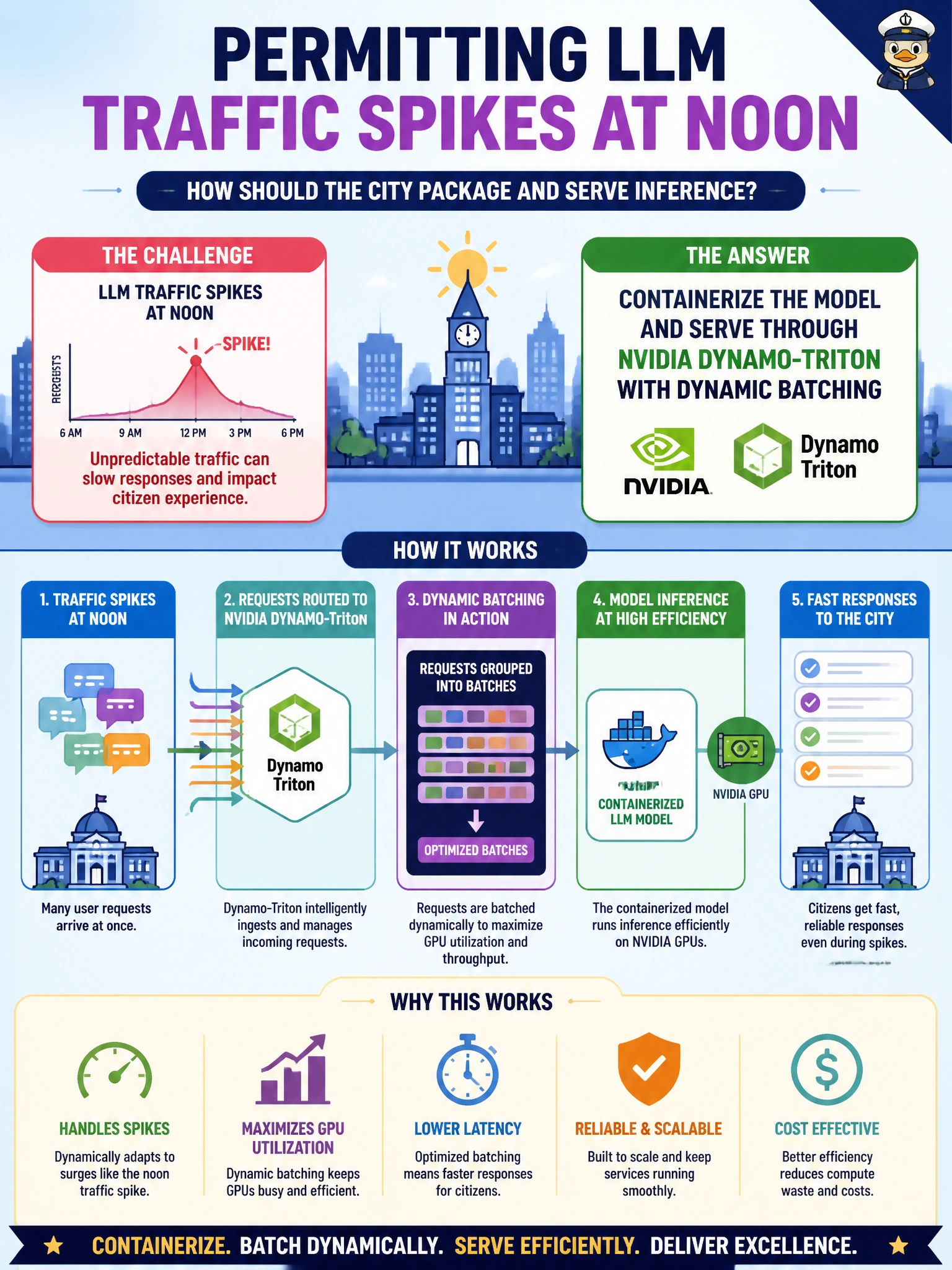
Permitting LLM traffic spikes at noon. How should the city package and serve inference?
Select an answer to reveal the explanation.
Short Explanation
Noon permitting rush is a lunch line—dynamic batching groups hungry requests instead of cooking one at a time. Drop the LLM in a container, put Dynamo-Triton in front, and let the batcher ride the spike.
Full Explanation
Permit-office noon rush inference needs packaging and throughput patterns that absorb bursty concurrent requests from the portal. Containerize the model and serve it through NVIDIA Dynamo-Triton with dynamic batching so arriving permit queries can share GPU kernels without rewriting application code for every spike. Bare-metal Python scripts with no containers and no batching leave process isolation gaps, dependency drift, and one-at-a-time execution that collapse under lunchtime load. Disabling batching so each permit request waits in a single-threaded queue forever maximizes queueing delay exactly when residents flood the system. Redeploying a new VM image by hand for every individual permit query is operationally impossible and destroys continuity. Exam caveat: dynamic batching improves throughput but can hurt latency if max batch or queue delay is unbounded—pair it with preferred and max batch settings aligned to the permit SLA. Operational check: load-test the Triton container with a noon-shaped permit trace, compare tokens per second and p95 against the unbatched script baseline, and confirm dynamic batching raises throughput without breaching the published latency objective.