
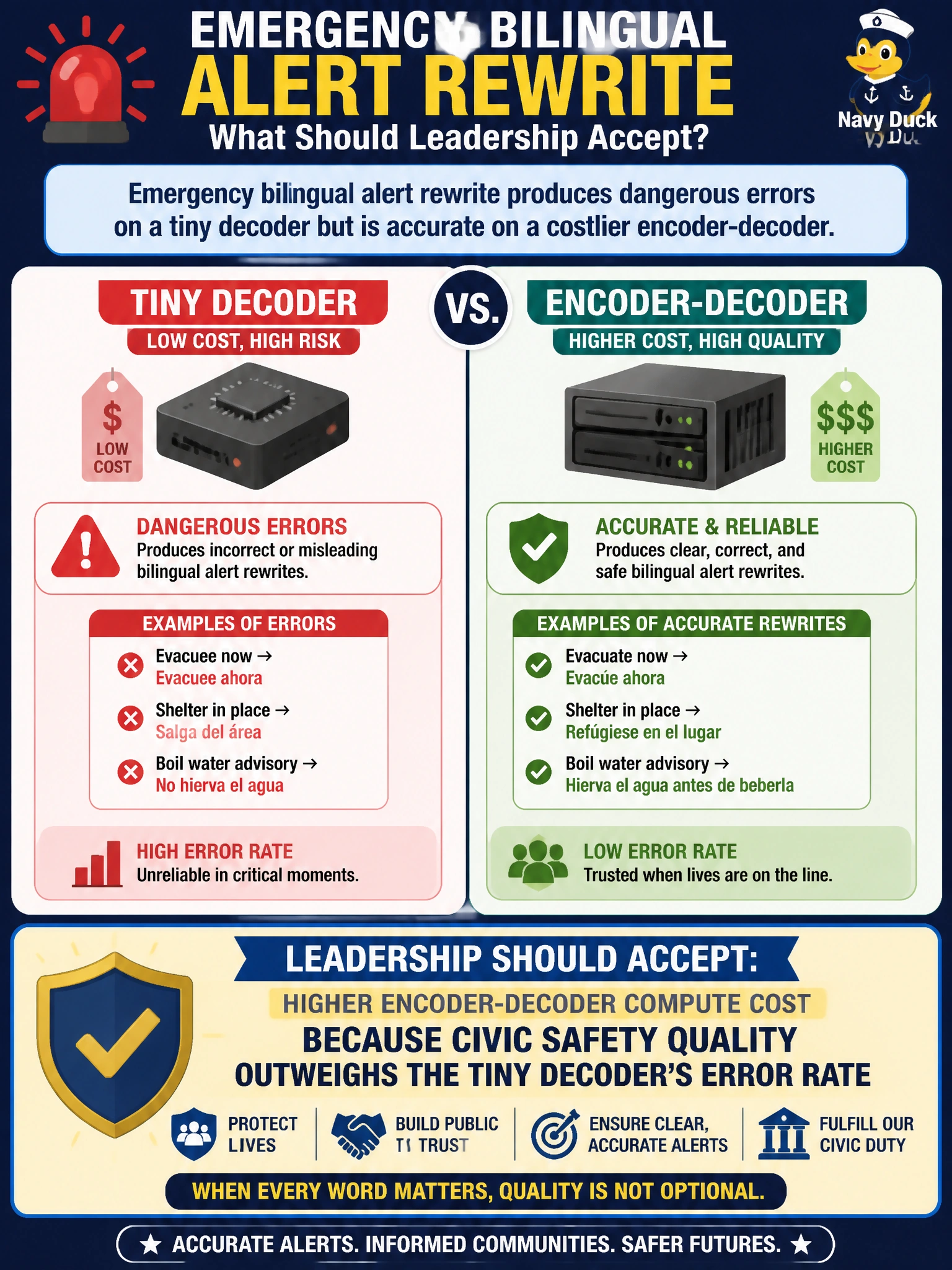
Emergency bilingual alert rewrite produces dangerous errors on a tiny decoder but is accurate on a costlier encoder-decoder. What should leadership accept?
Select an answer to reveal the explanation.
Short Explanation
When the cheap radio garbles evacuation orders, you pay for the clear channel. Leadership should accept the encoder-decoder’s higher compute bill so bilingual emergency rewrites stay accurate.
Full Explanation
Emergency bilingual alert rewrite that produces dangerous errors on a tiny decoder but is accurate on a costlier encoder-decoder is a safety-versus-cost decision: leadership should accept higher encoder-decoder compute cost because civic safety quality outweighs the cheap model’s error rate during activations. Keeping the tiny decoder and silencing quality reviews during activations hides harm when residents rely on alerts for evacuation or shelter guidance. Always choosing the cheapest model even for safety-critical alerts institutionalizes unacceptable failure modes across language communities. Translating alerts with an unreviewed regex and skipping neural models cannot handle linguistic variation and offers no measured quality bar. Exam caveat: cost acceptance does not mean unbounded spend—use the encoder-decoder for alert rewrite while keeping cheaper models for non-safety drafts, and keep a human or policy gate for highest-severity templates. Operational check: run a held-out bilingual alert suite with safety rubrics on both models, document error classes the tiny decoder introduces, and require the encoder-decoder path with audit logging before any activation-time rewrite is authorized for public dissemination.