
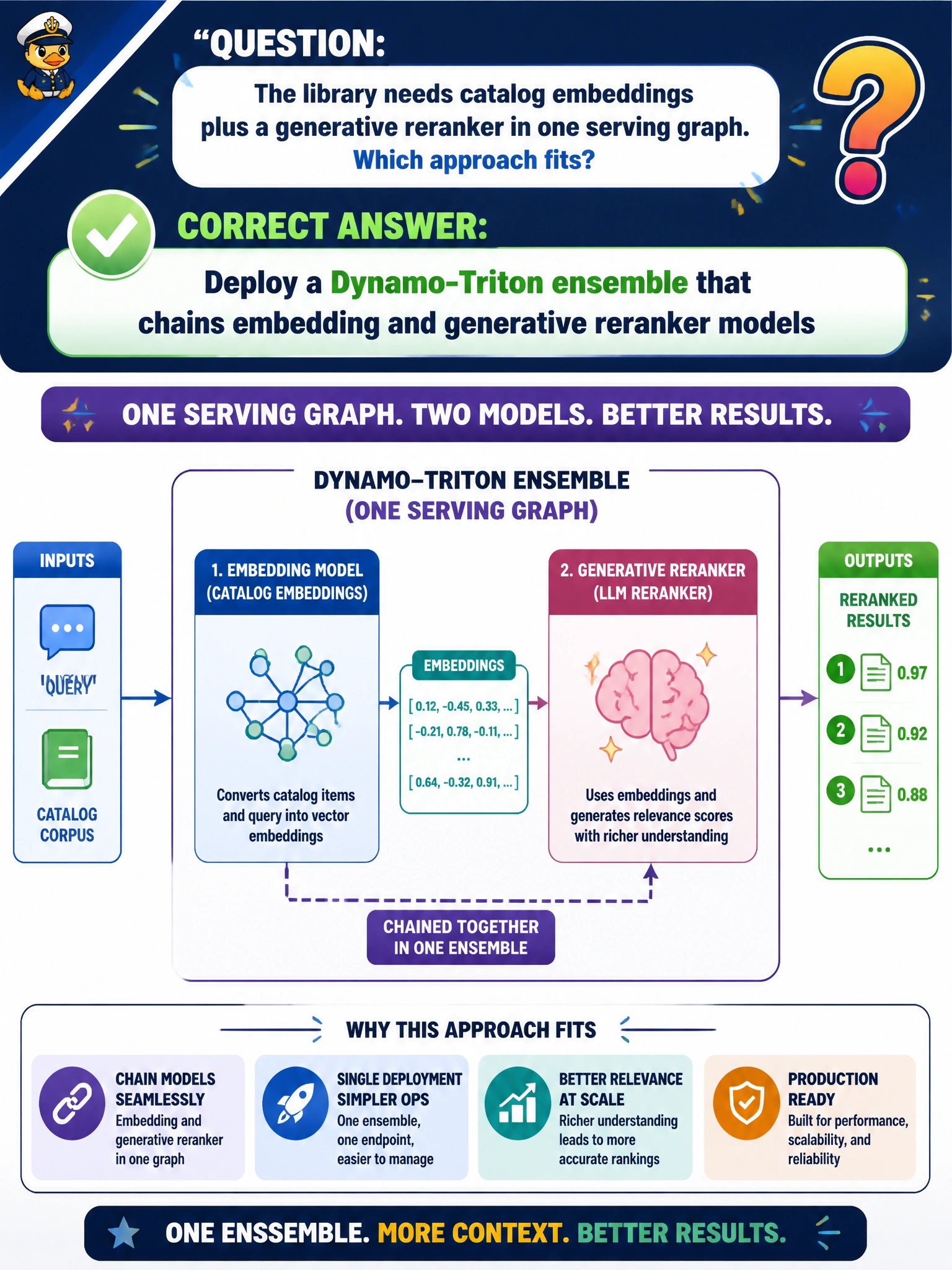
The library needs catalog embeddings plus a generative reranker in one serving graph. Which approach fits?
Select an answer to reveal the explanation.
Short Explanation
Think assembly line: embed the catalog card, then rerank with the generative brain—all in one Triton ensemble graph. Separate gadgets with no shared pipeline just drop the books between stations.
Full Explanation
Library catalog serving that needs embeddings plus a generative reranker in one graph should deploy a Dynamo-Triton ensemble chaining the embedding model into the generative reranker under unified scheduling, batching, and health checks. That keeps local control of latency budgets and failure domains for civic retrieval instead of scattering stages across unmanaged devices. Running embeddings on a laptop and the reranker on a phone with no shared pipeline drops operational cohesion and cannot enforce end-to-end SLAs. Calling two unrelated SaaS APIs with no local ensemble control forfeits data-residency, version pinning, and coordinated timeouts the library needs. Storing only keyword indexes and abandoning neural embeddings and reranking regresses ranking quality for modern catalog queries. Exam caveat: ensembles add hop latency—keep intermediate tensors in-process or on GPU where possible and size timeouts so a slow reranker cannot indefinitely block the embedding stage. Operational check: deploy the Triton ensemble, measure stage-level latency for embed versus rerank on representative catalog queries, and verify a single readiness probe and rollback unit covers the whole chain before exposing it to patrons.