
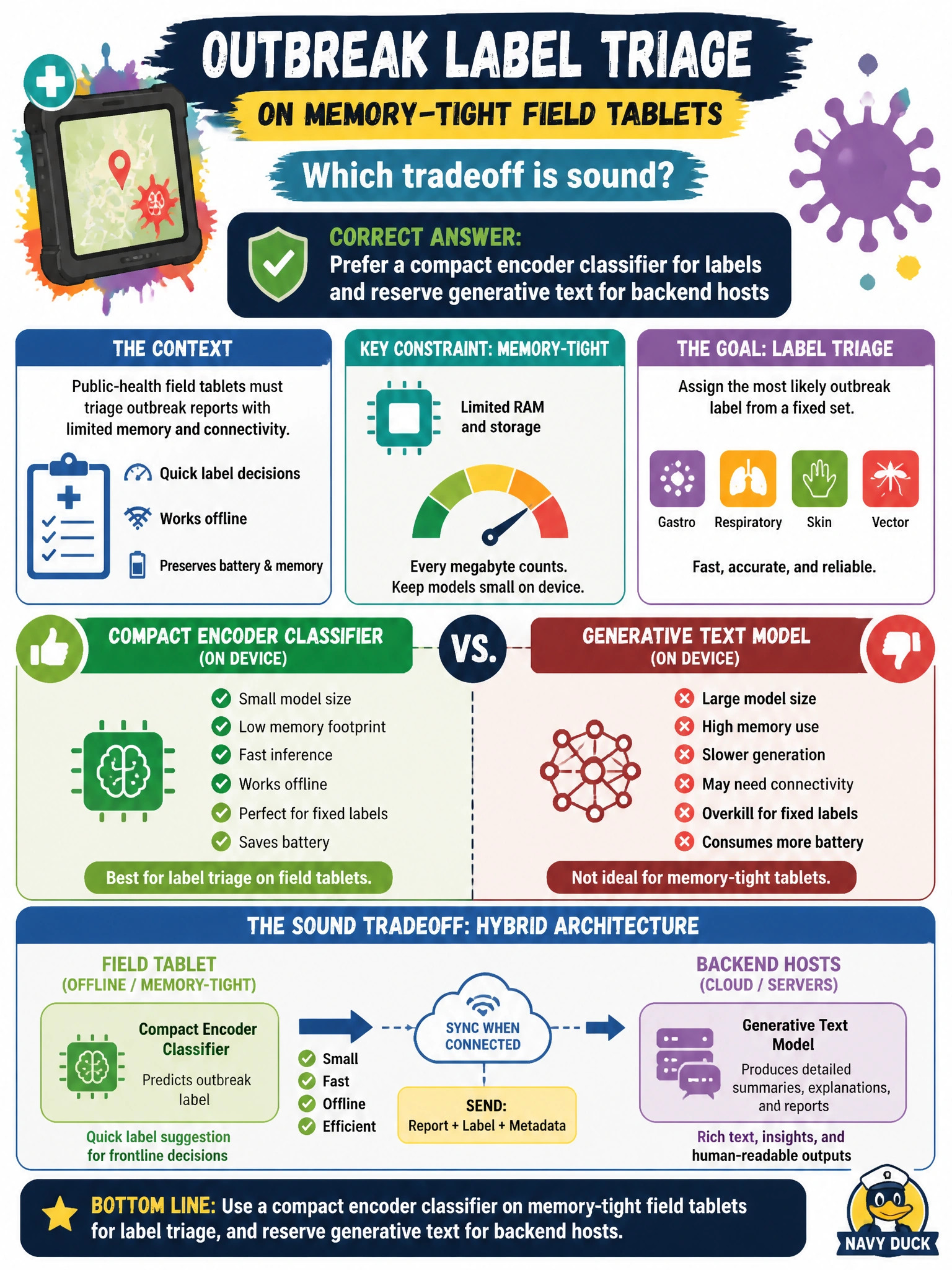
Public-health field tablets are memory-tight but need outbreak label triage. Which tradeoff is sound?
Select an answer to reveal the explanation.
Short Explanation
Tablets are lunchboxes, not data centers. Stick a compact encoder classifier on-device for outbreak labels and leave the wordy generative explanations on backend hosts with room to breathe.
Full Explanation
Public-health field tablets that are memory-tight but still need outbreak label triage should run a compact encoder classifier on device for discrete labels and reserve generative explanation text for backend hosts with more memory. That tradeoff keeps triage responsive offline or on weak links while avoiding a full generative LLM footprint on every tablet. Shipping a full generative explainer LLM to every tablet regardless of memory will thrash or fail on constrained devices and complicates fleet updates. Disabling all on-device models for paper forms only removes digital triage speed during outbreaks. Quantizing nothing while increasing sequence length until tablets crash deliberately ignores both memory compression and length control. Exam caveat: on-device classifiers must be validated against the same case mix as the backend; label drift between tablet and server models can misroute outbreak response if versioning is not locked. Operational check: profile peak RSS/VRAM (or NPU memory) for the compact encoder on representative field tablets, confirm label latency under the field SLA, and verify that generative narratives are invoked only via backend calls when connectivity and policy allow.