
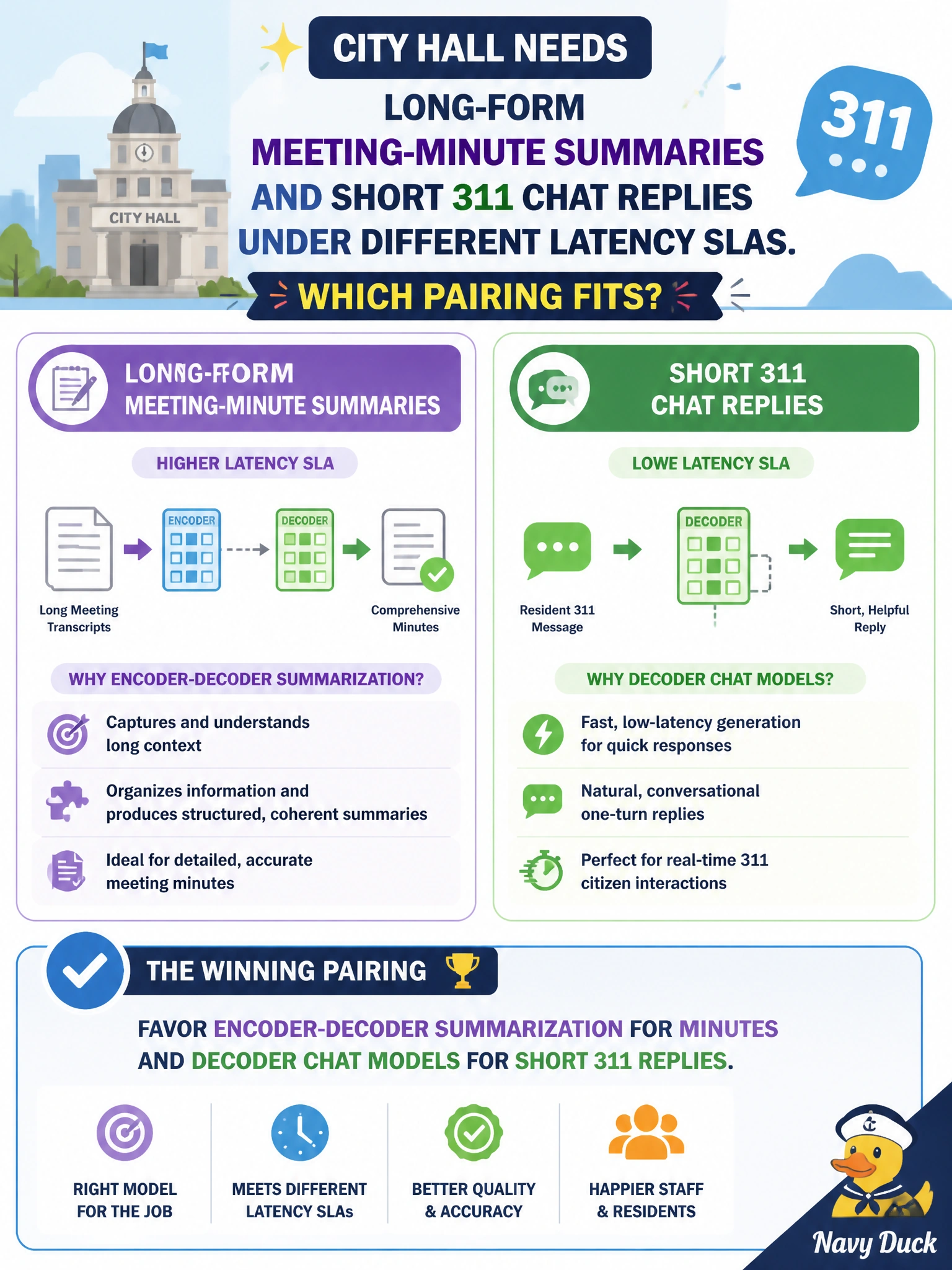
City hall needs long-form meeting-minute summaries and short 311 chat replies under different latency SLAs. Which pairing fits?
Select an answer to reveal the explanation.
Short Explanation
Long minutes are a book report; 311 replies are sticky notes. Encoder-decoder for the long summary, decoder chat for the quick reply—don’t make one lumbering model do both on the same SLA clock.
Full Explanation
City hall workloads that mix long-form meeting-minute summarization with short 311 chat replies under different latency SLAs should pair encoder-decoder summarization for minutes with decoder chat models for brief 311 turns. Encoder-decoder architectures suit condensation of long transcripts; decoder-only chat models keep one-line replies snappy on leaner serving footprints. Using the same huge encoder-decoder for both one-line 311 replies and hour-long minutes forces chat onto an oversized seq2seq path and risks missing 311 latency SLAs. Preferring decoder chat models for long minutes and encoder-decoder only for one-word replies reverses the strengths of each family. Rejecting neural summarization to paste raw transcripts into every resident inbox fails accessibility and length constraints residents expect from city communications. Exam caveat: long-minute summarization may still need chunk-and-merge or hierarchical passes when transcripts exceed context; architecture choice does not remove length engineering. Operational check: run separate load tests—minute summarization quality/latency on the encoder-decoder service and 311 p95 on the decoder chat service—and confirm each meets its SLA without collocating both on a single oversized model instance.