
Resident complaint translation needs bilingual rewrite quality, while FAQ chat must stay on a slim GPU. How should architecture be split?
Select an answer to reveal the explanation.
Short Explanation
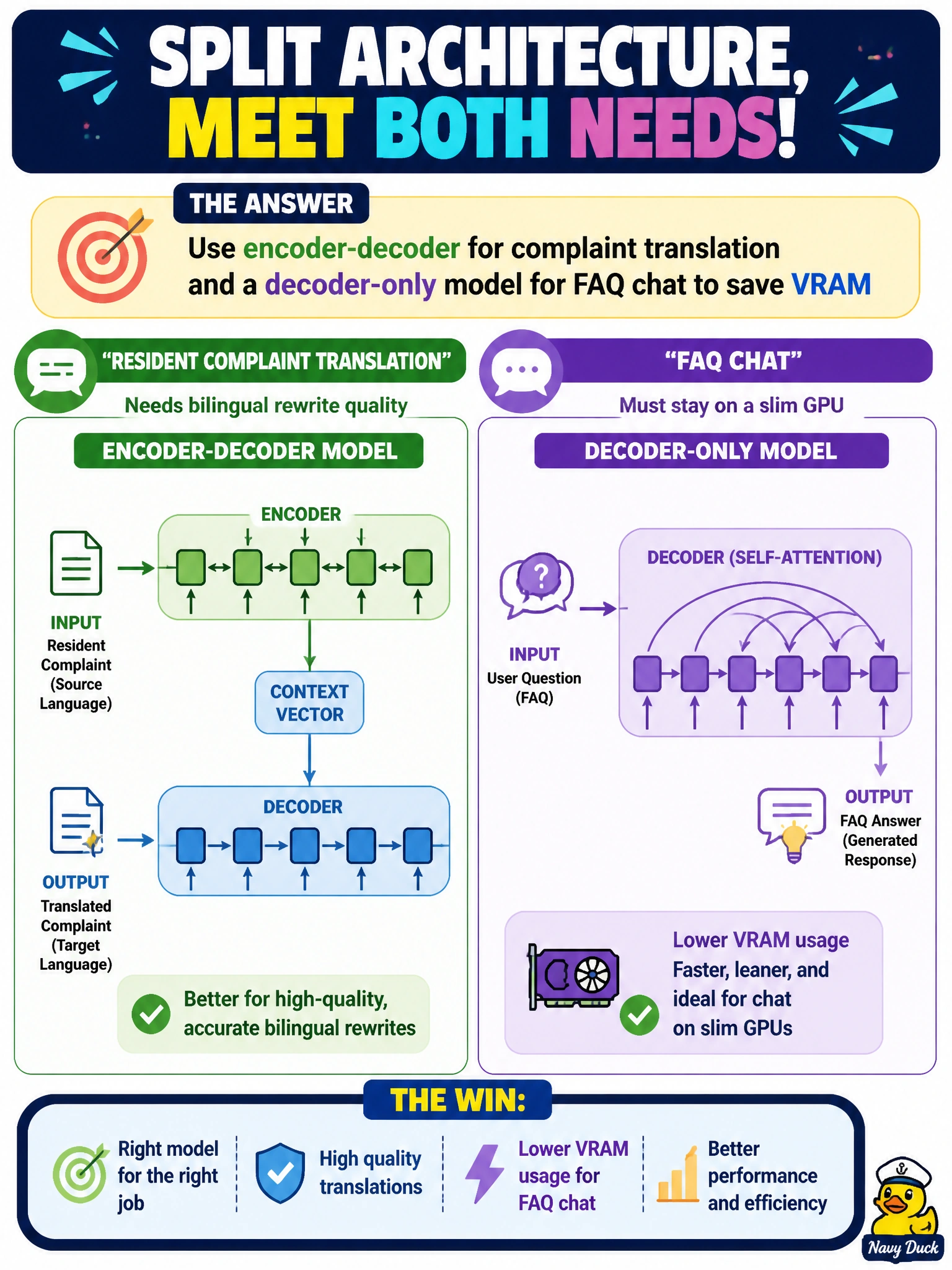
Translation wants the encoder-decoder bilingual brain; FAQ chat can live on a leaner decoder-only buddy. Split the architectures so the slim GPU isn’t crushed by one oversized model doing every job.
Full Explanation
Resident complaint translation that needs bilingual rewrite quality and FAQ chat that must stay on a slim GPU should be split by architecture: use an encoder-decoder where full-sequence conditioning improves translation fidelity, and a decoder-only chat model for FAQ turns that prioritize interactive latency and smaller VRAM. Forcing both workloads onto the largest encoder-decoder ignores the FAQ VRAM constraint and overpays for chat. Using decoder-only for translation while reserving encoder-decoder for one-word FAQ answers inverts the quality-versus-footprint fit—translation loses the encoder inductive bias it needs, and FAQs carry unnecessary seq2seq overhead. Dropping neural models for static PDF translations for every FAQ cannot cover evolving complaint language or interactive FAQ dialogue. Exam caveat: “encoder-decoder for translation” still requires evaluation on the county’s language pairs; a strong multilingual decoder can sometimes close the gap, but the exam pattern is to match seq2seq rewrite quality needs to encoder-decoder and keep slim chat on decoder-only. Operational check: measure complaint translation BLEU/COMET (or human safety review) and FAQ p95 latency/VRAM separately under the split serving graphs; confirm translation quality rises on the encoder-decoder path while FAQ chat remains within the slim GPU memory envelope.