
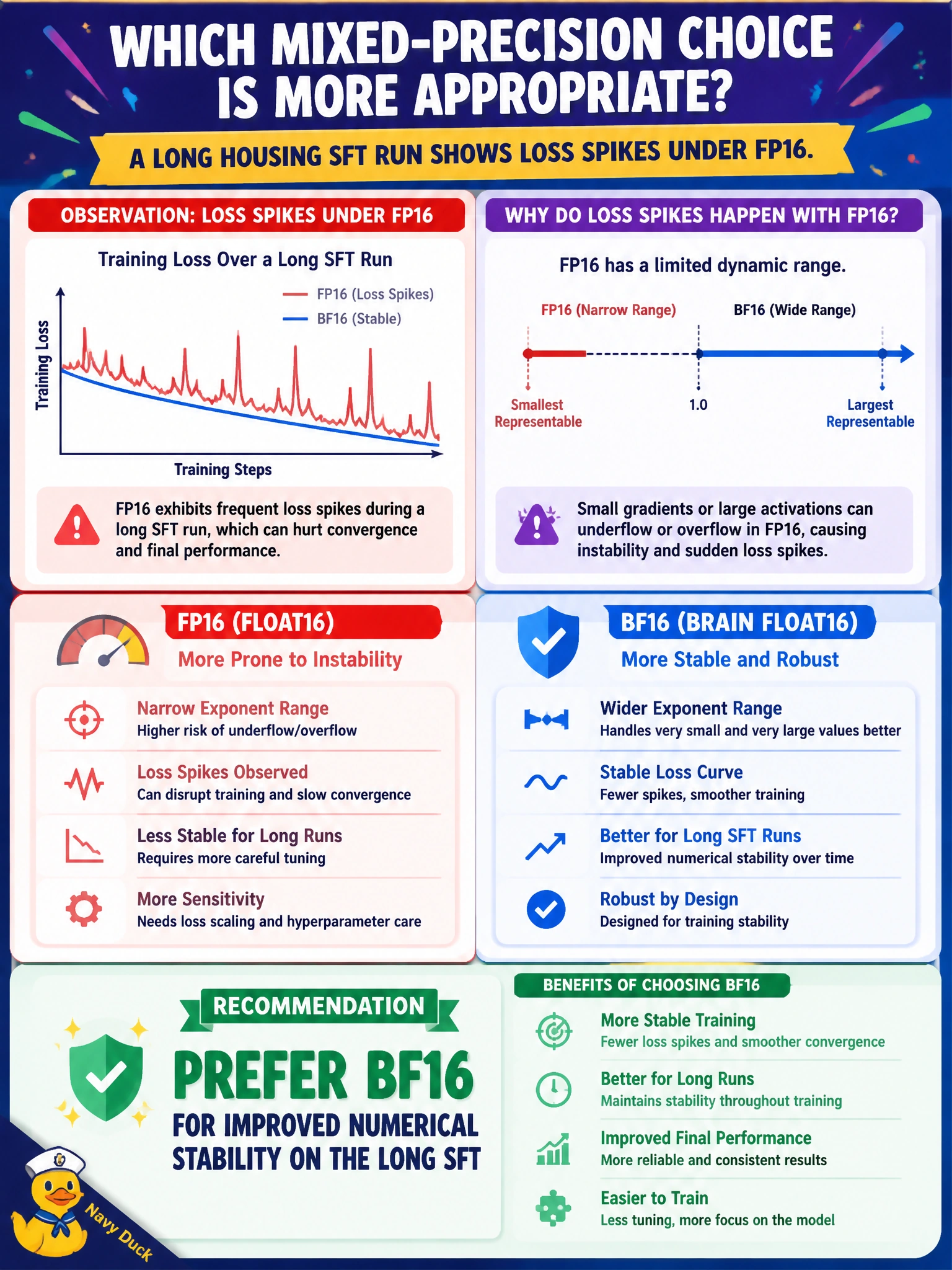
A long housing SFT run shows loss spikes under FP16. Which mixed-precision choice is more appropriate?
Select an answer to reveal the explanation.
Short Explanation
FP16 keeps poking the housing loss with spikes on a long SFT—BF16 usually rides smoother. Ignoring the spikes or jumping to random INT4 mid-run is not a stability fix.
Full Explanation
A long housing SFT run that shows loss spikes under FP16 should prefer BF16 for improved numerical stability in mixed precision: BF16’s wider exponent range typically reduces overflow and underflow pathologies that produce spiky loss on extended fine-tunes while still engaging Tensor Cores on modern data-center GPUs. That makes BF16 the usual next step when FP16 is unstable over long civic SFT. Staying on FP16 and ignoring the spikes for the full run risks silent quality damage, bad checkpoints, and irreproducible housing-model behavior in production. Switching to INT4 weight-only training mid-epoch without retuning changes the optimization problem abruptly and is not a drop-in stability fix for SFT loss spikes. Disabling all floating-point math and using integer embeddings only is not a viable mixed-precision training recipe for standard LLM SFT in municipal stacks. Exam caveat: when FP16 is unstable on long runs, BF16 is the usual next precision choice before exotic quantization mid-training; do not confuse inference quantization with training stability remedies. Operational check: restart or continue housing SFT under BF16 AMP with the same data order policy where possible, compare loss curves and eval metrics to the FP16-spiking run, verify Tensor Core utilization remains healthy, and lock precision settings in the experiment config for auditability.