
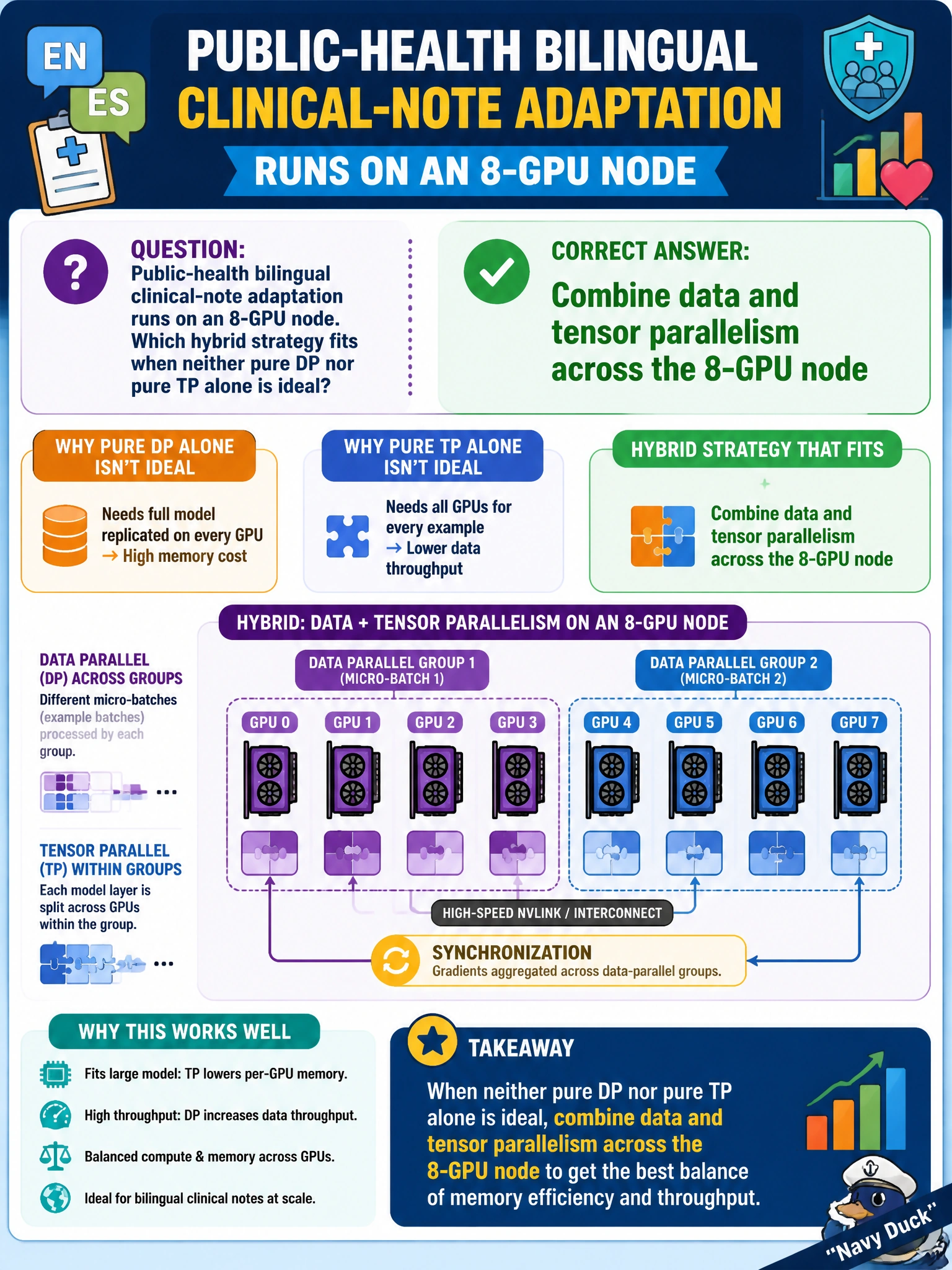
Public-health bilingual clinical-note adaptation runs on an 8-GPU node. Which hybrid strategy fits when neither pure DP nor pure TP alone is ideal?
Select an answer to reveal the explanation.
Short Explanation
Eight GPUs, one clinic job: slice the big layers with tensor parallel and still replicate groups with data parallel. Hybrid beats pretending a laptop CPU or eight lonely jobs will sync themselves.
Full Explanation
Public-health bilingual clinical-note adaptation on an 8-GPU node often needs a hybrid of data and tensor parallelism when neither pure DP nor pure TP alone is ideal: TP shards large layers so they fit and communicate efficiently within a tightly coupled group, while DP replicates those TP groups across the remaining GPUs to scale batch throughput for clinical notes. That hybrid uses all eight GPUs coherently under one synchronized run. Disabling multi-GPU and fine-tuning on a laptop CPU overnight abandons the node’s capacity and cannot meet clinical adaptation timelines or GPU-backed throughput expectations. Eight isolated single-GPU jobs with no gradient sync are not one coherent training run—they diverge independently and cannot produce a single synchronized clinic model for bilingual deployment. Applying expert parallelism to a dense non-MoE clinic model invents experts that do not exist and fails as a hybrid strategy for this architecture. Exam caveat: hybrid 2D parallelism is chosen from measured fit and scaling needs—combine DP and TP deliberately rather than defaulting to an unrelated parallel mode such as expert parallel on dense nets. Operational check: set TP degree to fit attention and MLP shards on the fast interconnect domain, use DP across groups to fill eight GPUs, validate bilingual note metrics and loss stability, and profile communication so the public-health job remains within overnight batch windows.