
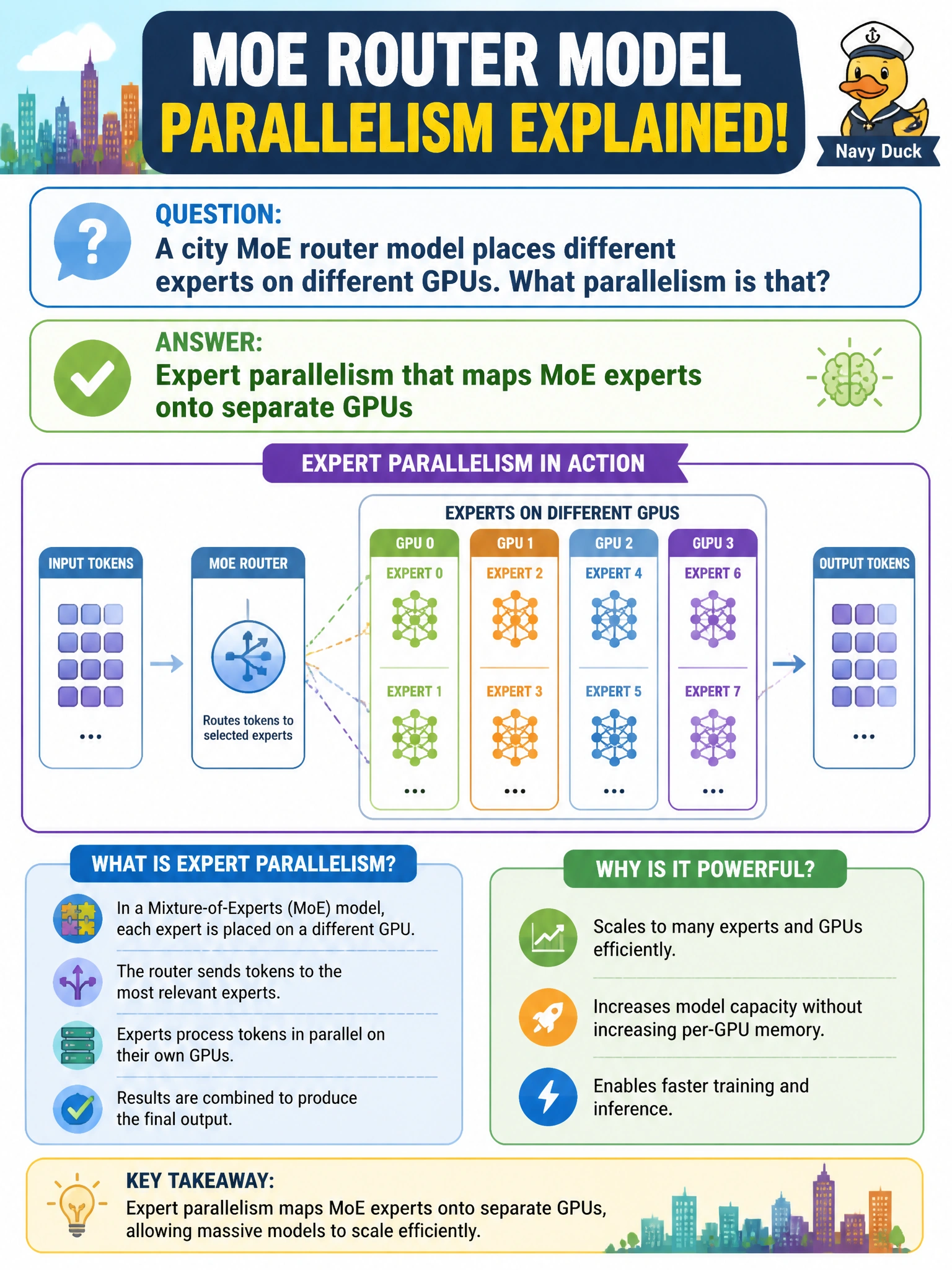
A city MoE router model places different experts on different GPUs. What parallelism is that?
Select an answer to reveal the explanation.
Short Explanation
MoE means many specialists—expert parallelism parks those experts on different city GPUs so the router can call them without cramming everyone onto one card.
Full Explanation
When a city MoE router model places different experts on different GPUs, that pattern is expert parallelism: MoE expert modules are mapped onto separate devices so the router can dispatch tokens to specialists without colocating every expert’s parameters on one GPU. That is the parallelism mode defined by expert placement under routing, not by batch replication alone. Pipeline parallelism that ignores the expert routing graph stages dense layers in time but does not describe placing MoE experts for token routing across a municipal cluster. Data parallelism that duplicates every expert on every GPU only maximizes memory use and misses the point of distributing experts; pure DP may still be combined with expert parallel in hybrid setups, but duplication-only is not the MoE placement strategy named in the stem. Tensor parallelism applied solely to the tokenizer vocabulary does nothing meaningful for expert compute and misidentifies where MoE capacity lives. Exam caveat: expert parallelism is meaningful only when the architecture actually has experts; do not confuse it with TP, PP, or DP on dense models—another frequent exam distractor pattern. Operational check: assign experts across city GPUs with balanced parameter and load distribution, monitor expert utilization and all-to-all routing costs, set capacity factors to avoid expert overload on hot civic intents, and verify MoE quality against a dense baseline before production promotion.