
Even a single layer of an assessor multimodal stack exceeds one GPU. What is required?
Select an answer to reveal the explanation.
Short Explanation
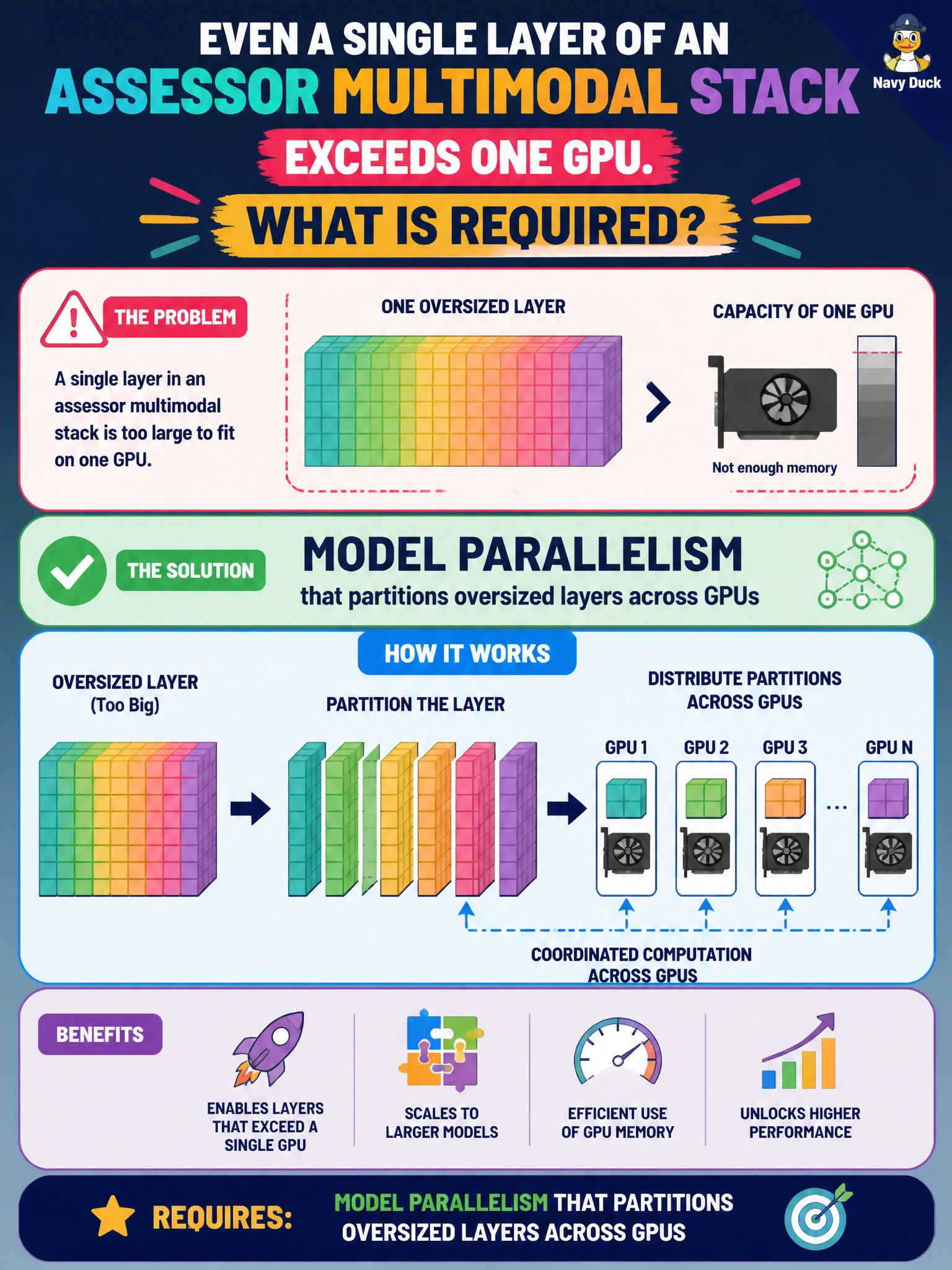
When a single assessor layer will not fit on one GPU, you need model parallelism to partition that layer across GPUs. A larger data-parallel batch without sharding still leaves the oversized layer on each GPU, so you run out of memory faster.
Full Explanation
When even one assessor multimodal layer exceeds a GPU’s capacity, model parallelism must partition that layer across GPUs so its weights and computation can run collectively across devices. Without partitioning, the assessor stack cannot train, regardless of dataloader tuning. A larger data-parallel batch without sharding increases activation pressure while each rank still must hold the impossible layer, so it runs out of memory faster. Tokenizer-only training skips the multimodal stack, avoiding the memory problem by not training the vision-language model needed for assessment workflows. Lowering civic image resolution may reduce activations somewhat, but it does not partition an oversized layer’s parameters and can damage accuracy on fine-grained property or inspection imagery. Exam caveat: when a single layer does not fit, partition the model rather than increasing the data-parallel batch or skipping the multimodal stack. Practical check: shard the oversized layer across GPUs using collective sizes supported by the framework, smoke-test forward and backward passes on sample assessor inputs, compare logits with a smaller reference where possible, and monitor per-rank memory headroom before full municipal training.