
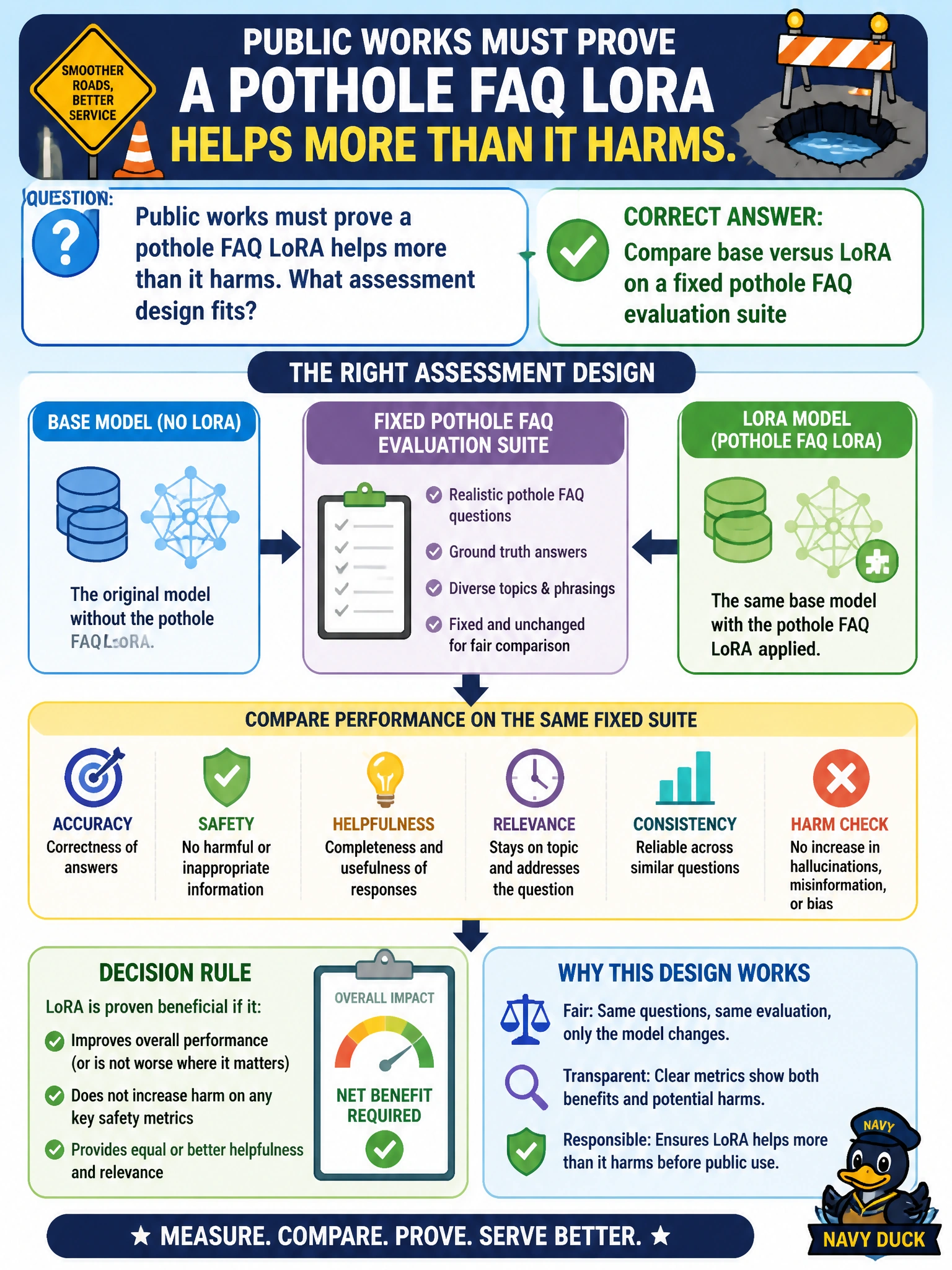
Public works must prove a pothole FAQ LoRA helps more than it harms. What assessment design fits?
Select an answer to reveal the explanation.
Short Explanation
Before-and-after on the same pothole FAQ quiz tells you if the LoRA is a helper or a headache. Fixed suite, base vs adapter—no vibes, just scores.
Full Explanation
Public works must prove a pothole FAQ LoRA helps more than it harms with a structured before/after assessment: compare the base model versus the LoRA on a fixed pothole FAQ evaluation suite. Same prompts, same metrics, same graders—only the adapter presence changes. That design attributes quality and safety deltas to the PEFT change and gives the city evidence for promote-or-rollback instead of vibes.
Comparing only training speed and ignoring answer quality fails by concept: throughput is not resident-facing correctness. Shipping without a baseline because LoRA is always beneficial fails because adapters can regress factual street-repair guidance. Evaluating solely on unrelated parks event questions fails because task mismatch cannot prove pothole FAQ benefit; transfer from parks chat is not evidence for work-order Q&A.
Exam caveat: fix decoding parameters and prompt templates across arms so the comparison is not confounded by hotter sampling on one side. Operational check: run the pinned pothole FAQ suite on base and base+LoRA, report exact-match/helpfulness and hallucination deltas with the same judge, and promote only if net benefit clears the public-works threshold without safety regressions.