
Housing ops will only allow PEFT updates in production. Why does that policy improve safety?
Select an answer to reveal the explanation.
Short Explanation
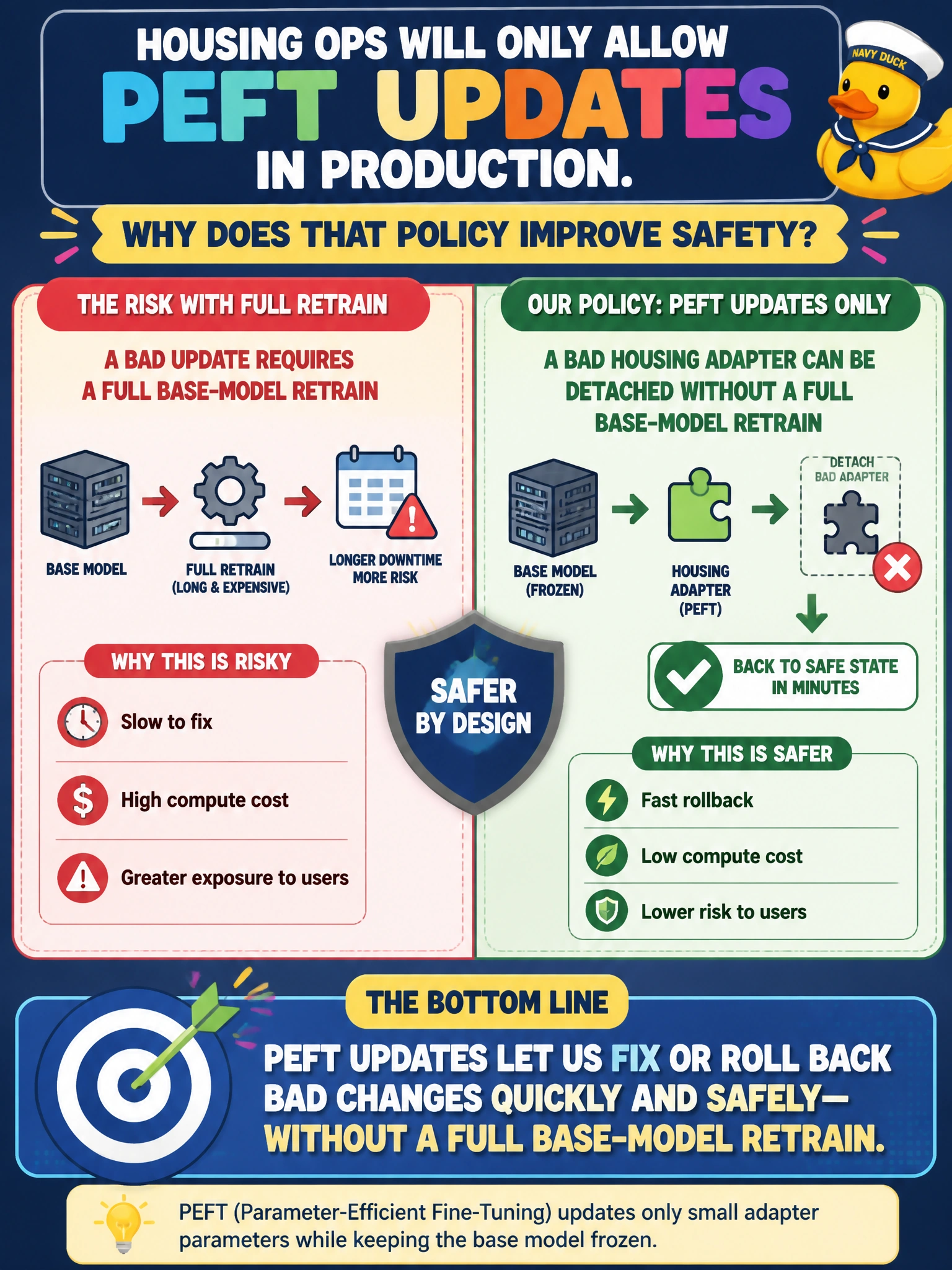
Think of PEFT as a removable badge on the city’s ID lanyard. If a housing adapter goes sideways, unclip it—no need to melt down and recast the whole base model.
Full Explanation
Housing ops that allow only PEFT updates in production improve safety because a bad housing adapter can be detached without a full base-model retrain. Adapters are swappable municipal change units: if a LoRA starts inventing voucher rules or eligibility cutoffs, ops unloads it and returns to the last known-good base (or prior adapter) while the foundation weights stay intact. That rollback asymmetry is the core production-safety argument for PEFT-only policies in resident-facing housing systems.
Claiming PEFT permanently merges into the base so rollback becomes impossible fails by concept: production PEFT is valuable precisely because adapters remain detachable until someone chooses an irreversible merge. Claiming PEFT disables all logging required for civic audits fails because logging is an orthogonal controls concern—adapter serving does not turn off audit trails. Claiming only full-weight updates can be versioned in municipal registries fails because adapter artifacts version cleanly (often more cleanly) as small, named checkpoints in the same model registry.
Exam caveat: “detachable” assumes you did not silently bake the adapter into a merged checkpoint and delete the base pin—keep base and adapter digests recorded. Operational check: deploy housing base+adapter behind a feature flag, induce a controlled bad-adapter scenario in staging, detach the adapter, and verify answers revert to base behavior without reloading a re-finetuned full model.