
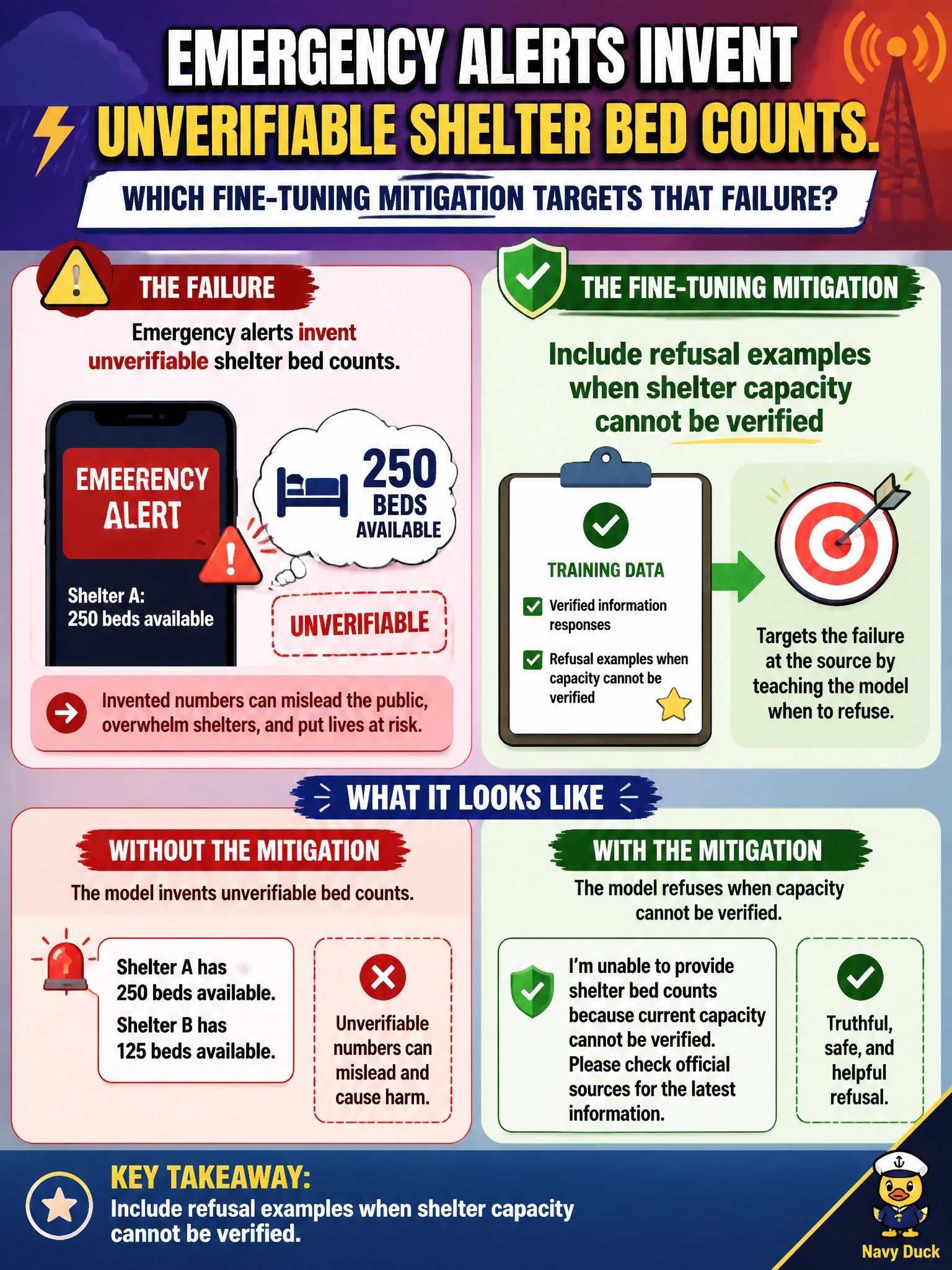
Emergency alerts invent unverifiable shelter bed counts. Which fine-tuning mitigation targets that failure?
Select an answer to reveal the explanation.
Short Explanation
If nobody checked the cot count, the alert bot should refuse—not invent beds. Teach that with refusal examples for unverifiable shelter capacity so emergencies don’t get fiction.
Full Explanation
When emergency alerts invent unverifiable shelter bed counts, the fine-tuning mitigation that targets that failure is to include refusal examples when shelter capacity cannot be verified. Teach the model to say it cannot confirm cot or bed counts without an authoritative feed, rather than guessing a number that residents might treat as operational truth. Refusal-labeled civic examples reshape the loss toward safe abstention on unverifiable capacity claims.
Adding more free-form capacity guesses labeled as gold answers fails by concept: it rewards invention and amplifies the exact hallucination mode. Removing all shelter topics from the safety evaluation set fails because hiding the topic blinds the gate that should catch bed-count fabrications. Fine-tuning only on weather poetry without operational facts fails as irrelevance: poetry does not teach emergency capacity discipline and wastes scarce fine-tune budget.
Exam caveat: pair refusal training with a retrieval or live-capacity tool path for when counts are verifiable—refusal alone is incomplete if a trusted shelter feed exists. Operational check: build an eval mix of verified-capacity and unverifiable-capacity shelter prompts; after fine-tuning, confirm refusals on unverifiable items rise, invented integers fall, and verified items still cite the feed when grounding is available.