
Clerk Q&A invents ordinance numbers. Which fine-tuning change best mitigates that hallucination pattern?
Select an answer to reveal the explanation.
Short Explanation
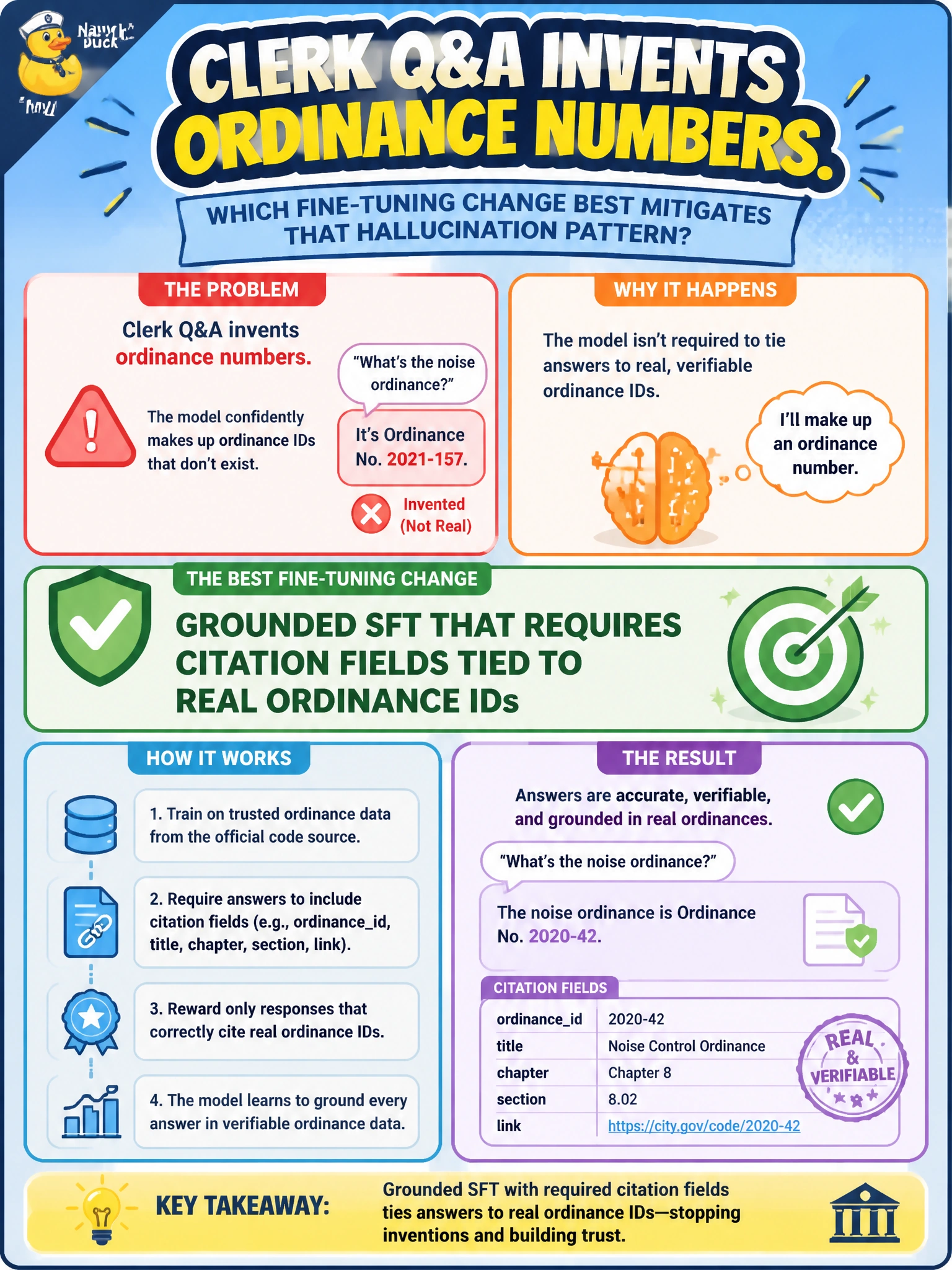
When your clerk Q&A invents ordinance numbers, it’s like citing a law that doesn’t exist at city hall. Grounded SFT with required citation fields tied to real ordinance IDs teaches the bot to cite the actual code instead of making one up.
Full Explanation
When clerk Q&A invents ordinance numbers, grounded supervised fine-tuning that requires citation fields tied to real ordinance IDs best targets the failure. Training examples should require authentic municipal code identifiers alongside answers, penalizing invented numbers and rewarding citations that match real IDs. This addresses the hallucination pattern during training rather than assuming free-form prose will become citation-accurate. Removing all ordinance references from every training example fails because the clerk bot still needs to discuss ordinances; their absence does not teach correct IDs and may leave the model more likely to invent them when asked. Training only on fictional municipal codes fails because creativity is the problem: synthetic codes teach the model that made-up numbers are acceptable. Turning off output constraints and encouraging detailed free-form responses fails because unconstrained, longer answers create more room for plausible-looking fabricated citations, not verification. Exam caveat: grounded SFT depends on a maintained ordinance ID catalog in the training and labeling pipeline; stale IDs can cause outdated citations. Practical check: after fine-tuning, test clerk queries that request ordinance citations, compare each ID exactly with the registry, measure invented-ID rates against the prior model, and promote only if citation precision rises and fabrication falls.