
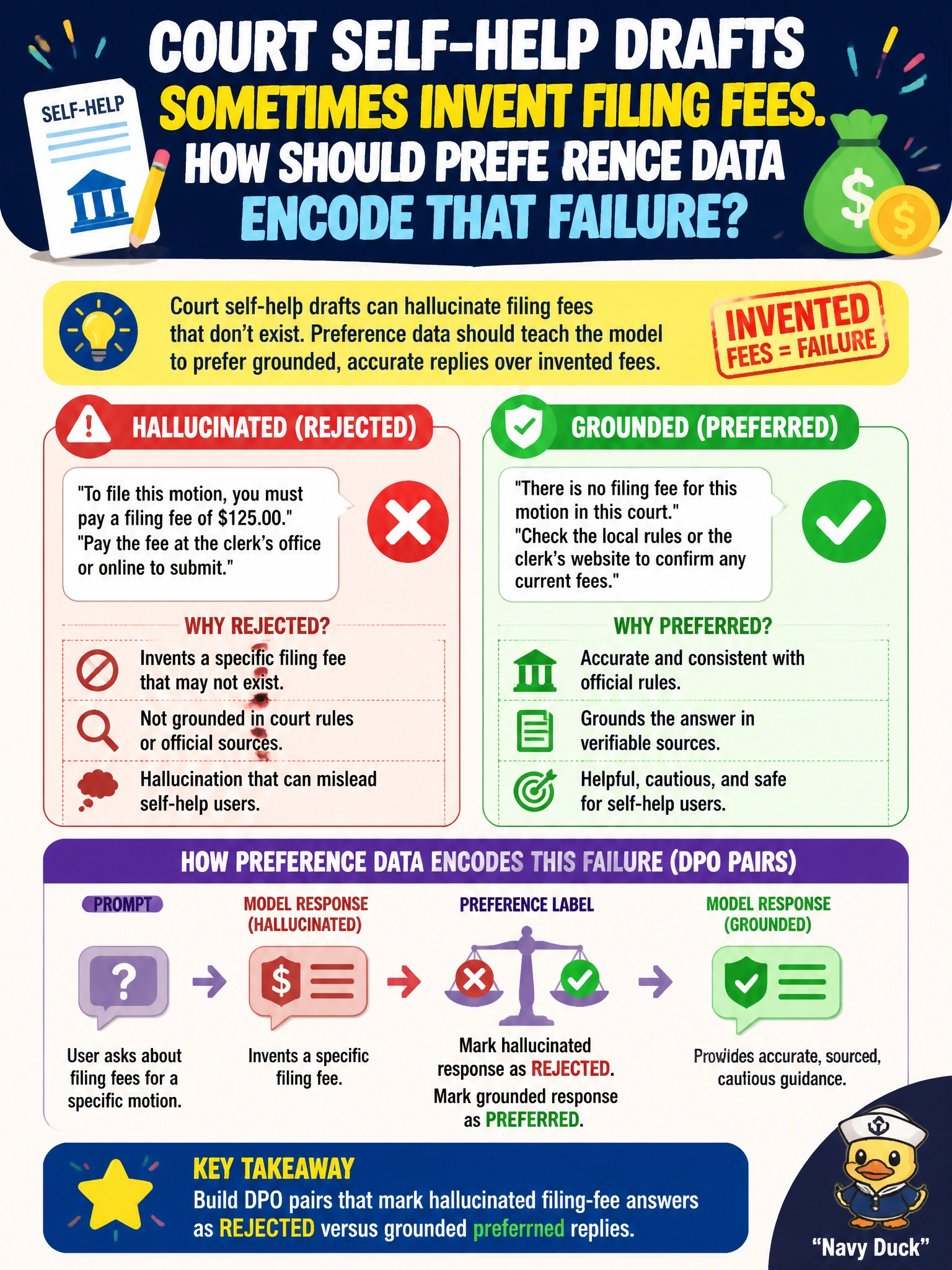
Court self-help drafts sometimes invent filing fees. How should preference data encode that failure?
Select an answer to reveal the explanation.
Short Explanation
Invented filing fees are the kind of confident wrong you never want from a court helper. Put those hallucinations on the rejected side of DPO pairs so the model learns to prefer grounded fee answers.
Full Explanation
Court self-help drafts that invent filing fees create high-confidence hallucinations that can harm residents financially and legally. Preference data should encode that failure explicitly: build DPO pairs that mark hallucinated filing-fee answers as rejected versus grounded preferred replies that cite the fee schedule or refuse to guess. That contrast teaches the municipal assistant to prefer grounded fee language over invented numbers. Marking invented fee answers as preferred so the model repeats confident numbers reinforces the unsafe behavior. Omitting fee-related examples entirely and hoping hallucinations disappear leaves the failure mode untrained and often persistent. Rewarding any numeric token equally whether or not the fee schedule supports it treats fabrication as success. On the exam, DPO (or similar) pairs should punish civic fee hallucinations against grounded alternatives; distractors prefer inventions, omit fee cases, or reward unsupported numbers. Caveat: grounded preferred replies must themselves be current—stale fee schedules in the preference set can teach outdated but “confident” amounts, so version fee sources. Operational check: mine known hallucinated fee drafts as rejected, pair each with a schedule-grounded or safe-refusal preferred reply, train with DPO, and evaluate fee accuracy / refusal rate on a held-out self-help prompt set before public court kiosk use.