
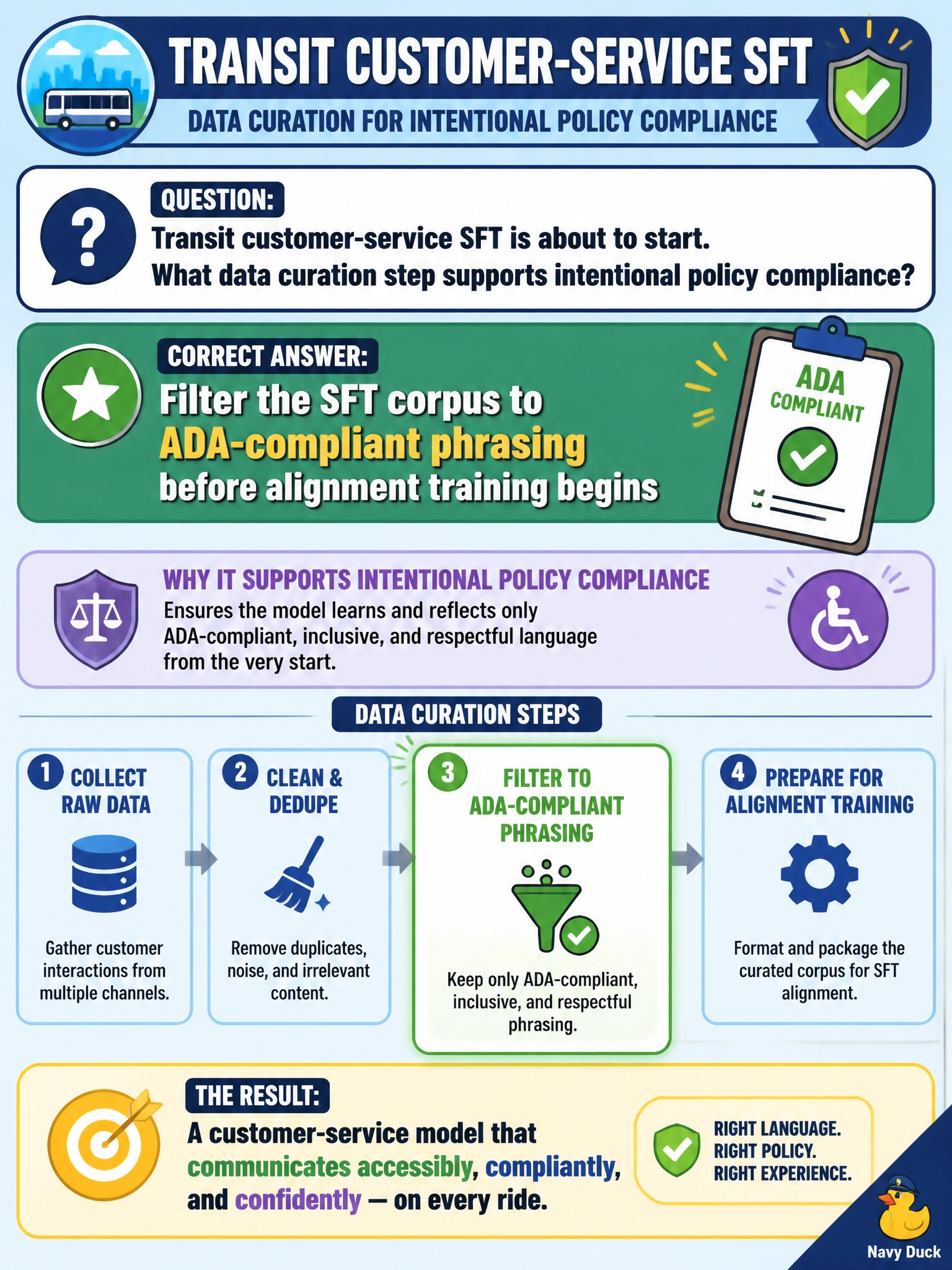
Transit customer-service SFT is about to start. What data curation step supports intentional policy compliance?
Select an answer to reveal the explanation.
Short Explanation
Before you fine-tune transit customer service, weed the teaching set so the gold replies already sound ADA-compliant. Intentional civic policy starts with what you put in the SFT bowl.
Full Explanation
Transit customer-service SFT about to start will imprint whatever phrasing appears in the gold completions, including accessibility language that must meet ADA expectations for resident communications. Filtering the SFT corpus to ADA-compliant phrasing before alignment training begins is the data-curation step that supports intentional policy compliance—teaching the model correct civic language up front rather than hoping later stages erase noncompliant demos. Including known noncompliant refusal scripts as the only positive targets trains the assistant to imitate bad policy. Stripping accessibility language so the model never sees ADA phrasing examples removes the very demonstrations needed for compliant tone. Mixing unverified social-media complaints as gold completions without review injects unvetted, possibly discriminatory or inaccurate text into supervised targets. On the exam, intentional civic policy compliance starts with SFT corpus filtering (here, ADA-compliant phrasing); distractors elevate noncompliant scripts, strip accessibility language, or treat unverified social posts as gold. Caveat: filtering must be documented and revisited when ADA guidance or agency style guides change—frozen corpora drift relative to policy. Operational check: run an ADA/style lint over candidate SFT completions, quarantine failures, retain only compliant gold replies, and sample-audit the final transit corpus before launching supervised fine-tuning.