
Public-health leaders can staff clinician raters for outbreak SMS tone and accept higher ops cost. When is RLHF the better choice?
Select an answer to reveal the explanation.
Short Explanation
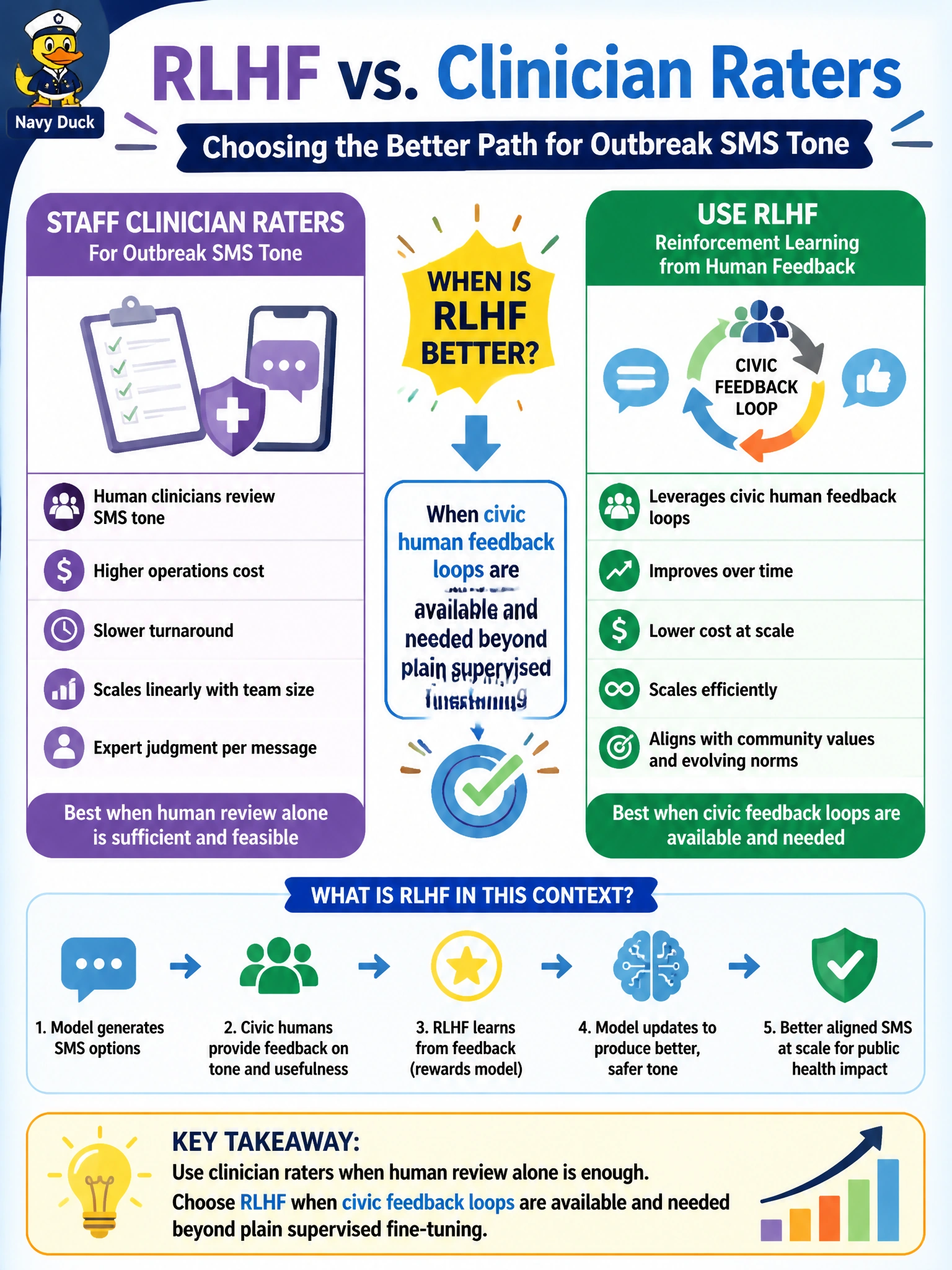
When you can staff clinicians to score outbreak SMS tone and fund the feedback loop, RLHF can do more than plain supervised fine-tuning. Use it when you need human judgment and have the raters to provide it.
Full Explanation
Public-health leaders can staff clinician raters for outbreak SMS tone and accept higher operational cost, so a human feedback loop is available beyond what plain supervised fine-tuning with static gold texts can provide. RLHF is the right fit when civic human feedback is available and needed: clinicians can judge the tone, empathy, and safety of outbreak messages, and those judgments can train a reward model to guide policy optimization. Relying only on synthetic random rewards, with no human raters, removes the clinical judgment RLHF is meant to add. If the sole goal is unsupervised continued pretraining on raw lab CSV files, that addresses representation learning rather than SMS tone alignment. Prohibiting human review throughout development and deployment contradicts RLHF’s premise and makes feedback-based tuning impractical. The exam distinction is to choose RLHF when municipal human feedback is required beyond plain supervised fine-tuning, not when the goal is synthetic-only rewards, CSV pretraining, or no human review. Caveat: operational cost and rater variance are real, so confirm that clinician time is genuinely available. Practical check: verify staffing and a written SMS tone rubric, collect preference or reward labels on outbreak drafts, and spot-check clinician win rates before sending resident messages.