
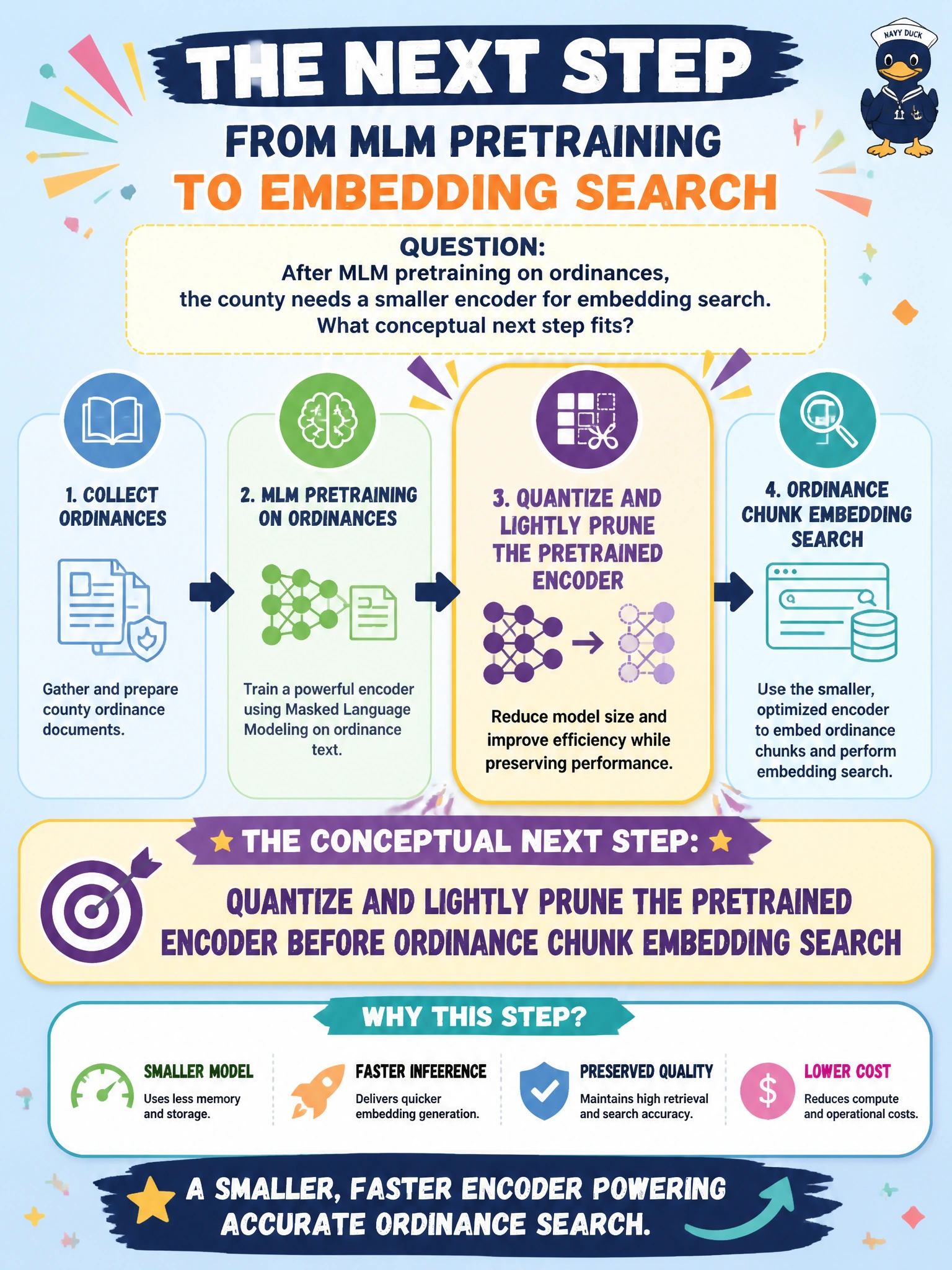
After MLM pretraining on ordinances, the county needs a smaller encoder for embedding search. What conceptual next step fits?
Select an answer to reveal the explanation.
Short Explanation
You taught the encoder the ordinance dialect with MLM—now slim it for search. A light quantize-and-prune pass makes those civic embeddings cheaper to run without throwing the pretraining away.
Full Explanation
After masked language modeling on ordinances, the county already owns civic-aware encoder weights; embedding search then needs a smaller, cheaper encoder for chunk retrieval over the code library. Quantizing and lightly pruning that pretrained encoder before ordinance chunk embedding search preserves most of the MLM knowledge while cutting memory and latency for municipal retrieval—conceptually the right next optimization step. Expanding the encoder to the largest available size before any retrieval deployment moves opposite the size goal and inflates serving cost. Deleting the MLM checkpoint and training retrieval embeddings from an empty vocabulary discards the ordinance language the city just paid to learn. Converting the encoder into a video diffusion model for ordinance illustration abandons retrieval entirely for an unrelated generative modality. On the exam, connect encoder MLM pretraining to later quantize-and-prune for civic embedding search; distractors enlarge models, delete checkpoints, or pivot to video diffusion. Caveat: aggressive prune/quant can hurt fine-grained section discrimination—re-evaluate recall@k on paraphrased resident queries after compression, not only on training loss. Operational check: take the MLM ordinance encoder, apply light INT8 (or similar) quantization plus modest unstructured/structured prune, rebuild the chunk index, and compare retrieval quality and QPS against the full-precision encoder on a civic FAQ query set.