
Public-health staff distill models for clinic FAQ chat versus for embedding search. What distinction should they keep clear?
Select an answer to reveal the explanation.
Short Explanation
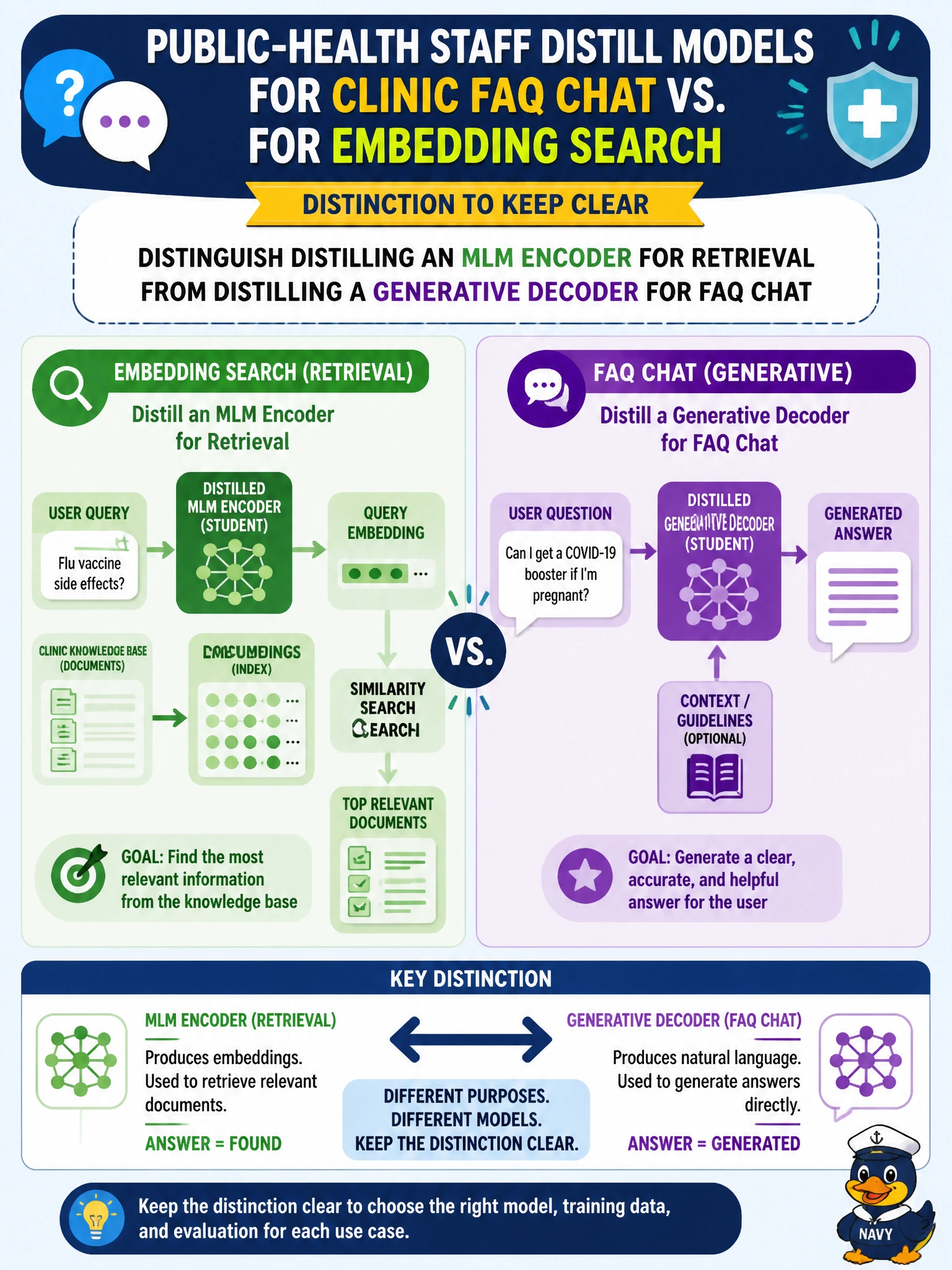
Clinic FAQ chat and ordinance-style embedding search aren’t the same student. Distilling an MLM encoder for retrieval is a different game from distilling a generative decoder for chat—keep those paths straight.
Full Explanation
Public-health teams distill for two different products: clinic FAQ chat needs a generative decoder student that writes answers, while embedding search needs a compressed MLM encoder student that ranks passages. Distinguishing distilling an MLM encoder for retrieval from distilling a generative decoder for FAQ chat keeps losses, teachers, and evaluation metrics aligned with each civic use case instead of forcing one pipeline onto both. Treating encoder MLM distillation and decoder generation distillation as identical pipelines with one loss mixes next-token chat objectives with embedding similarity needs and usually harms both. Assuming only decoder distillation exists and that encoders cannot be compressed at all incorrectly denies a whole optimization path for retrieval. Replacing both distillation paths with identical random projection matrices abandons teacher knowledge and produces untrained civic embeddings or text. On the exam, keep encoder-versus-decoder distillation conceptually separate in municipal stacks; distractors collapse pipelines, deny encoder compression, or swap in random projections. Caveat: some shared tokenizers or projection heads can be reused across paths, but the student architecture and distillation objective still differ—do not treat reuse of plumbing as identical training. Operational check: for FAQ chat, evaluate student answer quality and latency against the decoder teacher; for retrieval, evaluate encoder student recall@k and embedding size—never a single blended loss dashboard for both.