
Clerk staff want an encoder backbone that links agenda items to matching minutes paragraphs. Which objective helps?
Select an answer to reveal the explanation.
Short Explanation
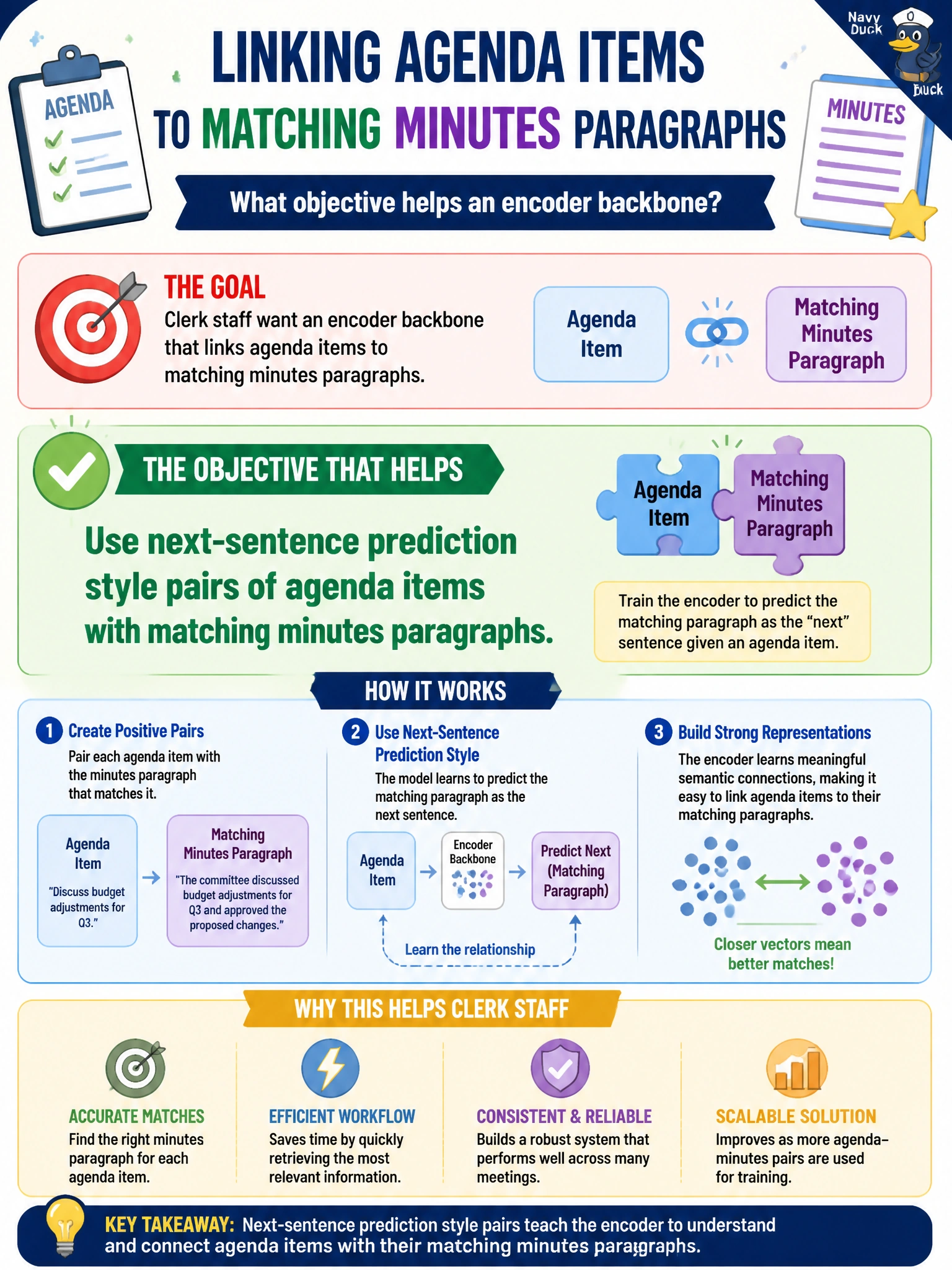
You can help the encoder connect civic documents by pairing agenda items with their matching minutes paragraphs in a next-sentence-style objective. Give it real, matched pairs so it learns the relationship staff need.
Full Explanation
Clerk workflows need an encoder backbone that recognizes when an agenda item and a minutes paragraph discuss the same motion, speaker, or ordinance reference across related civic documents. Training on next-sentence prediction style pairs of agenda items with matching minutes paragraphs teaches cross-document adjacency and topical continuity, producing embeddings or pairwise scores useful for linking and retrieval. That pairing signal directly serves the requested task. Reconstructing randomly masked pixels in scanned agendas while ignoring sentence links optimizes visual information rather than agenda–minutes relationships. Token-level spelling correction alone may improve orthography, but ignoring agenda–minutes pairing does not teach the document relationships needed for matching. Shuffling minutes across unrelated meetings makes pair labels noisy and destroys the useful supervision the backbone needs. Exam caveat: strict next-sentence formulations assume ordered adjacency; agenda-to-minutes matching may need explicit positive and negative pair mining beyond consecutive sentences, while the relational objective remains appropriate. Practical check: build labeled agenda–minutes pairs from clerk archives, train with a next-sentence-style or sentence-pair objective, and measure link accuracy or retrieval recall on held-out meetings before deployment.