
Council-meeting transcript assistants must cover multi-hour sessions without paying full-context attention cost. Which method fits?
Select an answer to reveal the explanation.
Short Explanation
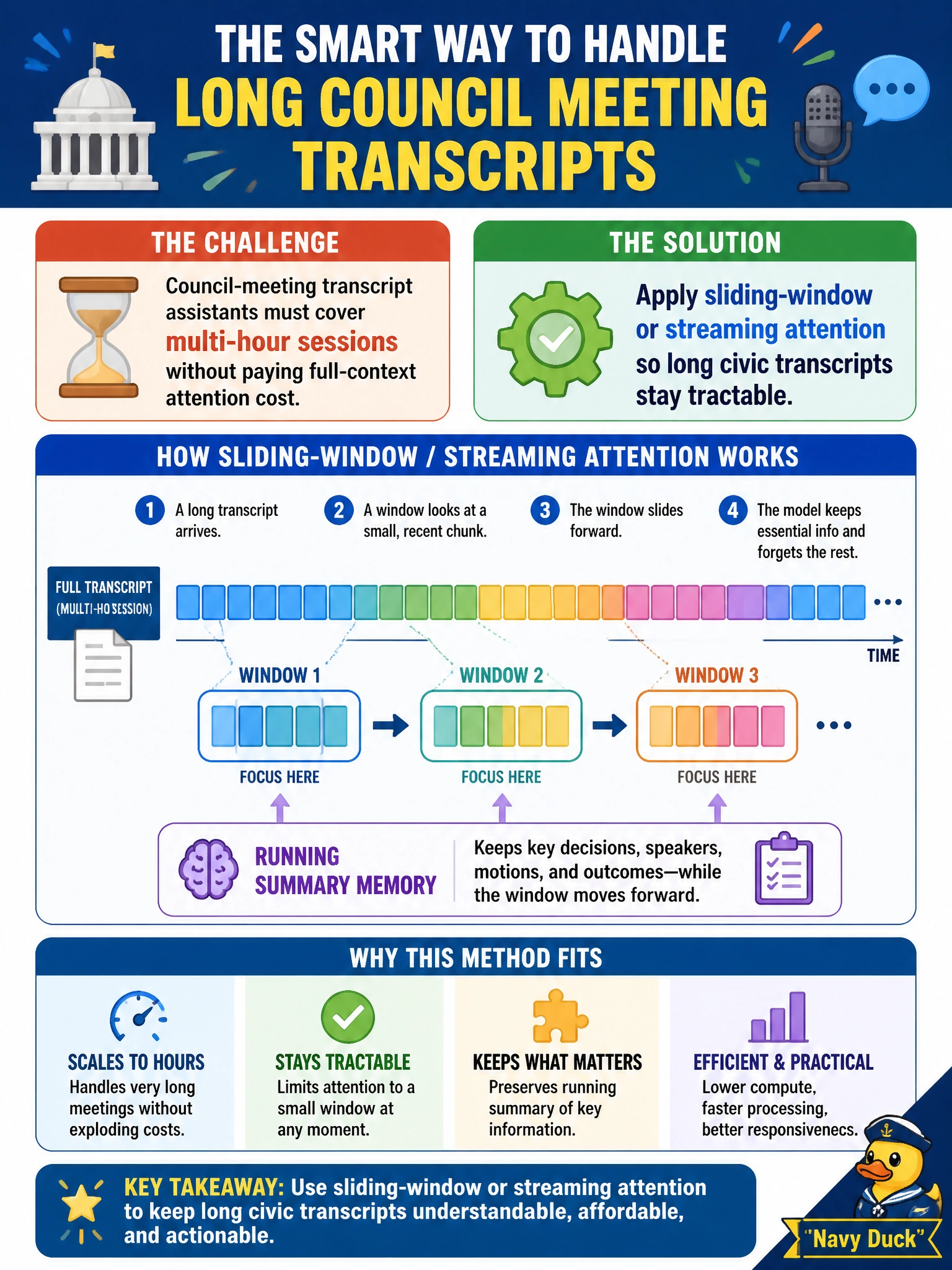
A three-hour council recording shouldn’t force you to make the model attend to every word equally at once. Sliding-window or streaming attention keeps long civic transcripts workable without the full-context cost.
Full Explanation
Multi-hour council transcripts make naive full-context attention scale poorly with length and can overwhelm municipal inference budgets. Sliding-window or streaming attention fits because it limits each token’s attention span or processes the stream incrementally, keeping long civic transcripts tractable while supporting useful summarization and Q&A without dense full-context cost on every query. This reflects the operational reality of evening meetings that run for hours. Dense full attention over the entire transcript for every query is conceptually complete, but computationally and financially prohibitive for routine city workloads. Bag-of-words classification without attention discards sequence modeling needed to interpret motions, amendments, and speaker turns. Storing transcripts as uncompressed video frames inside the language model confuses media storage with language modeling and does not reduce attention cost. Exam caveat: narrow windows can miss an early-agenda reference that returns during late public comment, so retrieval over earlier segments or hierarchical summaries may be needed. Practical check: time and price a multi-hour transcript job using sliding-window or streaming attention and full attention, assess motion and vote extraction on a labeled excerpt, then choose a window or streaming policy that meets accuracy and budget.