
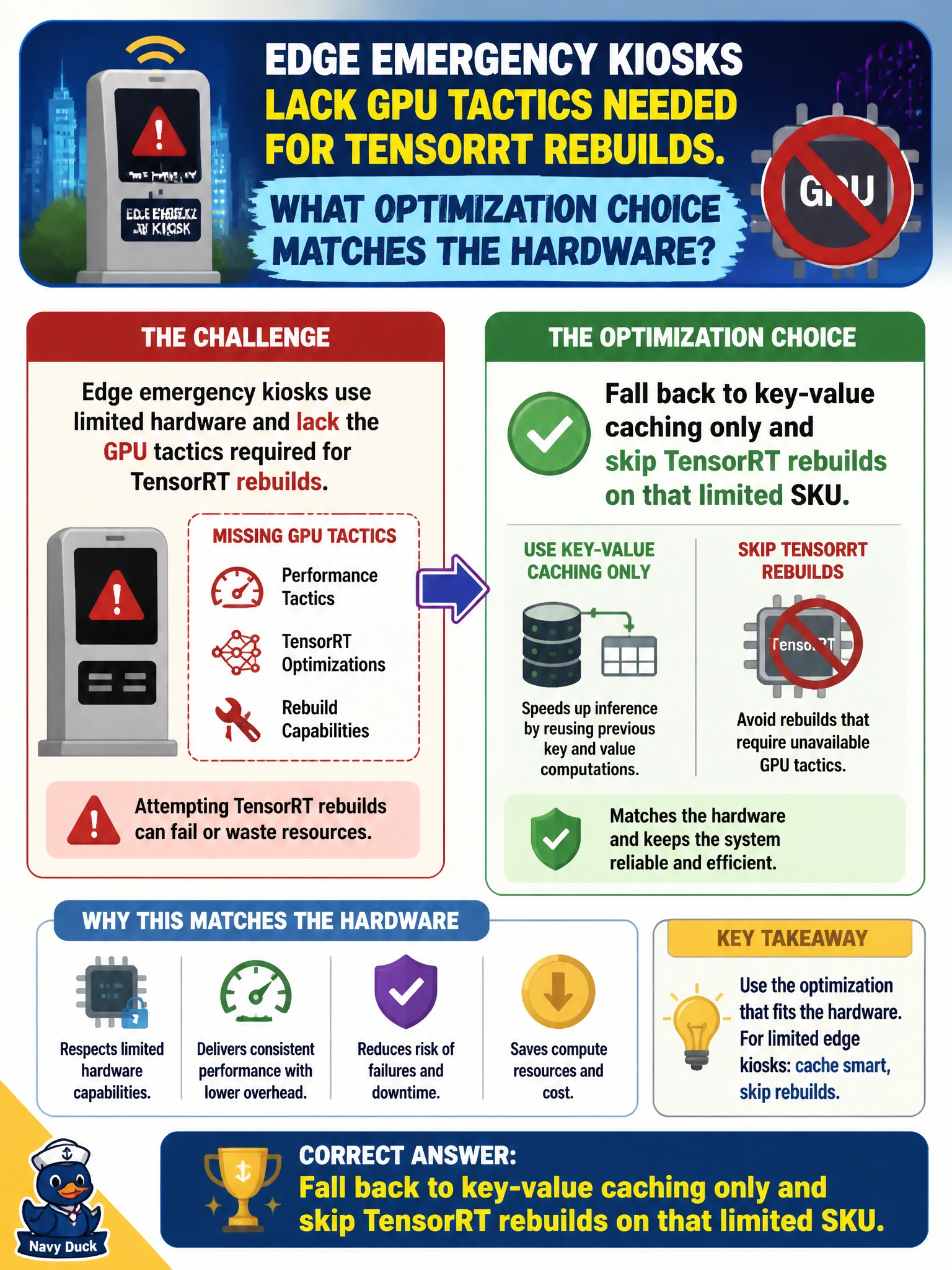
Edge emergency kiosks lack GPU tactics needed for TensorRT rebuilds. What optimization choice matches the hardware?
Select an answer to reveal the explanation.
Short Explanation
If the emergency kiosk GPU can’t host the TensorRT tricks you wanted, don’t force a broken rebuild—lean on KV-cache and move on. Match the optimization to the hardware you actually have.
Full Explanation
Edge emergency kiosks often ship with constrained GPUs that lack the TensorRT tactics required for successful engine rebuilds, even when datacenter A100 paths work. Falling back to key-value caching only and skipping TensorRT rebuilds on that limited SKU matches optimization method to available municipal hardware: keep the latency win that caching can deliver without forcing unsupported engine builds that fail nightly. That hardware-aware choice keeps kiosks serving residents instead of crashing on tactic errors. Forcing a TensorRT rebuild nightly even when the SKU cannot support the required tactics creates recurring pipeline failures and false confidence that an engine exists when it does not. Disabling all caching and recomputing from random weights each resident query both removes a viable optimization and invents nonsensical weight resampling. Replacing the kiosk GPU with a paper flowchart until new hardware arrives abandons automated assistance residents expect at the edge. On the exam, when hardware cannot host TensorRT tactics, prefer KV-cache fallback over forced rebuilds; distractors force unsupported engines, disable caching with absurd weight noise, or revert to paper. Caveat: KV-cache alone will not match TensorRT throughput on capable GPUs—document the SKU exception so fleet upgrades can re-enable engines later without rewriting the whole stack. Operational check: detect tactic support on the kiosk SKU, skip TensorRT build when unsupported, enable KV-cache, and verify emergency FAQ first-token latency and answer continuity on-device before public hours.