
A public-health summarizer feels flat after distillation. What evaluation step helps recover diversity without factual drift?
Select an answer to reveal the explanation.
Short Explanation
Distillation can make clinic summaries sound like oatmeal, so you may want to bring some variety back. A careful post-distillation temperature sweep helps you do that while checking that facts stay on track.
Full Explanation
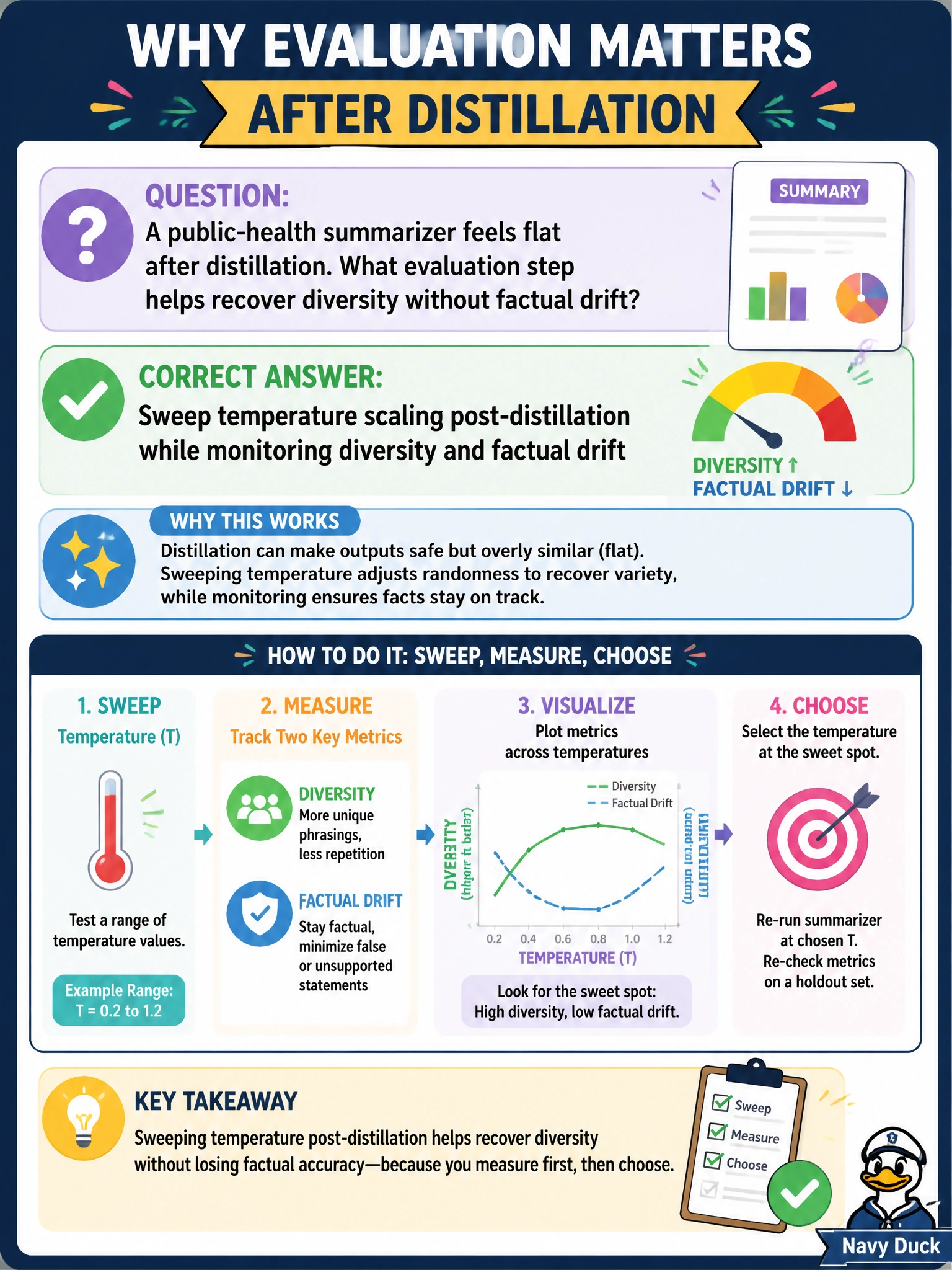
Distillation can compress a public-health summarizer into a flatter student that repeats safe clinic phrasing but loses lexical diversity residents need for understandable outbreak guidance. Sweeping temperature scaling after distillation while monitoring diversity metrics and factual drift lets you recover variety without inventing clinic hours, vaccine ages, or symptom advice. This evaluation treats temperature as a controllable civic UX lever bounded by truthfulness checks, not an unbounded creativity dial. Replacing the student with the full-size teacher abandons the latency and cost goals that motivated distillation for clinic FAQ capacity, and scale alone does not guarantee restored diversity or factuality. Freezing temperature at its maximum for every clinic summary maximizes entropy and risks factual drift in high-stakes public-health text. Ignoring factual checks and maximizing unique token counts optimizes novelty alone, which can surface unsupported medical claims. On the exam, pair post-distillation temperature sweeps with monitoring of both diversity and factual fidelity. Caveat: temperature cannot repair knowledge the student never inherited; if grounding fails at every temperature, revisit teacher data or retrieval rather than turning the dial higher. Practical check: for a fixed clinic FAQ prompt set, sweep temperature, plot distinct-n or self-BLEU against a factual checklist covering hours, eligibility, and referral numbers, then choose the lowest temperature that restores acceptable diversity without crossing the city’s drift threshold.