
Transit chatbot latency improved after several optimizations. How should the team isolate each contribution?
Select an answer to reveal the explanation.
Short Explanation
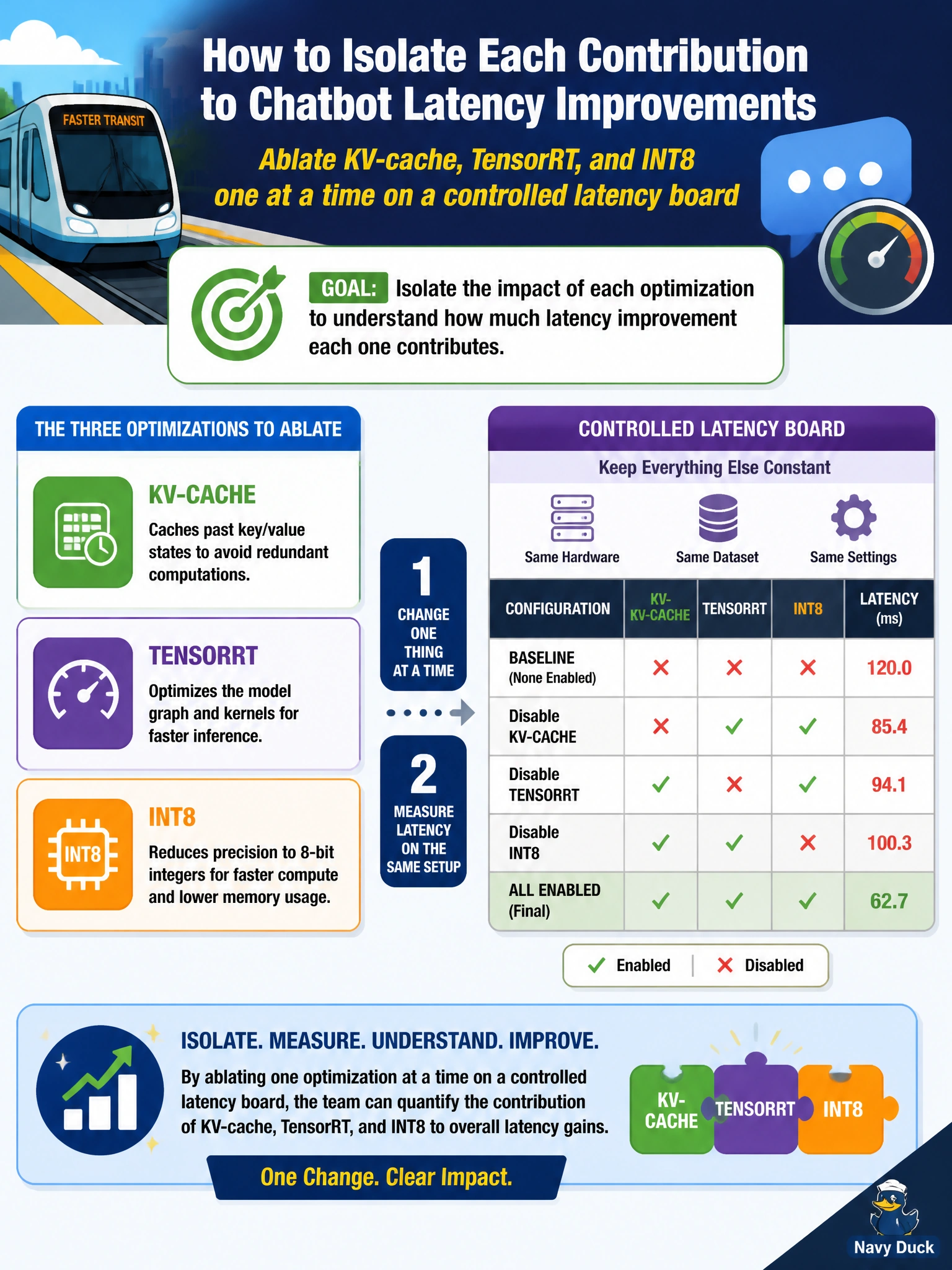
When a transit chatbot suddenly feels snappier, don’t guess which knob did it—pull KV-cache, TensorRT, and INT8 off the stack one at a time on a latency board. Ablations turn a mystery speedup into attributed wins.
Full Explanation
When a transit chatbot’s latency improves after stacking several optimizations, municipal engineering still owes a causal story: which layer paid for the win matters for budget, rollback, and future fleet SKUs. Ablating KV-cache, TensorRT, and INT8 one at a time on a controlled latency board isolates each contribution under peak-ridership-like load, producing attributed milliseconds instead of a mysterious blended speedup. That disciplined removal order turns stack folklore into measurable civic capacity planning. Toggling every optimization off and on randomly in the same minute of peak ridership confounds treatments with traffic spikes and yields non-reproducible noise rather than clean factor effects. Publishing one blended latency number without naming which stack change helped satisfies a dashboard vanity metric but leaves operations unable to prioritize maintenance or reverse a bad INT8 tradeoff. Assuming TensorRT alone caused the gain and skipping measurement of the other layers is narrative bias; KV-cache or quantization may dominate first-token or decode latency depending on route-FAQ length. On the exam, prefer single-factor ablations on a controlled board after multi-optimization wins; distractors randomize toggles, hide attribution, or crown one layer without evidence. Caveat: interactions exist—INT8 accuracy or TensorRT tactics can change how much KV-cache helps—so report main effects first, then a planned interaction pass if two layers move together. Operational check: freeze a ridership replay trace, disable KV-cache, TensorRT, and INT8 individually while holding the others constant, and record p50/p95 first-token and tokens-per-second deltas for the transit chatbot release notes.