
Housing eligibility answers got worse after pruning while staff also lowered temperature. How can they prove what caused the drop?
Select an answer to reveal the explanation.
Short Explanation
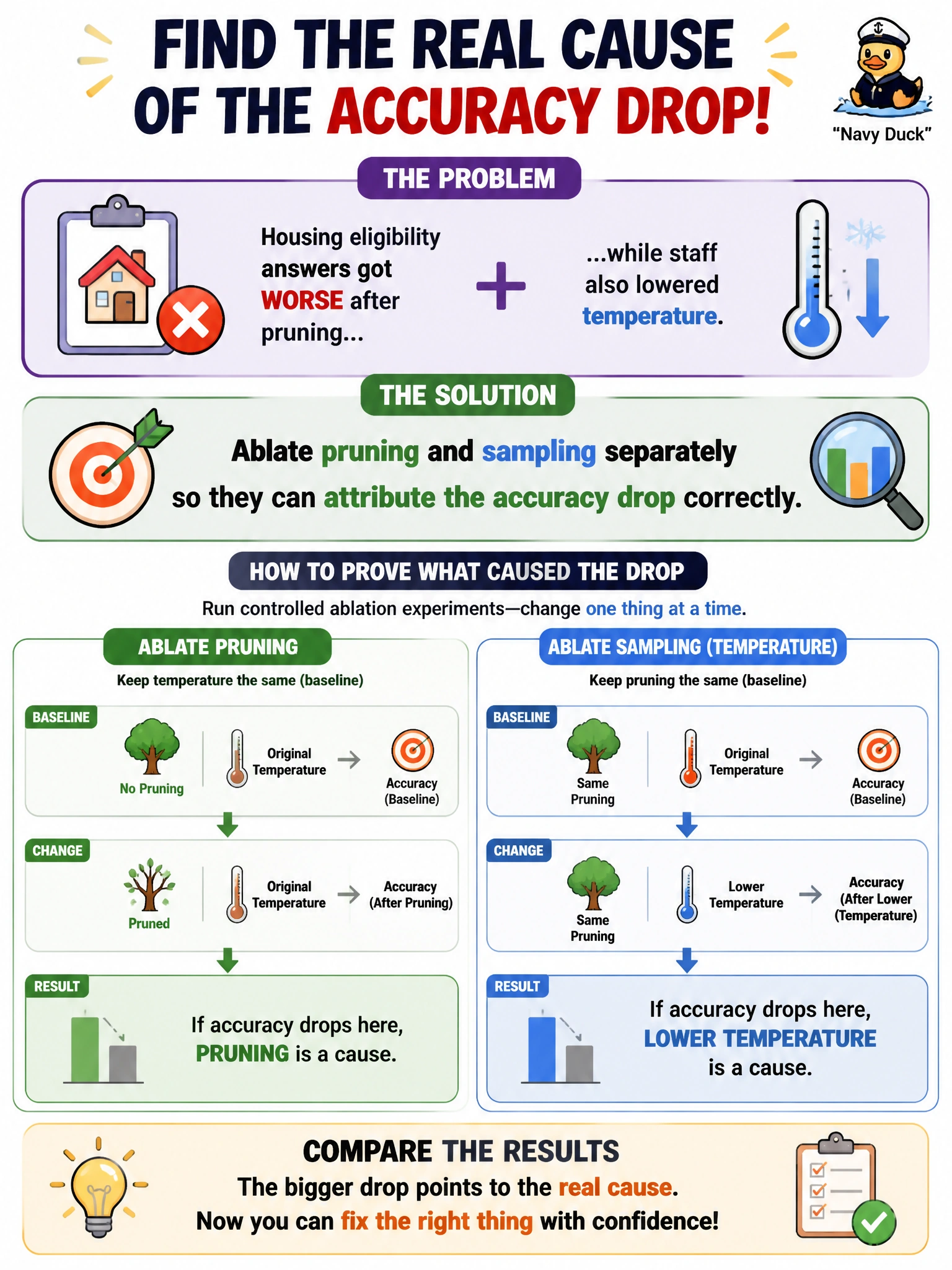
Two knobs moved—pruning and cooler sampling—so don’t guess which one dinged housing answers. Ablate them separately and you’ll know whether the accuracy drop came from the cut weights or the colder decode.
Full Explanation
Housing eligibility answers degraded after pruning coincided with staff also lowering sampling temperature, so two optimization axes moved before anyone measured either in isolation. Ablating pruning and sampling separately—restore dense weights with the new temperature, then restore the old temperature on the pruned model—attributes the accuracy drop to the correct cause and prevents leadership from funding the wrong fix. That factorial discipline is how municipal ML teams protect eligibility fairness when compression and decoding experiments overlap. Blaming sampling by default because temperature is easier to explain to leadership substitutes narrative convenience for evidence and may leave a harmful prune in production. Increasing pruning further until accuracy recovers without testing sampling compounds the unknown and often worsens eligibility mistakes. Merging pruning and temperature into one unlabeled A/B flag collapses two mechanisms into a single opaque treatment, so analysts cannot say what to roll back. On the exam, insist on separate ablations when multiple civic optimizations change before a quality drop; distractors assign blame by convenience, prune harder blindly, or fuse flags. Caveat: interaction effects can still appear—aggressive pruning can make low-temperature greedier decoding more brittle—so after main-effect ablations, test the joint setting that operations actually ship. Operational check: on a sealed housing-eligibility rubric, score four cells (pruned/dense × low/original temperature), publish the attribution table, and only then decide whether to un-prune, warm the sampler, or both.