
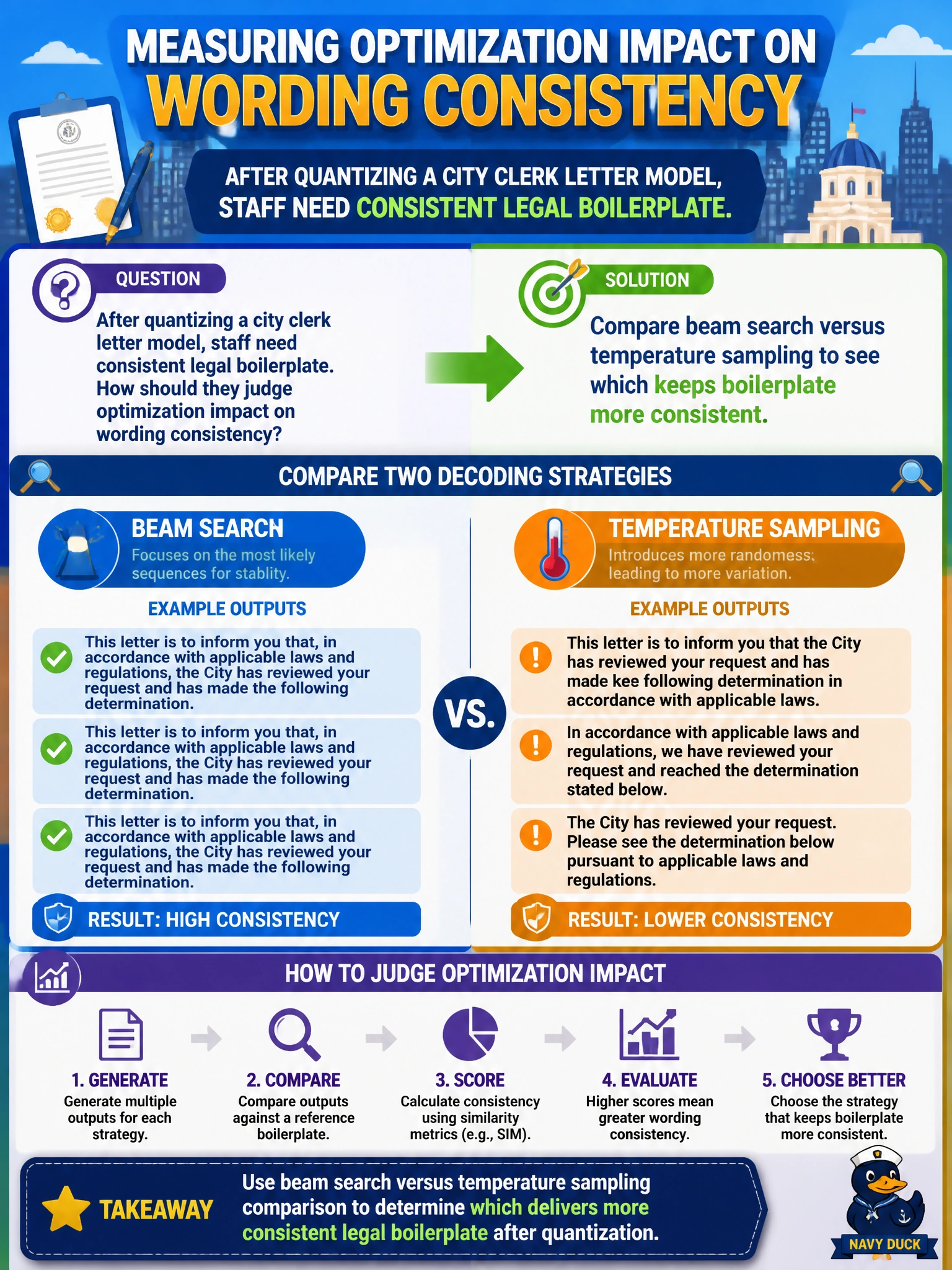
After quantizing a city clerk letter model, staff need consistent legal boilerplate. How should they judge optimization impact on wording consistency?
Select an answer to reveal the explanation.
Short Explanation
You can judge the quantization impact by comparing beam search with temperature sampling on the same legal boilerplate and seeing which keeps the wording steadier. Raising temperature alone, removing decoding controls, or switching to a random n-gram generator won’t provide that comparison.
Full Explanation
After INT8 or similar quantization, a city clerk letter model may become less consistent when generating fixed legal boilerplate, such as disclaimer blocks, appeal rights language, and statutory citations. Comparing beam search with temperature sampling on the same civic templates shows which decoding strategy keeps the wording steadier under the quantized weights, helping staff assess optimization impact and decide whether to retain the quantized checkpoint, adjust decoding, or both. Raising temperature only and never comparing decoding strategies changes one setting without a baseline, so you cannot separate quantization effects from sampling effects. Disabling all decoding controls and accepting the first token emitted abandons the levers that can stabilize legal phrasing and may produce inconsistent letter bodies. Replacing the quantized model with a random n-gram generator stops testing the municipal model and measures unrelated output rather than optimization impact. Exam caveat: beam search can consistently select an incorrect statutory clause if the quantized model’s logits favor it, so wording-consistency metrics do not replace citation-grounding checks. Practical check: run identical clerk-letter prompts through beam search and temperature sampling on the quantized checkpoint, score boilerplate token-level agreement and citation match rate, and document which strategy restores acceptable wording.