
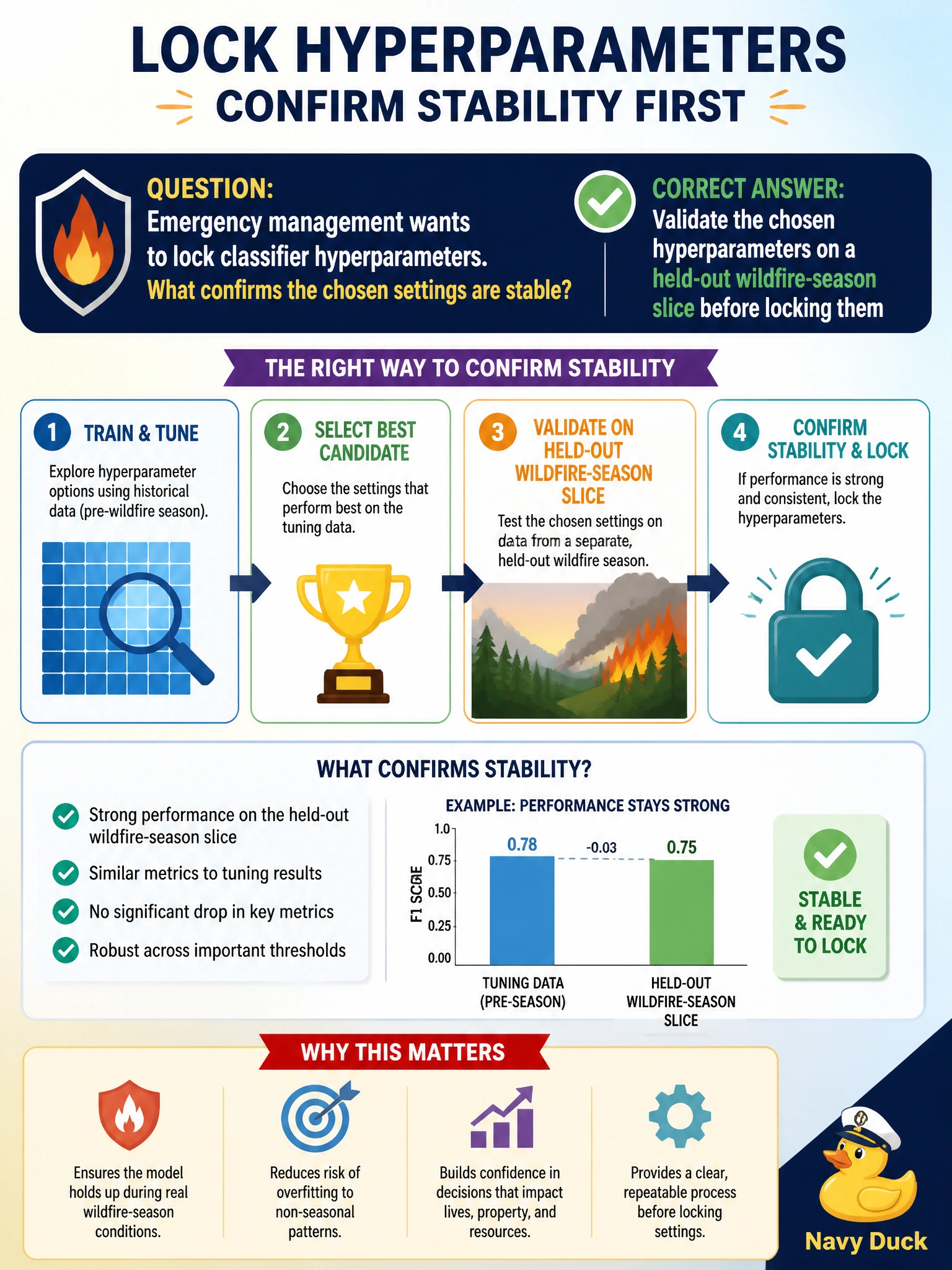
Emergency management wants to lock classifier hyperparameters. What confirms the chosen settings are stable?
Select an answer to reveal the explanation.
Short Explanation
Picking hyperparameters is like choosing bunker settings—you don’t lock them until a wildfire-season holdout proves they hold up. Confirm stability on that civic time slice before you freeze the knobs.
Full Explanation
Emergency-management classifiers that route 911 transcripts, wildfire notes, and seasonal incident labels live under shifting civic distributions: smoke seasons, holiday weekends, and storm surge periods do not look like ordinary training weeks. Locking hyperparameters only after validating the chosen settings on a held-out wildfire-season slice confirms that learning-rate, regularization, and class-weight choices remain stable when the municipal risk profile changes—not merely when training loss dips. That time-based holdout is the operational proof that bunker-style settings will still triage correctly when the next fire season arrives. Locking on the first training-loss dip without any holdout check confuses optimization progress with generalization; a sharp loss drop can reflect memorization of summer training notes rather than robust seasonal behavior. Retuning every hyperparameter live from each incoming 911 call transcript treats production traffic as an online search space, injecting non-reproducible policy churn into emergency routing and making audit trails impossible. Discarding time-based holdouts and reusing the training wildfire notes as the only check evaluates the model on data it has already seen, so apparent stability is circular. On the exam, prefer civic time-slice validation before freezing knobs; distractors usually skip holdouts, tune from live calls, or recycle training notes. Caveat: a single wildfire season may still miss rare multi-hazard co-occurrence, so agencies often rotate additional seasonal slices in later reviews without undoing the first lock gate. Operational check: score the candidate hyperparameter set on a sealed wildfire-season holdout dashboard (precision/recall by incident type and calibration) and only then write the settings into the emergency classifier config registry.