
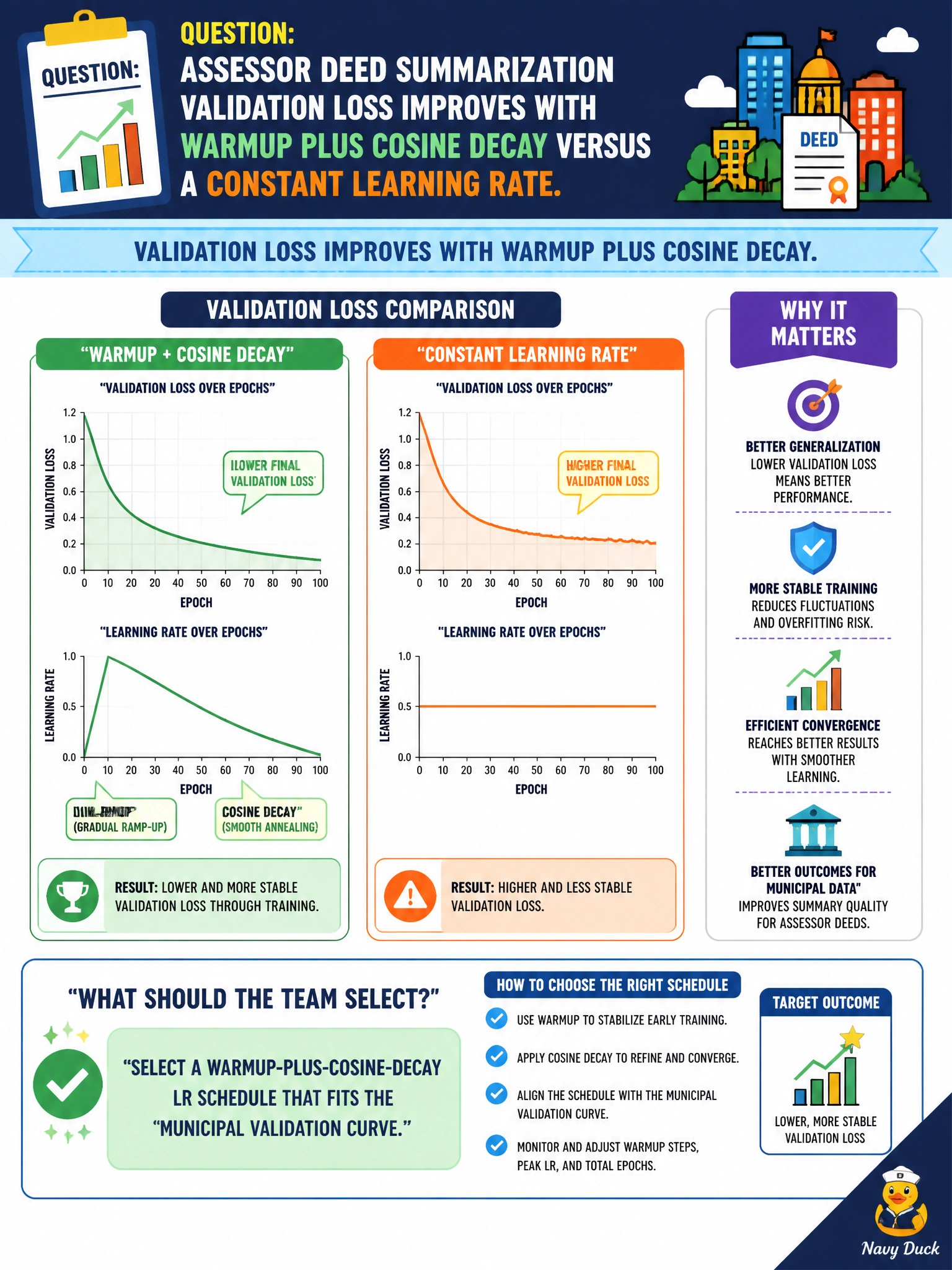
Assessor deed summarization validation loss improves with warmup plus cosine decay versus a constant learning rate. What should the team select?
Select an answer to reveal the explanation.
Short Explanation
Deed summaries liked a gentle warmup then a cosine coast—not a flat constant pedal. Pick the schedule that actually wins on the assessor validation curve.
Full Explanation
Assessor deed summarization validation curves that improve under warmup plus cosine decay versus a constant learning rate indicate the schedule—not just the nominal LR—matters for municipal fine-tunes. Selecting a warmup-plus-cosine-decay LR schedule that fits the municipal validation curve adopts the empirically stronger optimizer schedule for deed summaries and reduces early-training shock on long parcel text. Keeping a constant LR because schedules never matter for civic fine-tunes contradicts the measured validation improvement in the stem and ignores optimizer dynamics. Using an exploding LR with no warmup to finish epochs faster risks divergence and unstable early updates on deed text, which can corrupt parcel identifiers in summaries. Disabling the optimizer and updating weights with random signs abandons gradient-based learning entirely and cannot produce usable assessor outputs. Exam caveat: warmup length and cosine period should scale with dataset size and epoch count; copying a schedule from a much larger web run can under-warm a smaller assessor corpus or decay too fast. Operational check: plot validation loss for constant versus warmup+cosine on the same deed split, confirm the cosine schedule wins without late-spike divergence, and freeze that schedule in the assessor training config before production fine-tunes.