
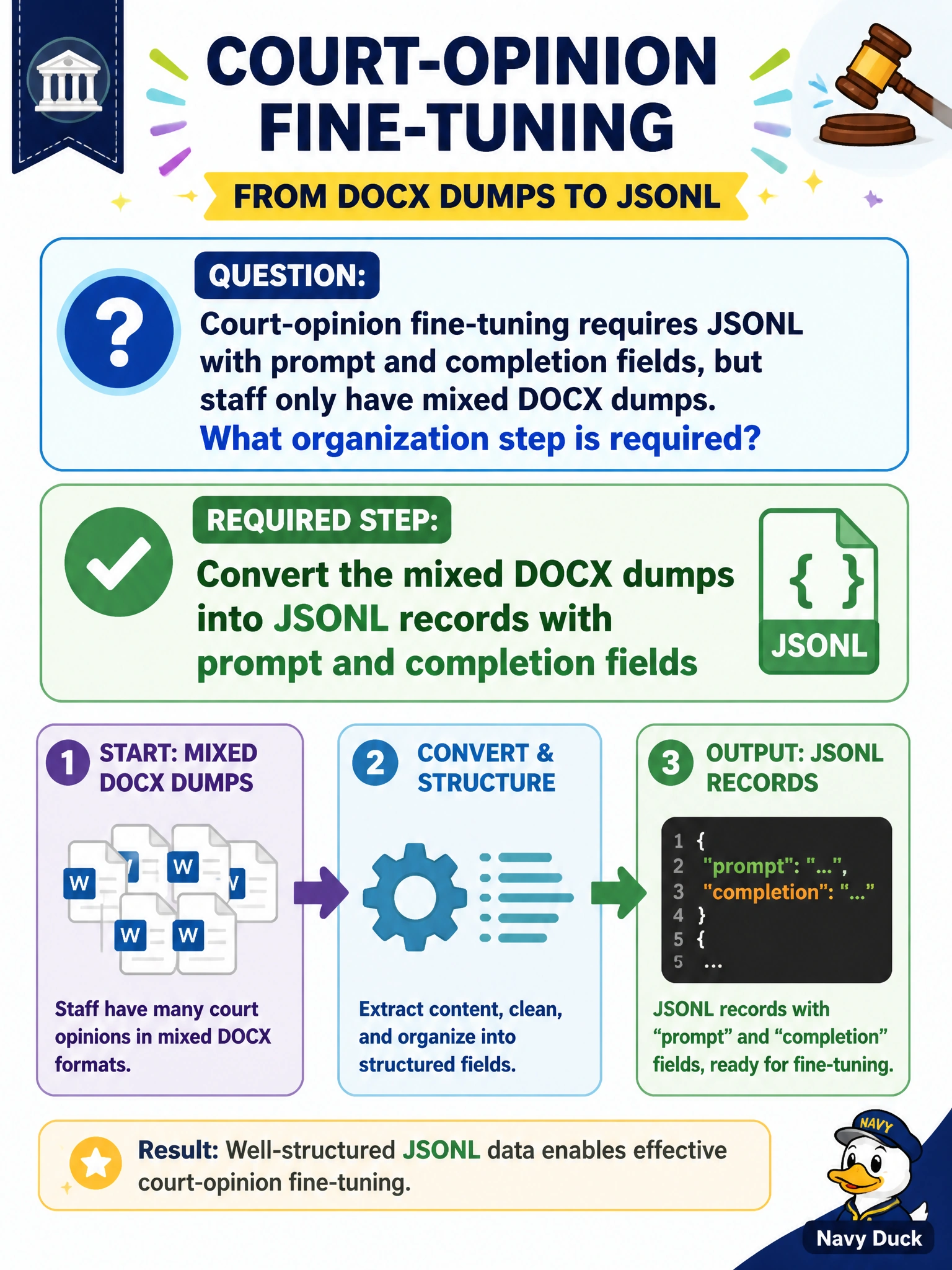
Court-opinion fine-tuning requires JSONL with prompt and completion fields, but staff only have mixed DOCX dumps. What organization step is required?
Select an answer to reveal the explanation.
Short Explanation
The trainer wants neat prompt/completion lines, not a pile of Word files. Convert those mixed DOCX dumps into JSONL so the court opinions are actually model-ready.
Full Explanation
Court-opinion fine-tuning that requires JSONL with prompt and completion fields needs staff to convert mixed DOCX dumps into those JSONL records before training. Model trainers and NeMo-style pipelines expect structured text examples, not Office binaries. Organization into prompt/completion JSONL is the required format-preparation step that turns unstructured document piles into supervised fine-tuning data. Uploading DOCX binaries unchanged and hoping the trainer parses Office XML leaves formatting, macros, and XML noise in the path and usually fails standard LLM data loaders. Storing opinions only as screenshots in a slide deck replaces text with images and blocks ordinary text fine-tuning. Zipping DOCX files without extracting text and labeling the zip as train.jsonl falsifies the format: a zip of binaries is not newline-delimited prompt/completion JSON. Exam caveat: conversion must preserve opinion text integrity and redact sealed content; JSONL structure alone does not make confidential material lawful to train on. Operational check: extract text from DOCX, build JSONL lines with explicit prompt and completion keys, validate with a JSONL schema checker, and run a one-batch dry load in the fine-tuning pipeline before full court-opinion training.