
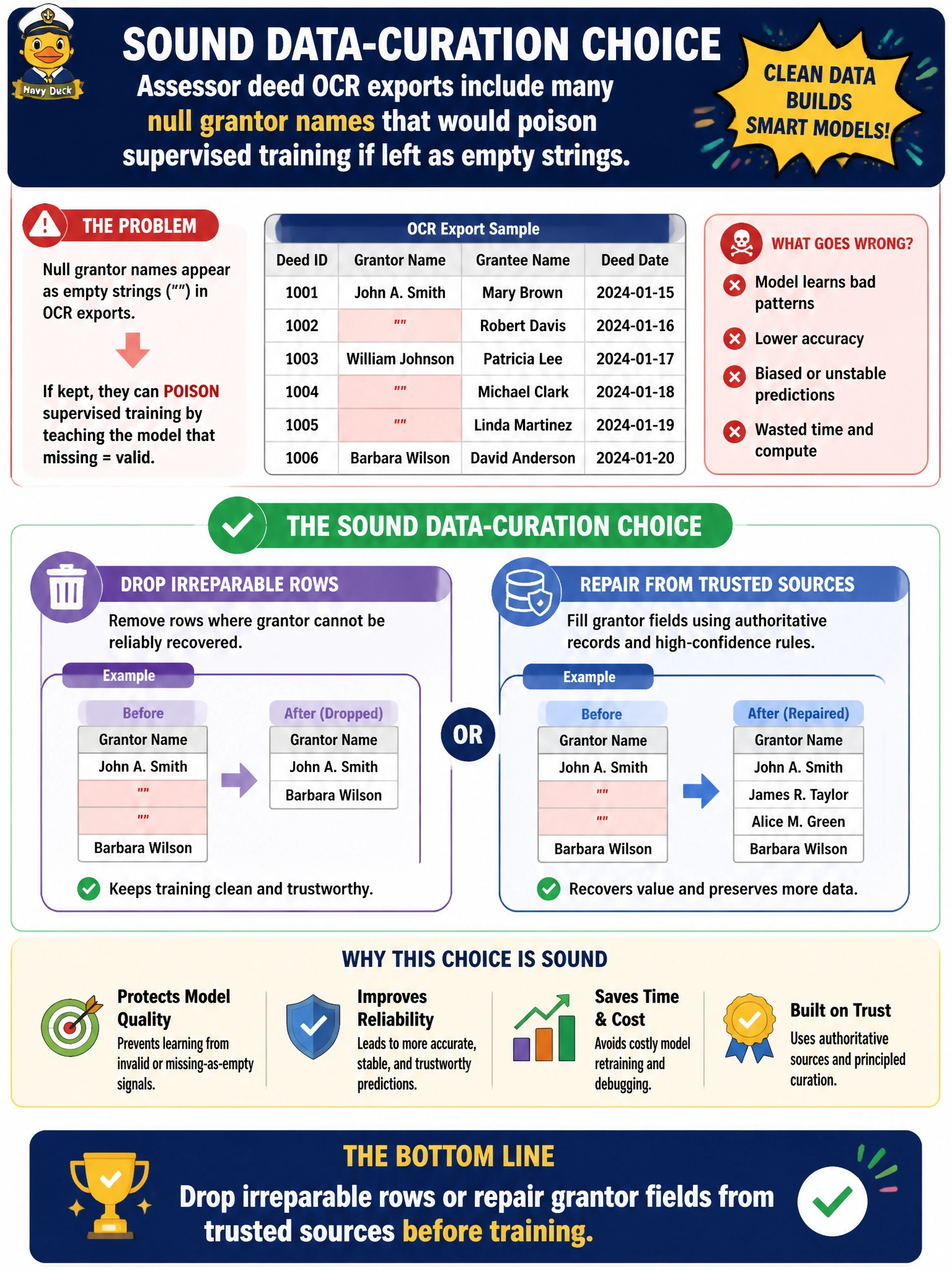
Assessor deed OCR exports include many null grantor names that would poison supervised training if left as empty strings. What is the sound data-curation choice?
Select an answer to reveal the explanation.
Short Explanation
Empty grantor fields aren’t a cute edge case—they’re junk food for the model. Drop what you can’t fix or repair from a trusted source before training on deeds.
Full Explanation
For assessor deed OCR exports with many null grantor names, the sound curation choice is to drop irreparable rows or repair grantor fields from trusted sources before supervised training. Empty-string targets teach the model that blank grantors are desirable outputs and poison entity-learning on deeds. Drop-versus-repair is the core civic data-quality decision when OCR systematically misses parties. Leaving null grantors as empty targets so the model 'practices predicting blanks' institutionalizes missingness as a label and degrades grantor extraction or generation quality. Replacing every grantor with a random celebrity name for diversity injects false parties into legal-adjacent training data and creates dangerously wrong associations. Training only on the null rows to specialize in missing-party deeds concentrates the model on defective OCR artifacts rather than on well-formed deed language the assessor needs. Exam caveat: repair only from trusted sources (prior recorded deeds, validated parcel databases); never invent grantors. If repair coverage is low, prefer dropping those rows from supervised sets and track OCR quality upstream. Operational check: quantify null-grantor rate, attempt joins to trusted party sources, document drop and repair counts, and block training jobs that still contain empty grantor targets in the supervised split.