
After residents confuse trash versus recycling rules, public works wants the model to distinguish correct sortation answers. What few-shot strategy helps?
Select an answer to reveal the explanation.
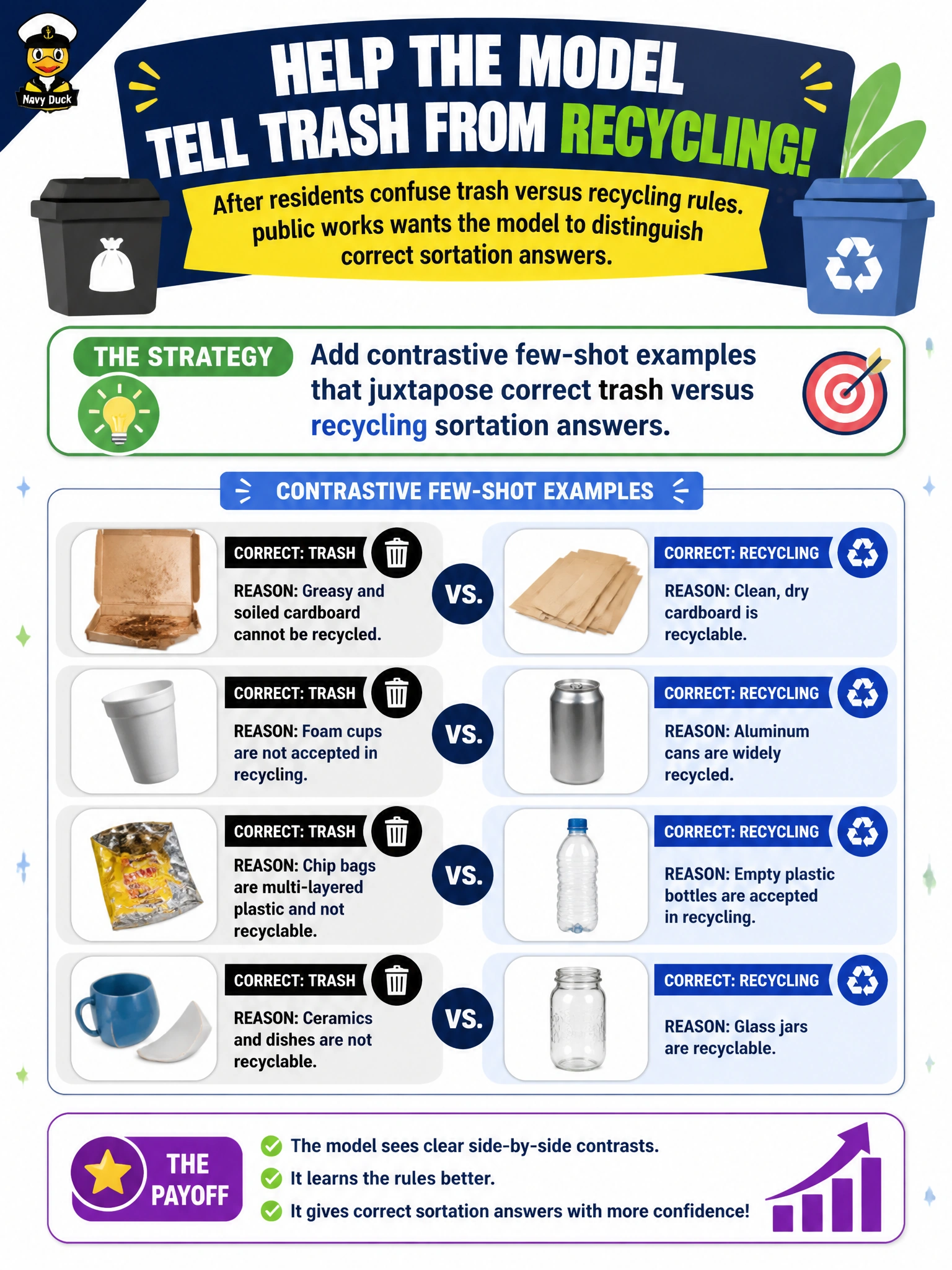
Short Explanation
Put the look-alike answers side by side in the prompt—trash this way, recycling that way—so the model learns the contrast residents keep missing. One-sided or poetic examples will not untangle the two streams.
Full Explanation
After residents confuse trash versus recycling rules, public works should use contrastive few-shot examples that juxtapose correct trash answers with correct recycling sortation answers for look-alike items. Side-by-side contrasts teach decision boundaries residents miss—what belongs in which stream—rather than hoping the model infers the distinction from one-sided text. That contrastive structure is especially effective when items share materials or everyday language that blurs municipal categories and drives contamination fees. Providing only recycling answers never teaches trash rules or the contrast that reduces cart mistakes. Using zero examples leaves the confusion unaddressed in the prompt and relies on generic pretrained knowledge that may not match local hauler contracts. Few-shot poetry about landfills without sortation labels fails to encode actionable municipal rules staff can defend at the curb. Exam caveat: local rules differ by hauler and season, such as glass or soft-plastic policies; contrastive exemplars must match the current public-works flyer. Operational check: test paired items that residents commonly mix, measure correct stream classification, revise few-shots when contamination reports spike for specific materials, and align examples with the latest cart labeling campaign from solid-waste outreach.