
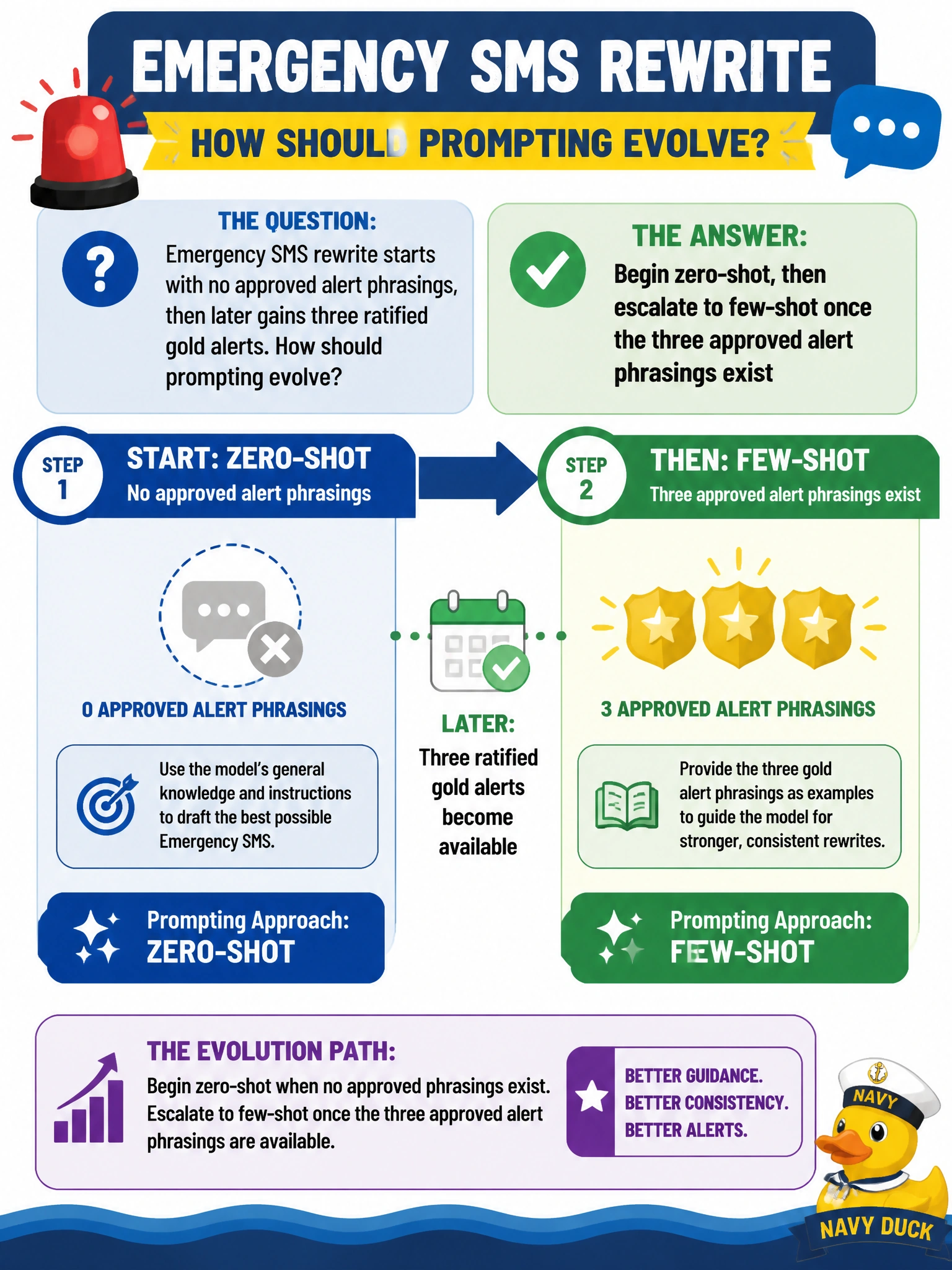
Emergency SMS rewrite starts with no approved alert phrasings, then later gains three ratified gold alerts. How should prompting evolve?
Select an answer to reveal the explanation.
Short Explanation
Start zero-shot when the cupboard of approved alert lines is empty, then graduate to few-shot once three ratified phrasings land—like moving from improvising to quoting the official script. Pretending you already have gold examples—or ignoring them once you do—fights that natural escalation.
Full Explanation
Emergency SMS rewrite should evolve with approved content availability. Begin zero-shot when no ratified alert phrasings exist—instructions plus official hazard guidance only—then escalate to few-shot once three approved gold alerts are available so the model quotes and mirrors ratified municipal wording. That progression matches governance: improvise carefully first under policy constraints, then standardize on the official script as soon as communications leadership ratifies language. Staying zero-shot forever after gold alerts exist wastes ratified language that improves consistency, accessibility, and compliance with alerting style guides. Jumping immediately to full model pretraining from scratch on day one is unnecessary and operationally extreme for SMS phrasing control. Using few-shot first with fabricated alerts, then deleting examples after ratification, trains on unapproved emergency language—an unacceptable risk when false evacuation or shelter wording can cause harm. Exam caveat: even few-shot emergency text requires human authorization before send; prompting does not replace alerting authority or local emergency protocol. Operational check: gate few-shot inclusion on ratification metadata, compare zero-shot versus three-shot rubric scores against approved alerts, lock the prompt pack under emergency-communications change control, and run tabletop drills that score rewrite quality before storm season.