
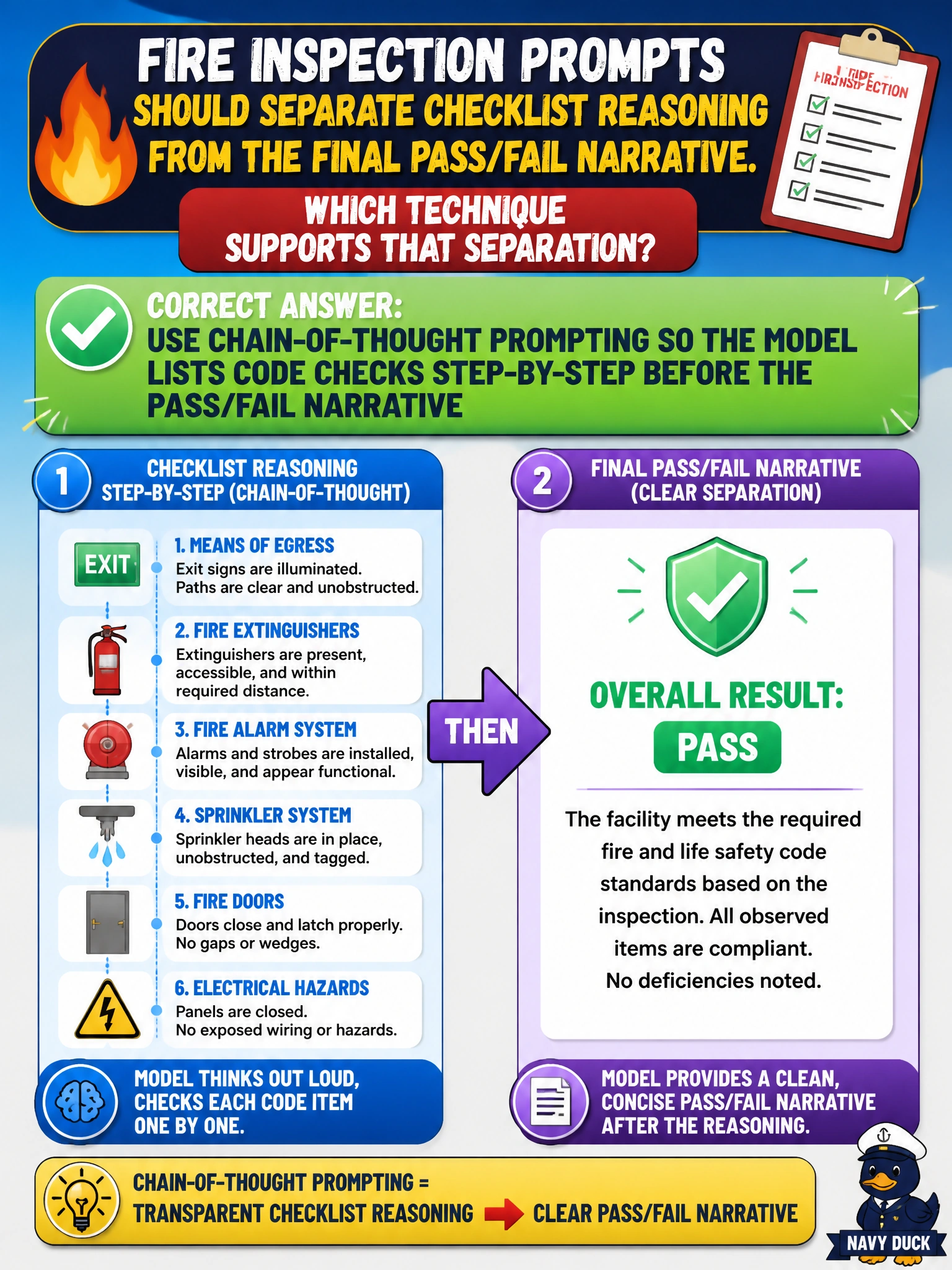
Fire inspection prompts should separate checklist reasoning from the final pass/fail narrative. Which technique supports that separation?
Select an answer to reveal the explanation.
Short Explanation
You can separate the checklist from the verdict by asking the model to walk through code checks before writing the pass/fail narrative. That ordered reasoning gives you a reviewable basis for the conclusion; asking for a verdict without checks, removing fire-code references, or requesting emoji alone leaves out important inspection logic.
Full Explanation
Fire inspection prompts should separate checklist reasoning from the final pass/fail narrative so reviewers can see how a verdict was reached. Chain-of-thought prompting supports that separation by asking the model to walk through code checks step by step before composing the narrative, mirroring inspector workflow and producing a reviewable trail. That ordered reasoning is the technique the question asks for. Requesting a concise pass/fail conclusion up front while omitting the checklist and supporting code checks hides the reasoning the department wants documented and raises the chance of an unjustified verdict. Removing all fire-code references may shorten answers, but it discards the governing standard inspectors must apply. Requesting only emoji outcomes provides no inspection logic for auditors, courts, or property owners. Exam caveat: exposed chain-of-thought may be truncated or inappropriate to show publicly; use structured checklists or tool-verified items for resident-facing reports while retaining ordered reasoning internally. Practical check: require enumerated code checks in the model output or tool trace before accepting a verdict, spot-check that the narrative matches those checks, and calibrate prompts to the adopted fire-code edition used by the municipal fire marshal.